The Challenge

A quantitative trading desk was executing thousands of trades per second and needed a way to monitor their Value-at-Risk (VaR) and 'Greeks' in real-time. During periods of high market volatility, their existing risk reports were too slow, creating a danger of exceeding exchange-mandated risk limits.

A single breach could lead to massive fines or loss of trading privileges. They needed a 'systemic kill-switch' that could respond faster than a human trader could click a button.
Technical Implementation

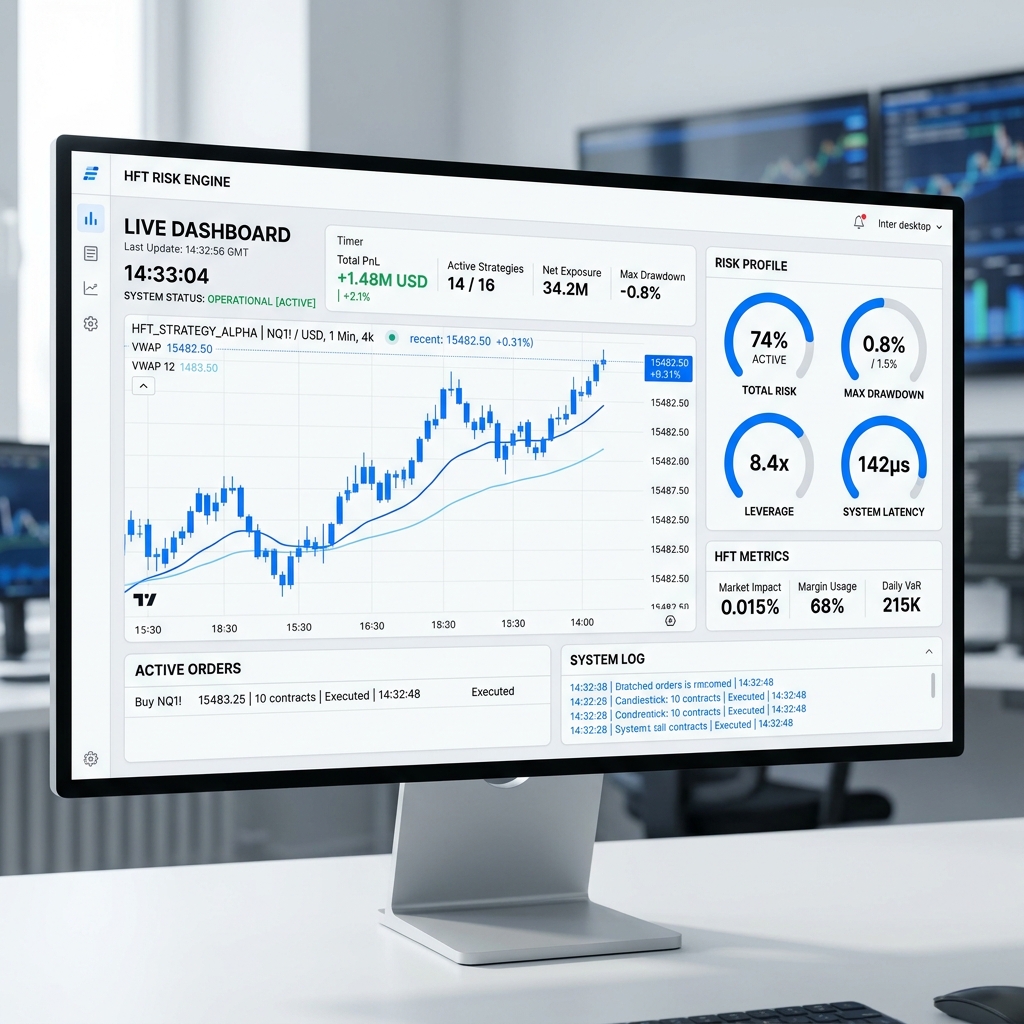
I developed a specialized Risk Engine using a hybrid of C++ for computation-heavy Greeks calculations and Python for data orchestration and visualization. The system consumes live market data feeds and recalculated the entire portfolio's risk profile on every tick.

I implemented a high-performance dashboard that uses 'Traffic Light' signaling to warn traders when they are approaching risk thresholds. The engine also features an automated 'Kill Switch' that can halt specific algos if they exceed pre-defined loss limits.

I also integrated a 'Stress Test' simulator that allows the risk team to 'shock' the portfolio with historical scenarios (like the 2008 crash) to see how it would perform in extreme conditions, all in real-time.

Interactive Experience

Explore the high-fidelity implementation and architectural logic of the Algo Trading Risk Engine development environment.

Project Visualization

Development Lifecycle

The sequential process followed to ensure architectural integrity and delivery excellence.

Discovery

Requirement gathering and technical feasibility audits.

Architecture

Structural design and integration of core microservices.

Execution

Agile development cycles and real-time integration testing.

Deployment

Production release and automated staging environment validation.

Visual Ethos

Designed with a focus on high data density and accessibility. The interface utilizes a fluid grid system to ensure seamless performance across enterprise environments.

Core Stack

Built using industry-standard protocols to ensure scalability. Every module is optimized for fast load times and real-time data integrity.

C++ • Python • High-Frequency Data • Risk Management • Monte Carlo Simulation

System Modules & Core Capabilities

An analytical breakdown of the proprietary modules and architectural logic integrated into the system.

CORE-01

Pre-trade Risk Limit Validation

CORE-02

Real-time VaR (Value at Risk) Monitor

CORE-03

Automatic Order Slicing Logic

CORE-04

High-Frequency Latency Auditing

CORE-05

Market Impact Simulation Models

CORE-06

Multi-exchange Connectivity Architecture