
Master the art of writing high-performance SQL queries for complex enterprise-level financial reporting and data analysis.
Advanced SQL for reporting for Enterprise Reporting
In today’s data-driven enterprises, reporting is no longer just about extracting numbers—it’s about delivering timely, accurate, and actionable insights. As organizations deal with massive datasets, traditional SQL approaches often fall short in terms of performance and scalability. This is where advanced SQL strategies come into play. By leveraging optimized queries, efficient data modeling, and modern techniques, businesses can significantly improve their reporting capabilities.
Understanding Enterprise Reporting Needs
Enterprise reporting typically involves large-scale data processing, multiple data sources, and complex transformations. Reports must be fast, reliable, and capable of handling concurrent users. Whether it’s financial dashboards, operational KPIs, or customer analytics, SQL remains the backbone of data retrieval and transformation.
However, poorly written queries or inefficient database design can lead to slow performance, increased costs, and inaccurate reporting. Advanced SQL strategies focus on solving these issues through smarter query execution and better data handling.
Query Optimization Techniques
One of the most critical aspects of advanced SQL is query optimization. Writing efficient queries ensures faster execution and reduced load on the database.
Start by avoiding unnecessary columns in your SELECT statements. Using SELECT * may seem convenient, but it increases data transfer and processing time. Instead, select only the required fields.
Another key strategy is filtering data as early as possible. Use WHERE clauses effectively to limit the dataset before applying joins or aggregations. This reduces the workload on the database engine.
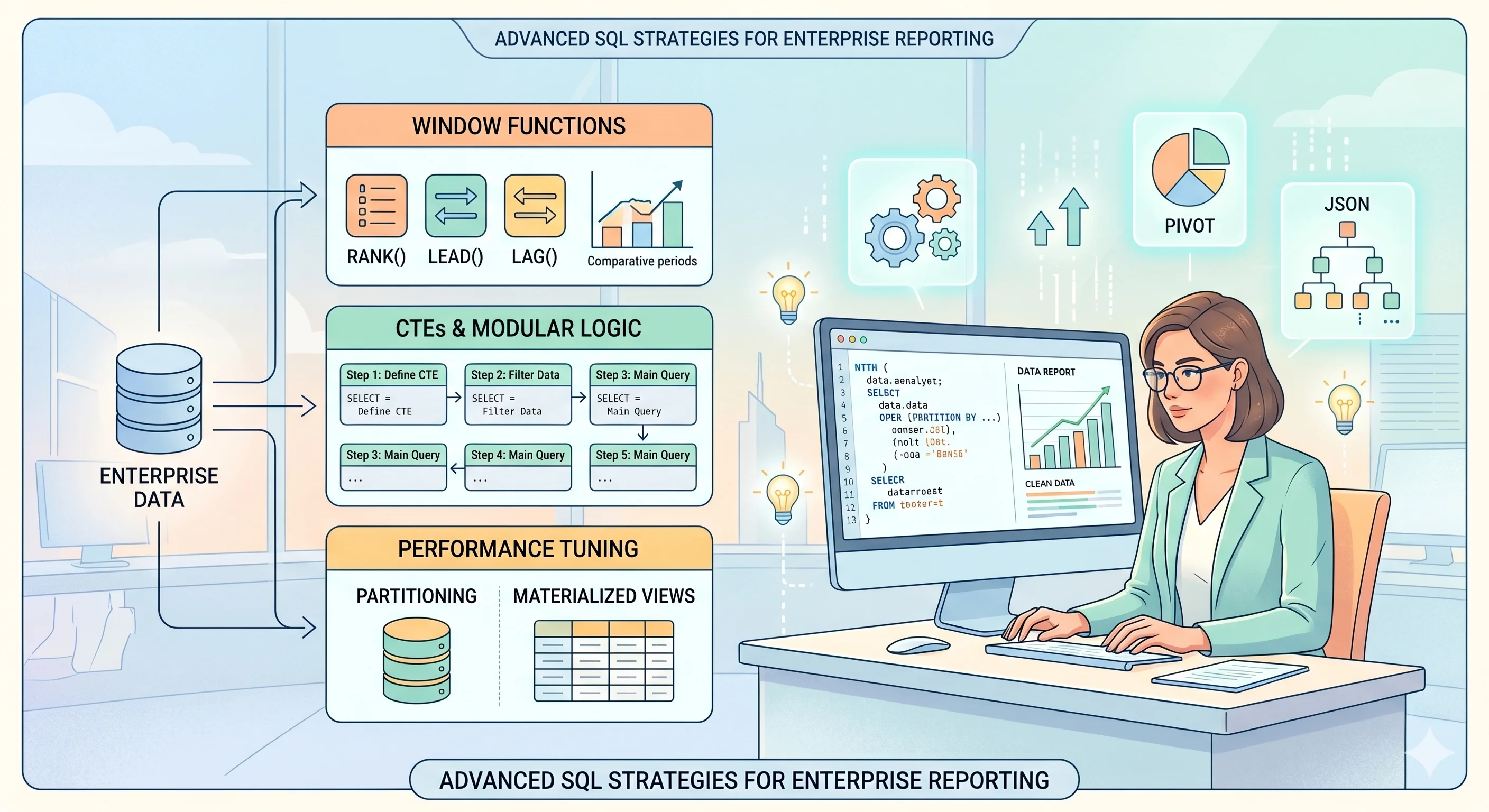
Subqueries should be used carefully. In many cases, replacing subqueries with JOINs or Common Table Expressions (CTEs) improves readability and performance. CTEs also make complex queries more structured and easier to maintain.
Indexing for Performance | Advanced SQL for reporting
Indexes are essential for speeding up data retrieval. In enterprise reporting, where queries often scan large tables, proper indexing can dramatically reduce execution time.
Create indexes on frequently used columns, especially those involved in JOIN conditions, WHERE filters, and ORDER BY clauses. However, over-indexing can slow down write operations, so it’s important to strike a balance.
Composite indexes are particularly useful when queries involve multiple columns. For example, an index on (customer_id, order_date) can optimize queries filtering by both fields.
Regular index maintenance is also crucial. Fragmented indexes can degrade performance, so periodic rebuilding or reorganizing ensures optimal efficiency.
Leveraging Window Functions
Window functions are powerful tools for advanced reporting. They allow you to perform calculations across a set of rows without collapsing them into a single result.
Functions like ROW_NUMBER(), RANK(), DENSE_RANK(), and SUM() OVER() are widely used in enterprise reports. For example, you can calculate running totals, rank employees by performance, or identify trends over time.
Unlike traditional GROUP BY queries, window functions preserve row-level detail while adding aggregated insights, making them ideal for dashboards and analytical reports.
Partitioning Large Tables
As data grows, table partitioning becomes essential. Partitioning divides large tables into smaller, more manageable pieces based on a specific column, such as date or region.
This improves query performance because the database scans only relevant partitions instead of the entire table. For instance, a sales report for the current year will only access the partition containing that year’s data.
Partitioning also simplifies data management tasks like archiving and backup, making it a valuable strategy for enterprise environments.
Using Materialized Views
Materialized views store the results of complex queries physically, allowing faster access compared to standard views. In enterprise reporting, where the same queries are executed repeatedly, materialized views can significantly reduce computation time.
They are especially useful for pre-aggregated data, such as monthly sales summaries or customer segmentation reports. However, they need to be refreshed periodically to ensure data accuracy.
Choosing the right refresh strategy—whether real-time, scheduled, or on-demand—depends on the reporting requirements.
ETL and Data Transformation
Enterprise reporting often relies on ETL (Extract, Transform, Load) processes to prepare data. Advanced SQL plays a crucial role in transforming raw data into meaningful insights.
Use staging tables to clean and validate data before loading it into the final reporting tables. This ensures consistency and reduces errors in reports.
Transformations such as data normalization, aggregation, and deduplication should be handled efficiently using SQL functions and procedures. Automation of ETL workflows further enhances reliability and reduces manual effort.
Handling Real-Time Reporting | Advanced SQL for reporting
Modern enterprises increasingly demand real-time or near real-time reporting. This requires strategies that minimize latency while maintaining accuracy.
Techniques like incremental data loading, change data capture (CDC), and streaming queries help achieve real-time insights. Instead of processing entire datasets, these methods focus only on new or updated data.
Combining SQL with in-memory processing and optimized indexing ensures that reports are updated quickly without compromising performance.
Managing Concurrency and Scalability
In enterprise environments, multiple users often access reports simultaneously. Poor query design can lead to locking issues and slow response times.
Using appropriate isolation levels helps manage concurrency without affecting data integrity. Read-optimized replicas or data warehouses can offload reporting workloads from transactional systems.
Scalable database architectures, such as distributed systems and cloud-based solutions, further enhance performance and reliability.
Best Practices for Maintainable SQL
As reporting systems grow, maintaining SQL code becomes a challenge. Writing clean, modular, and well-documented queries is essential.
Use consistent naming conventions for tables, columns, and aliases. Break complex queries into smaller, reusable components using CTEs or views. This improves readability and simplifies debugging.
Version control for SQL scripts ensures that changes are tracked and reversible. Regular performance monitoring and query tuning help maintain efficiency over time.
Conclusion
Advanced SQL strategies are the foundation of efficient enterprise reporting. From query optimization and indexing to partitioning and real-time processing, each technique plays a crucial role in handling large-scale data.
By implementing these strategies, organizations can deliver faster, more accurate, and scalable reports. As data continues to grow, mastering advanced SQL is no longer optional—it’s essential for staying competitive in a data-driven world.