
For the last fifteen years, our digital lives have been dictated by the grid. We wake up, unlock our phones, and tap on a neat square icon to check the weather, another to order coffee, and yet another to log our work hours. We have been trained to act as the manual routers of our own data—copying info from an email, pasting it into a calendar app, and switching to a messaging app to confirm the details.
But in 2026, that grid is quietly dissolving.
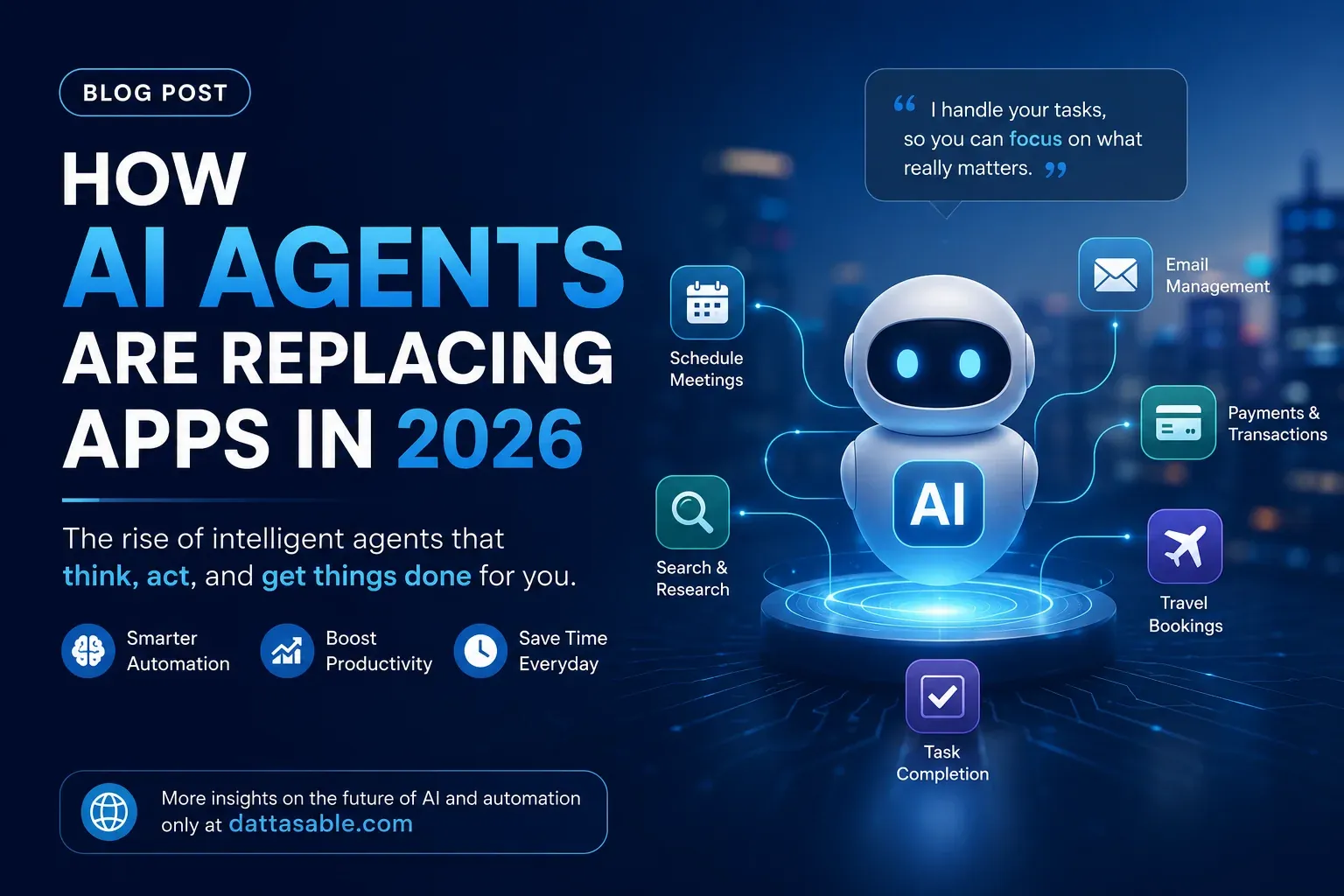
We are entering the era of cognitive interfaces, where the primary way we interact with technology is no longer through a collection of siloed software programs, but through a single conversational relationship. AI agents replacing apps is no longer a futuristic prediction—it is the active reality of the 2026 digital ecosystem.
What Are AI Agents?
At their core, AI agents are autonomous software entities designed to understand intent, formulate multi-step plans, and execute tasks on behalf of a user.
Unlike traditional chatbots that merely generate text, AI agents possess agency. They are equipped with memory, tool-use capability, and the ability to make decisions within pre-defined guardrails. By leveraging Large Action Models (LAMs), modern agents don't just tell you how to do something; they do it for you by directly interacting with APIs, databases, and web elements.
Think of traditional apps like a massive shopping mall. If you want a new outfit, dinner, and a movie ticket, you have to physically walk into three different stores, interact with three different cashiers, and manage three separate transactions.
An AI agent is like a highly trained personal concierge. You simply tell them, "Find me an outfit for a beach wedding, book a dinner table nearby at 8 PM, and buy a ticket for the latest sci-fi movie." You don't care which stores they visit or how they route the payment—you only care about the end result.
Why Traditional Apps Are Losing Relevance
The decline of the traditional application model boils down to one major issue: app fatigue and cognitive load.
The average smartphone user has over 80 apps installed on their device but active engagement is concentrated in less than ten. Every new app represents another account to create, another interface to learn, another notification stream to manage, and another monthly subscription to track. This software fragmentation has created a disjointed user experience.
Apps are losing relevance because:
- High Friction: Opening multiple apps to complete a single task (e.g., planning a trip) is inefficient.
- Data Silos: Apps rarely talk to one another smoothly without complex integrations.
- Rigid Interfaces: Users must adapt to the app's UI, rather than the app adapting to the user's natural language.
With the emergence of AI automation tools 2026, users are shifting from searching for the right application to simply expressing their desired outcome.
How AI Agents Work (Simply Explained)
To understand this paradigm shift, we must look at how an agent orchestrates complex workflows under the hood. When you give a command to an AI agent, it goes through a four-stage loop:
- Intent Recognition: The agent uses natural language processing to translate your conversational command into a structured goal.
- Planning & Decomposition: The agent breaks the goal down into sequential sub-tasks (e.g., searching, calling an API, verifying a response).
- Tool Execution: The agent calls external services (such as databases, email clients, or payment gateways) to execute the plan.
- Validation & Output: The agent verifies the results and presents a unified response to the user.
Here is how that agentic flow replaces the manual app-switching behavior of the past:
          flowchart TD
            User(["User: Book a flight to NYC and email my manager"]) --> Agent{Autonomous AI Agent}
            Agent -->|1. Search & Compare| TravelAPI[Travel Search Engine]
            Agent -->|2. Authorize Transaction| Payment[Secure Payment Gateway]
            Agent -->|3. Generate Itinerary| Calendar[Google Calendar API]
            Agent -->|4. Send Notification| Email[Gmail/Outlook API]

            TravelAPI --> Agent
            Payment --> Agent
            Calendar --> Agent
            Email --> Agent
            Agent --> Final[User Output: Flight Booked & Email Sent]

            style Agent fill:#c9f31d,stroke:#000000,color:#000000
            style Final fill:#111111,stroke:#c9f31d,stroke-width:2px,color:#ffffff
Real-World Use Cases in 2026
The AI productivity revolution is transforming three major pillars of daily life:
1. Personal Productivity & Assistants
In 2026, scheduling a dentist appointment or organizing a family vacation no longer involves open browser tabs, calendar checks, and booking forms. You simply tell your agent, "Find a dentist under my insurance with openings on Thursday afternoon." The agent cross-references your insurance directory, checks your calendar, locates a slot, books the appointment, and updates your agenda.
2. Business Automation
Enterprise operations are moving away from traditional ERP and CRM software suites. Instead of manually updating Salesforce, sending emails via HubSpot, and compiling reports in Excel, team members use no-code AI agents. These agents monitor incoming client requests, draft custom proposals, update client pipelines, and generate invoices automatically based on natural language triggers.
3. Personal Finance & Wealth Management
Instead of logging into banking apps, budget trackers, and investment platforms individually, individuals use financial agents that continuously monitor their accounts. An agent can detect a price drop in a subscription service, cancel it automatically, shift idle savings to high-yield accounts, and execute stock transactions within parameters set by the user.
AI Agents vs. Mobile Apps
The transition from static apps to dynamic agents represents a structural leap in software design:
| Feature | Traditional Mobile Apps | Autonomous AI Agents (2026) |
|---|---|---|
| Interface | Graphical User Interface (GUI) - Buttons, menus, screens | Conversational / Intent-Based Natural Language |
| Integration | Isolated silos; requires manual APIs (Zapier/Make) | Deep native tool-use; autonomous API orchestration |
| Customization | Rigid, one-size-fits-all layouts | Hyper-personalized; dynamically adapts to user habits |
| Maintenance | Frequent updates, downloads, storage footprint | Server-side execution; near-zero local storage needed |
| Execution | User executes actions step-by-step | Agent executes multi-step plans autonomously |
The Productivity Dividend: Quantifying the Shift
Enterprise adoption of AI agents has triggered massive improvements in productivity metrics:
| Metric / Task | Traditional App Workflow Time | AI Agent Workflow Time | Average Efficiency Gain |
|---|---|---|---|
| Travel Booking | 45 minutes (10+ tabs, comparisons) | 45 seconds (Single prompt) | 98.3% Faster |
| Expense Auditing | 2 hours (Gathering receipts, entry) | 3 minutes (Auto-extract & submit) | 97.5% Faster |
| Weekly Reporting | 3 hours (SQL queries, slide design) | 10 minutes (Agentic compilation) | 94.4% Faster |
| Customer Support | 15 minutes / ticket (Manual lookups) | 90 seconds (Agentic resolution) | 90.0% Faster |
Impact on Jobs & Businesses
The reality of AI replacing mobile apps is restructuring the developer economy.
For the past decade, building a successful tech business meant building an app. In 2026, the focus has shifted from building apps to building services and APIs. If your business does not expose clean API endpoints that AI agents can discover and interact with, you are invisible to the modern consumer.
For developers, this is a transition from frontend GUI design to backend agentic integrations. Software engineering now emphasizes creating secure, self-documenting APIs and training custom agents that can execute business-specific tasks reliably.
Future Predictions (2026–2030)
As we look toward the end of the decade, the evolution of the future of AI agents will follow three distinct trajectories:
- Zero-UI Devices: We will see a rise in ambient, screenless hardware that relies entirely on voice and gesture-controlled agents, bypassing the smartphone paradigm completely.
- Agent-to-Agent Economies: AI agents will negotiate with other business-owned agents directly. Your personal agent will negotiate with a restaurant's booking agent to secure a reservation, settling payments securely in the background.
- Self-Assembling Software: Instead of buying software, users will describe their problem, and an agent will assemble a temporary micro-application on the fly, dissolving it when the task is complete.
Conclusion: The End of the Application Era
The application era was a necessary stepping stone, a transitional phase where humans learned how to speak the language of computers by clicking buttons and navigating menus.
But computers have finally learned to speak our language.
As AI agents continue to replace traditional applications, the screen will transition from a wall of distracting icons into a clean canvas of intent. We are moving from a world of how we use technology to a world of what we want to accomplish. The future of software is no longer an app—it is an agent.