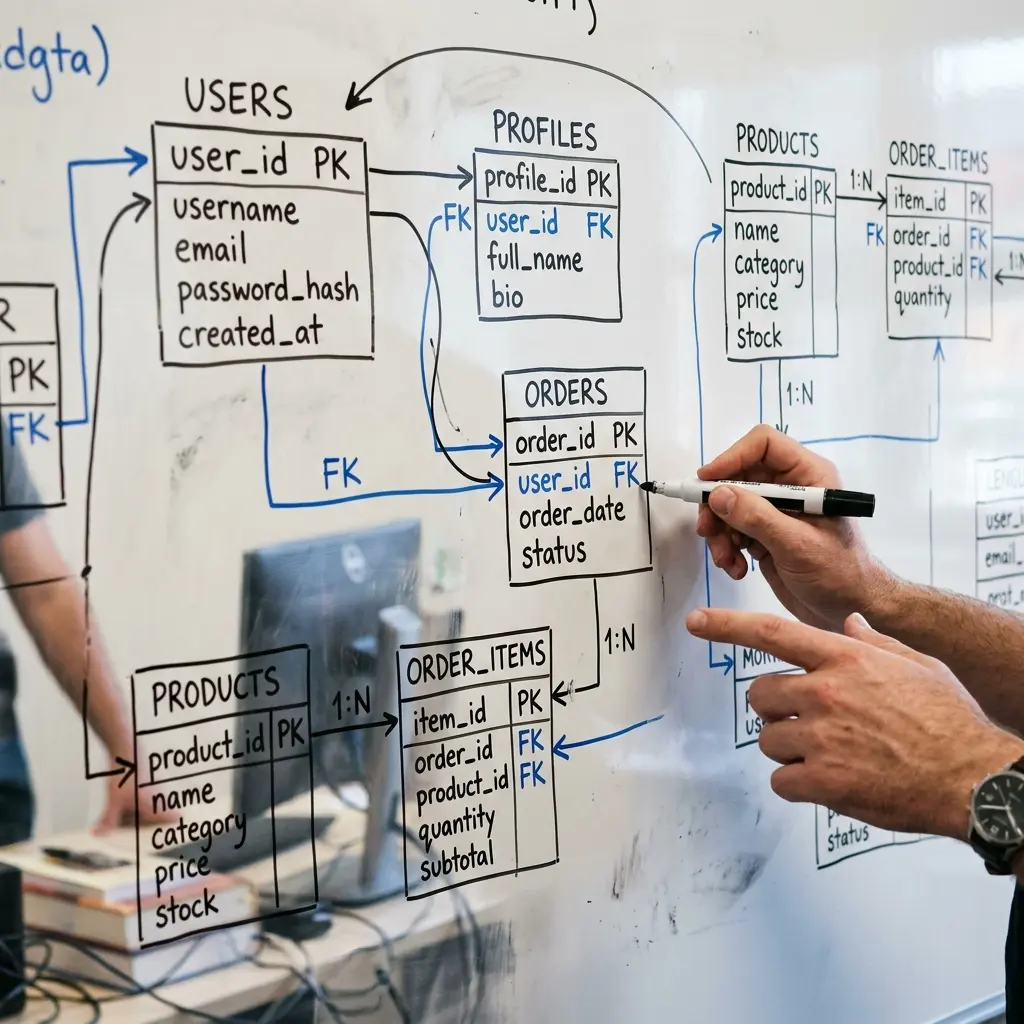

Understanding SQL joins is the prerequisite for database analytics. We visualize join types, explain execution plan hashes, and analyze how database engines merge tables under the hood.
Table of Contents
1. 1. How SQL Engines Execute Joins under the Hood
Writing joins is simple, but configuring them to execute efficiently requires understanding database execution plans. Modern database engines use three main join operators: Nested Loop Joins (best for small tables), Hash Joins (builds a hash index in memory from the smaller table to scan the larger one), and Sort-Merge Joins (sorts both tables before merging them). If queries degrade, check if your joins are forcing nested loop evaluations across millions of records due to missing foreign key indexes.
2. 2. SQL Join Query Optimization Analysis
This SQL snippet compares inner and outer joins, showing how to read query plans to verify join performance:
-- Standard Join Query with filter conditions
EXPLAIN ANALYZE
SELECT c.customer_name, SUM(s.sales_amount)
FROM dim_customer c
INNER JOIN fact_sales s ON c.customer_key = s.customer_key
WHERE c.region = 'APAC'
GROUP BY c.customer_name;

-- Correcting cross-joins: Ensure relationships exist on key columns
3. 3. Core Comparison and Metrics
The table below provides a detailed technical comparison of the operational paradigms under review:
| Join Operator | Optimal Table Size | Memory Requirement |
|---|---|---|
| Nested Loop | Small tables (<10,000 rows) | Low (Iterative scan) |
| Hash Join | Large unsorted datasets | High (Builds memory hashtable) |
| Sort-Merge Join | Pre-sorted indexed tables | Medium (Scans parallel pointers) |
4. 4. Production Best Practices
When running this configuration in a production cluster, your engineering team must adhere to the following checklist:
- Ensure both sides of join keys have identical data types to prevent type conversions.
- Avoid joining on calculated columns; construct relationships on primary keys.
- Add composite indexes on foreign keys to accelerate query search speeds.
- Filter source tables as early as possible before running join operations.
5. 5. Architectural Insight
"A query planner is your best friend. Look at the execution plan: if you see a nested loop scanning millions of records, you have missing indexes." — Datta Sable, Principal BI Consultant
6. 6. Frequently Asked Questions (FAQ)
Q1: What is a Hash Join in SQL?
A Hash Join is used when joining large tables. The database reads the smaller table, builds a hash index in RAM, and then scans the larger table to find matches.
Q2: Why does joining on different data types slow queries?
It forces the query planner to run implicit type conversions (like casting text to integer) on every single row, bypassing any available table indexes.
7. Strategic Outlook & Scalability
When incorporating solutions in BI/Analytics, architectural scalability should be prioritized alongside immediate operational gains. For workloads relating to "The Ultimate Visual Guide to SQL Joins: Mastering Advanced Cases", teams must expect substantial growth in transactional volume and data velocity over a multi-year horizon. Mitigating this risk requires a commitment to decoupled database systems, strict data validation layers, and automated end-to-end integration workflows. By implementing continuous validation checks and maintaining detailed telemetry dashboards, enterprise engineers can identify bottleneck conditions before they cascade into high-severity client outages.
In the long term, investing in clean software standards and developer ergonomics will reduce maintenance overhead and accelerate release frequency, allowing your organization to remain agile and competitive in a rapidly changing technical landscape. Furthermore, establishing clear ownership profiles for each system component ensures that documentation and troubleshooting protocols remain in lockstep with codebase evolutions. This disciplined approach prevents technical debt accumulation, reduces onboarding latency for new developers, and guarantees that your operational infrastructure can adapt dynamically to emerging business requirements.
Ultimately, a successful deployment is not just about making the code work today, but ensuring it is maintainable for the next five years. By building modules that are isolated and well-tested, you protect the core user experience from regression failures. This operational resilience translates directly into customer trust and long-term brand equity, providing a solid foundation for sustainable commercial growth.
8. Conclusion & Summary
Achieving stability and execution speed requires a dedicated engineering strategy, strict validation, and active telemetry. Implementing these practices will optimize your workflows and ensure system reliability.