
RAG was just the beginning. The future of enterprise AI lies in collaborative multi-agent architectures. Moving from single-prompt chat systems to systems where multiple autonomous agents assign tasks, audit code, and update state variables is a massive jump in complexity. This guide explores the architectural patterns, state synchronization methods, and resilience mechanics required to scale multi-agent networks to millions of automated execution steps in production environments.
Building high-fidelity AI systems in 2026 requires more than stitching API calls together. As agents operate autonomously in loops, minor errors compound into infinite execution cycles, API rate-limit exhaustion, and corrupted database state. Here is how you construct deterministic, resilient multi-agent orchestration frameworks.
Table of Contents
- 1. Agent Orchestration Patterns: Router vs. Supervisor
- 2. Distributed State Management and Conflict Resolution
- 3. Preventing Infinite Loops and Cascade Failures
- 4. Context Management, Token Budgets, and Cost Controls
- 5. Telemetry, Tracing, and Observability
- 6. Frequently Asked Questions (FAQ)
1. Agent Orchestration Patterns: Router vs. Supervisor
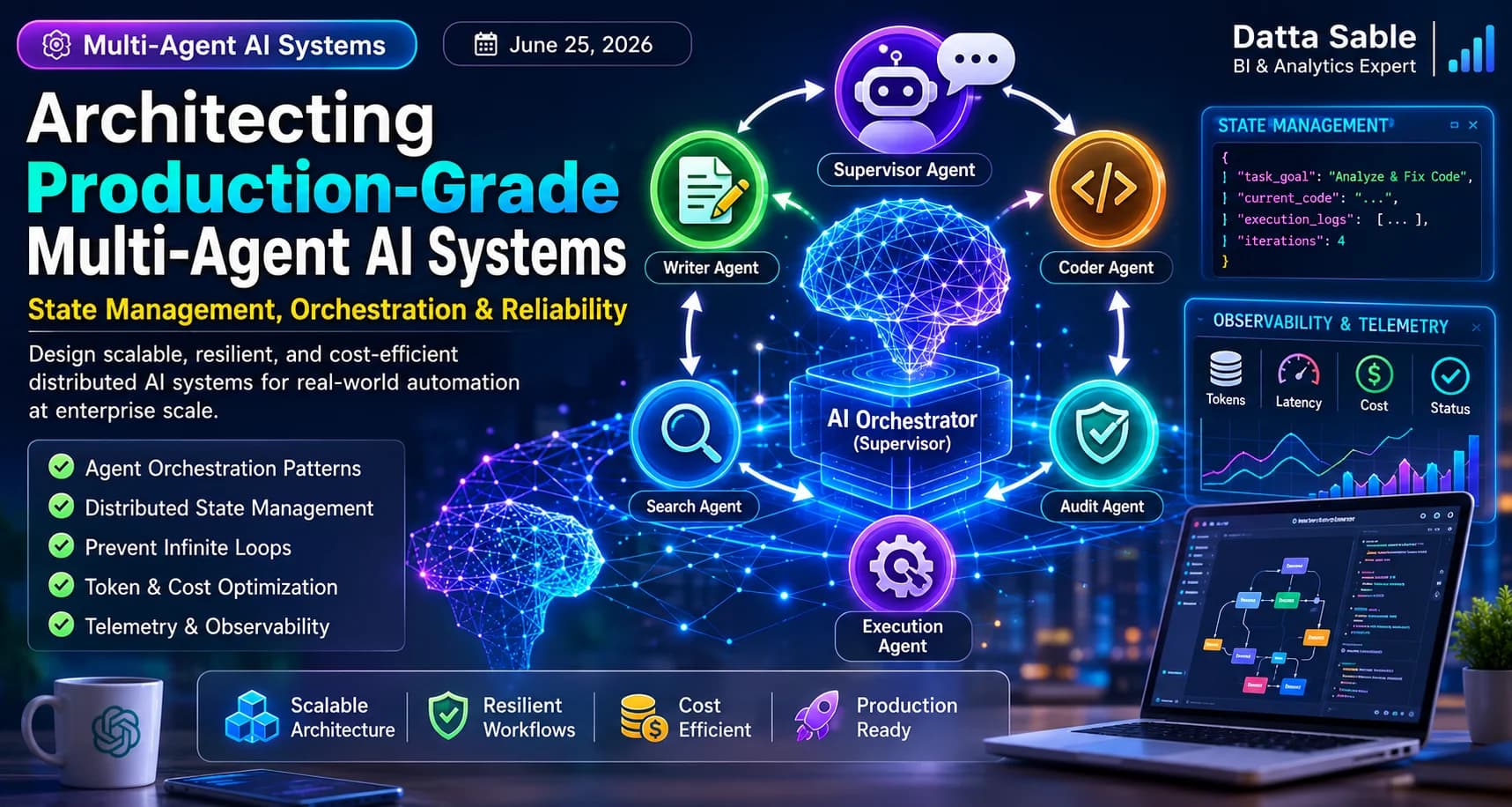
When multiple agents interact, how tasks are delegated and passed is the first major design decision. There are three primary orchestration topologies:
- Router-Worker Pattern: A single entry router inspects the input query and maps it to a single dedicated worker agent (e.g., routing a bug report to the software engineer agent and a billing question to the account agent). Communication is strictly point-to-point.
- Supervisor-Worker Pattern: A central supervisor agent holds the execution graph. It assigns sub-tasks to workers, gathers their outputs, evaluates the quality, and decides whether to assign follow-up tasks or return the final answer. This is highly flexible but creates a cognitive bottleneck at the supervisor.
- Choreographed Network (Peer-to-Peer): Agents communicate via a shared message queue, triggering based on event topics. There is no central orchestrator. While extremely decoupled, debugging state transitions in peer-to-peer networks is notoriously difficult.
    flowchart TD
      User[User Request] --> Supervisor[Supervisor Agent]
      Supervisor -->|Assign Task| Writer[Writer Agent]
      Writer -->|Submit Draft| Supervisor
      Supervisor -->|Assign Audit| Editor[Editor Agent]
      Editor -->|Feedback / Fixes| Supervisor
      Supervisor -->|Return Final Output| User
2. Distributed State Management and Conflict Resolution
Unlike single conversational threads, multi-agent workflows require a structured state representation (a "shared memory space"). If two agents modify the state simultaneously, race conditions and logical conflicts occur.
Production frameworks like LangGraph solve this by representing state as a **read-only state channel graph**, where updates are handled through **reducers**. Each state variable has an associated reducer function that determines how new updates merge with the existing state.
# Define state schema with custom reducers to merge lists and dicts
from typing import Annotated, Sequence
from typing_extensions import TypedDict

def merge_logs(old: list, new: list) -> list:
    return old + new  # Append logs instead of overwriting

class AgentState(TypedDict):
    task_goal: str
    current_code: str
    execution_logs: Annotated[list, merge_logs]
    iterations: int
3. Preventing Infinite Loops and Cascade Failures
When agents write and execute code recursively, a common failure mode is the **Infinite Audit Loop**. An engineer agent writes code, a tester agent finds an error, and the engineer fixes it but introduces another bug, looping indefinitely. This drains your API budgets and causes system lockups.
To prevent loops in production:
- Hard Execution Limits: Implement a strict maximum step count (e.g.,
max_iterations = 15). Once the budget is hit, terminate the execution and escalate to a human operator. - State Similarity Metrics: Cache the generated code and compare similarity scores of output states across iterations. If the cosine similarity of the generated code remains identical across three loops, it indicates the agent is stuck in a circular reasoning loop.
- Surgical Persona Shift: If an agent fails to solve a task after three attempts, dynamically switch the model temperature or swap the system prompt to a highly restricted "debugger persona" to break the loop.
4. Context Management, Token Budgets, and Cost Controls
Long-running agentic execution chains build up massive token contexts, leading to slower response times and high billing. Implement the following token hygiene guidelines:
- Summarized Context Windows: Don't pass the entire conversation history between agents. Instead, maintain a running summary of previous steps in the state, discarding raw system logs once a task completes.
- Local Routing for Simple Workloads: Use small, local models (e.g., Llama 3 8B) for classification, validation, or simple formatting tasks. Route only high-complexity reasoning tasks to premium models (e.g., Gemini 1.5 Pro, Claude 3.5 Sonnet).
5. Telemetry, Tracing, and Observability
Debugging a multi-agent system without tracing is like debugging a microservices network without log aggregation. You cannot diagnose failures from the final output alone; you must analyze the step-by-step trace of agent-to-agent prompts, tool execution times, and raw inputs.
Integrate telemetry tools (such as LangSmith, Phoenix, or OpenTelemetry) directly into your workflow orchestrators. Track metadata for every step, including:
- Input/Output prompt tokens
- Latency per node in milliseconds
- Tool execution return status and payloads
- LLM invocation cost
6. Frequently Asked Questions (FAQ)
Q1: How do you handle agents executing malicious terminal commands?
Never execute agent-generated code or system commands directly on the host system. Always run code execution tools inside isolated Docker containers, firewalled sandboxes, or secure remote execution environments with strict memory and CPU caps.
Q2: Should agents make decisions in parallel?
Yes. For workflows like comparative research or source gathering, running multiple search agents in parallel significantly reduces latency. Use standard threading or async features (like Python's asyncio.gather) to run agent execution paths concurrently before joining their state.
7. Conclusion
Multi-agent AI engineering is less about writing prompts and more about designing distributed software systems. By defining clean state schemas, enforcing hard iteration bounds, isolating tools in secure sandboxes, and logging every trace, you can transition agentic prototypes into highly reliable, cost-efficient, production-grade automation systems.