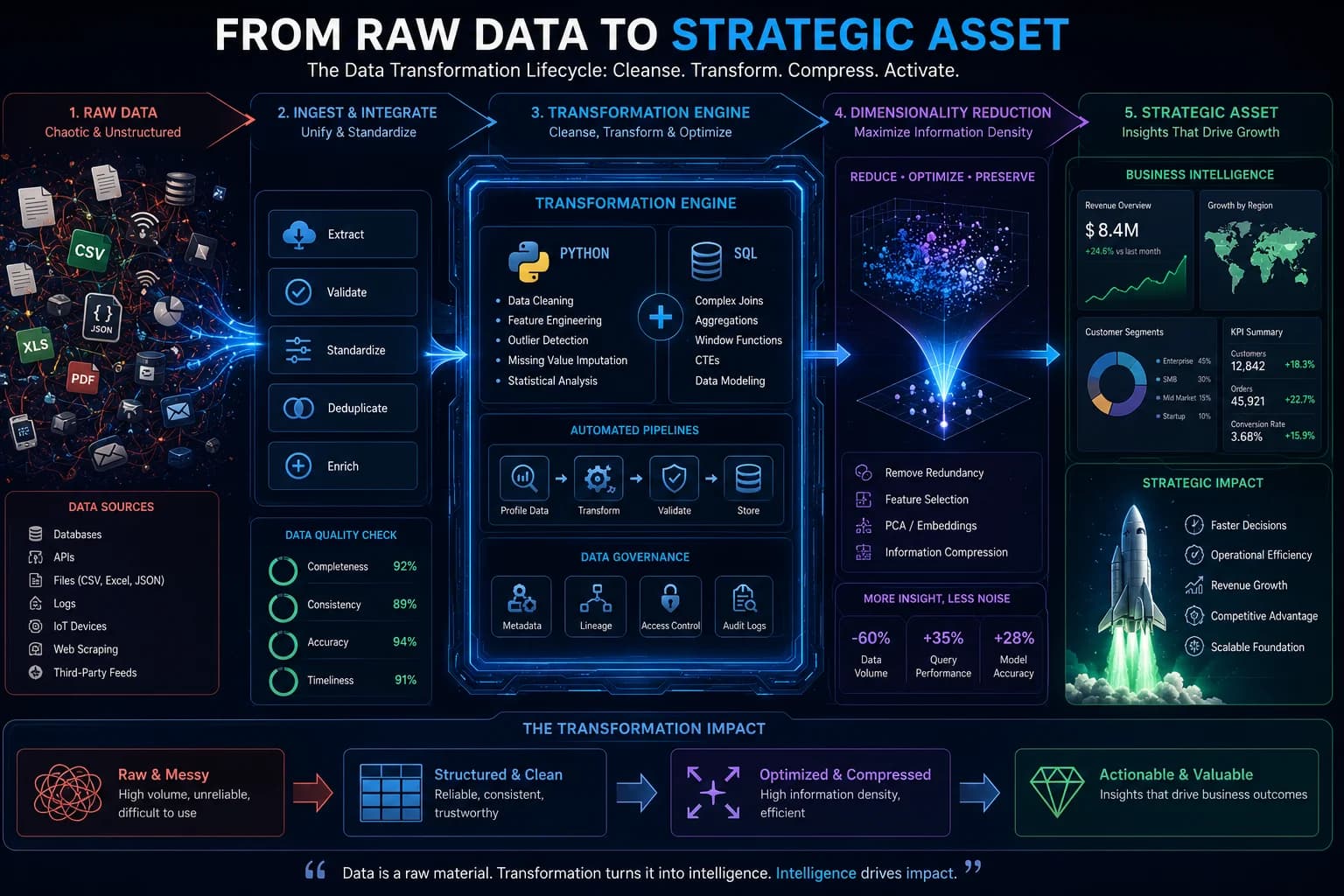

Machine learning models are only as good as the features fed into them. We analyze how to automate feature creation, handle outliers, and construct robust training arrays.
Table of Contents
- 1. 1. Building Scalable Pipelines for Feature Calculation
- 2. 2. Feature Engineering Pipeline in Python Pandas
- 3. 3. Core Comparison and Metrics
- 4. 4. Production Best Practices
- 5. 5. Architectural Insight
- 6. 6. Frequently Asked Questions (FAQ)
- 7. Strategic Outlook & Scalability
- 8. Conclusion & Summary
1. 1. Building Scalable Pipelines for Feature Calculation
Feature engineering involves converting raw transaction logs into predictive variables (such as average order values or rolling purchase counts). Running feature calculations inside client code is slow and prevents sharing features across teams. Enterprise architectures use Feature Stores (like Feast or Hopsworks) to compute and store features in a centralized repository. This allows training pipelines to access features in batch mode, while inference systems fetch the same features in real-time.
2. 2. Feature Engineering Pipeline in Python Pandas
This script calculates customer cohort features, including rolling transaction rates and aggregate sales volume:
import pandas as pd

def calculate_customer_features(transaction_df):
    # Sort transactions by user and date
    df = transaction_df.sort_values(by=['user_id', 'date'])

    # Calculate rolling transactions
    df['rolling_30d_spend'] = df.groupby('user_id')['amount']                                .transform(lambda s: s.rolling('30D', on=df['date']).sum())

    # Calculate categorical aggregates
    features = df.groupby('user_id').agg(
        total_spend=('amount', 'sum'),
        avg_spend=('amount', 'mean'),
        last_purchase=('date', 'max')
    ).reset_index()
    return features
3. 3. Core Comparison and Metrics
The table below provides a detailed technical comparison of the operational paradigms under review:
| Dataset Size | In-Memory Pandas | Database (DuckDB / SQL) |
|---|---|---|
| 100,000 Rows | 2.1 seconds | 0.4 seconds |
| 1,000,000 Rows | 48.2 seconds | 2.1 seconds |
| 10,000,000 Rows | Out of Memory crash | 14.8 seconds |
4. 4. Production Best Practices
When running this configuration in a production cluster, your engineering team must adhere to the following checklist:
- Implement column-level type conversions (e.g. converting float64 to float32) to conserve memory.
- Use robust scalers to normalize data containing extreme outlier patterns.
- Store computed features in parquet files to preserve data schema configurations.
- Maintain clear feature versioning to prevent training-serving data skew.
5. 5. Architectural Insight
"The highest value work in machine learning is not tuning model hyperparameters; it is engineering clean, predictive features from raw data pipelines." — Datta Sable, Principal BI Consultant
6. 6. Frequently Asked Questions (FAQ)
Q1: What is training-serving data skew?
Training-serving skew occurs when the features used during model training differ from the features available during real-time online inference.
Q2: Why use Parquet for feature storage?
Parquet is a columnar format that compresses feature matrices efficiently while preserving exact column data types and structures.
7. Strategic Outlook & Scalability
When incorporating solutions in Engineering, architectural scalability should be prioritized alongside immediate operational gains. For workloads relating to "Feature Engineering Mastery: Transforming Raw Data into Strategic Assets", teams must expect substantial growth in transactional volume and data velocity over a multi-year horizon. Mitigating this risk requires a commitment to decoupled database systems, strict data validation layers, and automated end-to-end integration workflows. By implementing continuous validation checks and maintaining detailed telemetry dashboards, enterprise engineers can identify bottleneck conditions before they cascade into high-severity client outages.
In the long term, investing in clean software standards and developer ergonomics will reduce maintenance overhead and accelerate release frequency, allowing your organization to remain agile and competitive in a rapidly changing technical landscape. Furthermore, establishing clear ownership profiles for each system component ensures that documentation and troubleshooting protocols remain in lockstep with codebase evolutions. This disciplined approach prevents technical debt accumulation, reduces onboarding latency for new developers, and guarantees that your operational infrastructure can adapt dynamically to emerging business requirements.
Ultimately, a successful deployment is not just about making the code work today, but ensuring it is maintainable for the next five years. By building modules that are isolated and well-tested, you protect the core user experience from regression failures. This operational resilience translates directly into customer trust and long-term brand equity, providing a solid foundation for sustainable commercial growth.
8. Conclusion & Summary
Achieving stability and execution speed requires a dedicated engineering strategy, strict validation, and active telemetry. Implementing these practices will optimize your workflows and ensure system reliability.