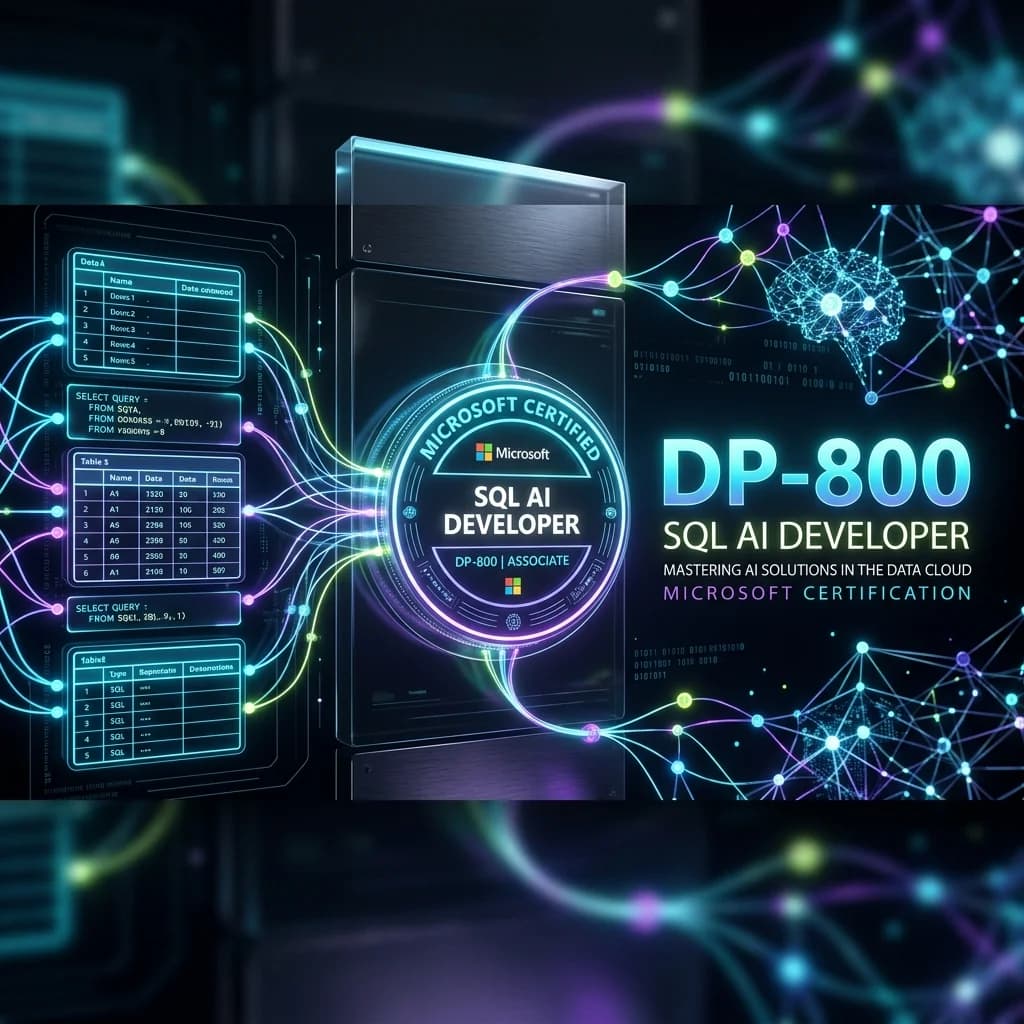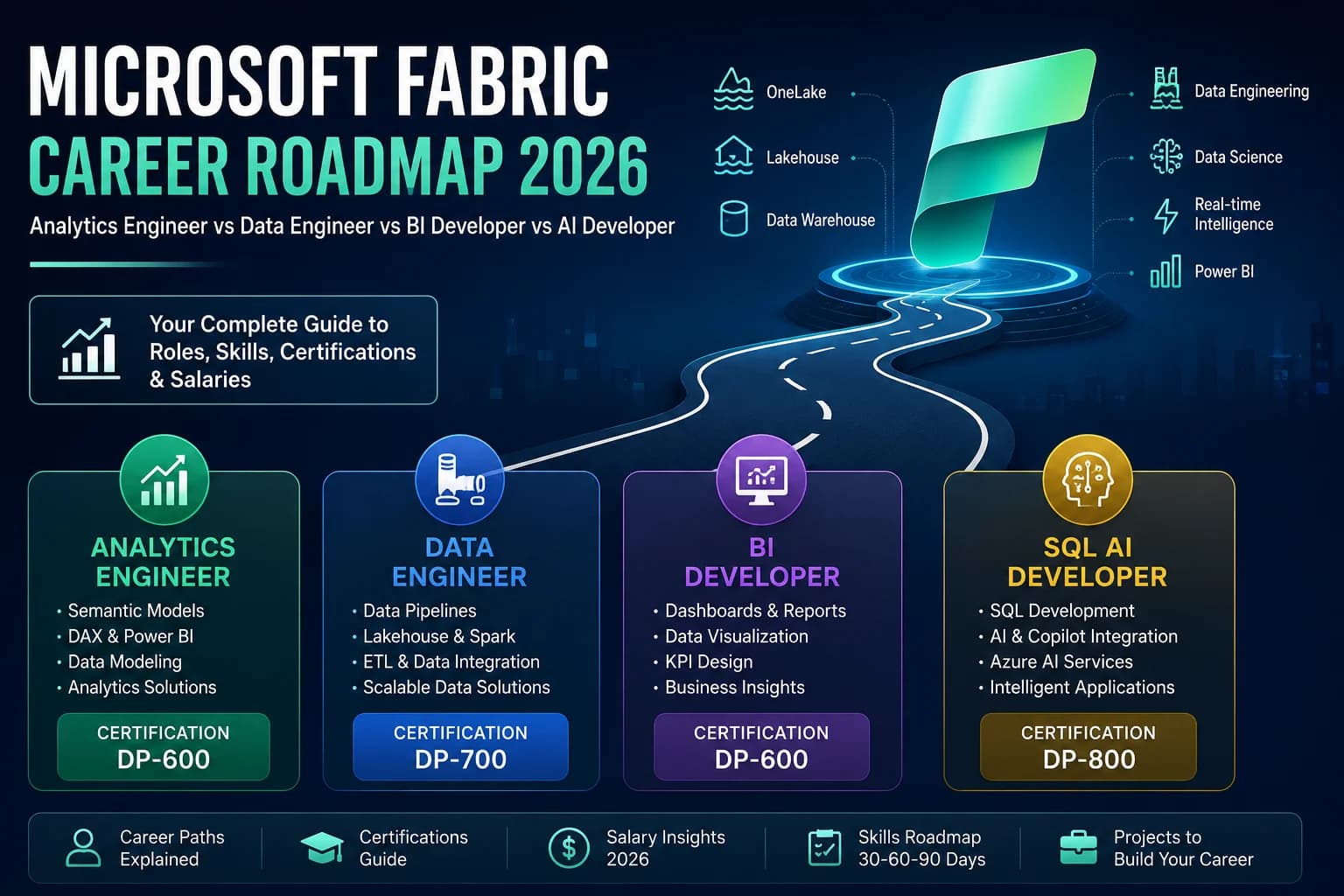

Passing the DP-800 exam certifies you as a Microsoft SQL AI Developer. We outline the salary benchmarks, certification roadmap, and technical preparation steps.
Table of Contents
1. 1. The Rising Demand for AI-Enabled SQL Developers
With the emergence of vector data types inside relational database systems, SQL developers are no longer simple database administrators. In 2026, companies require professionals who can embed AI operations directly inside database engines. The DP-800 certification validates your capability to build AI-enabled databases using Azure SQL, SQL Server, and Microsoft Fabric. Developers learn to generate vector embeddings, run similarity searches using cosine distance queries, and construct Retrieval-Augmented Generation (RAG) loops natively inside database procedures.
2. 2. Vector Search Execution Query in T-SQL
This T-SQL stored procedure demonstrates how to run a similarity search on a database using cosine distance metrics:
CREATE PROCEDURE dbo.FindSimilarProducts
  @QueryEmbedding VECTOR(1536),
  @MatchLimit INT = 5
AS
BEGIN
  SELECT TOP (@MatchLimit)
    product_id,
    product_name,
    VECTOR_DISTANCE('cosine', product_embedding, @QueryEmbedding) AS Distance
  FROM dbo.dim_products
  ORDER BY Distance ASC;
END;
3. 3. Core Comparison and Metrics
The table below provides a detailed technical comparison of the operational paradigms under review:
| Professional Level | Average Salary (2026) | Core Skill Requirement |
|---|---|---|
| Associate Developer | $95,000 - $115,000 | SQL, Azure SQL, basic OpenAI API integration |
| Senior SQL AI Engineer | $140,000 - $175,000 | Vector indexes, RAG pipelines, Fabric databases |
| Lead Data Architect | $190,000 - $230,000 | Zero-trust security, distributed data vaults |
4. 4. Production Best Practices
When running this configuration in a production cluster, your engineering team must adhere to the following checklist:
- Master vector distance metrics including cosine, dot product, and Euclidean distances.
- Learn to call Azure OpenAI APIs from database trigger procedures.
- Configure security protocols including row-level security on customer embeddings.
- Deploy Azure SQL database configurations that auto-scale compute based on AI workloads.
5. 5. Architectural Insight
"AI belongs inside the database database, where the data lives. The DP-800 validates your ability to write precision AI solutions directly in T-SQL." — Datta Sable, Principal BI Consultant
6. 6. Frequently Asked Questions (FAQ)
Q1: What is a vector embedding?
A vector embedding is a numerical representation of semantic meaning, expressing words or objects as an array of high-dimensional numbers (e.g. 1536 float values).
Q2: Does the DP-800 require Python experience?
No. The DP-800 focuses primarily on T-SQL database configurations, API triggers, and database-level integrations within the Microsoft ecosystem.
7. Strategic Outlook & Scalability
When incorporating solutions in Certification, architectural scalability should be prioritized alongside immediate operational gains. For workloads relating to "DP-800 Career Path: Opportunities for SQL AI Developers", teams must expect substantial growth in transactional volume and data velocity over a multi-year horizon. Mitigating this risk requires a commitment to decoupled database systems, strict data validation layers, and automated end-to-end integration workflows. By implementing continuous validation checks and maintaining detailed telemetry dashboards, enterprise engineers can identify bottleneck conditions before they cascade into high-severity client outages.
In the long term, investing in clean software standards and developer ergonomics will reduce maintenance overhead and accelerate release frequency, allowing your organization to remain agile and competitive in a rapidly changing technical landscape. Furthermore, establishing clear ownership profiles for each system component ensures that documentation and troubleshooting protocols remain in lockstep with codebase evolutions. This disciplined approach prevents technical debt accumulation, reduces onboarding latency for new developers, and guarantees that your operational infrastructure can adapt dynamically to emerging business requirements.
Ultimately, a successful deployment is not just about making the code work today, but ensuring it is maintainable for the next five years. By building modules that are isolated and well-tested, you protect the core user experience from regression failures. This operational resilience translates directly into customer trust and long-term brand equity, providing a solid foundation for sustainable commercial growth.
8. Conclusion & Summary
Achieving stability and execution speed requires a dedicated engineering strategy, strict validation, and active telemetry. Implementing these practices will optimize your workflows and ensure system reliability.