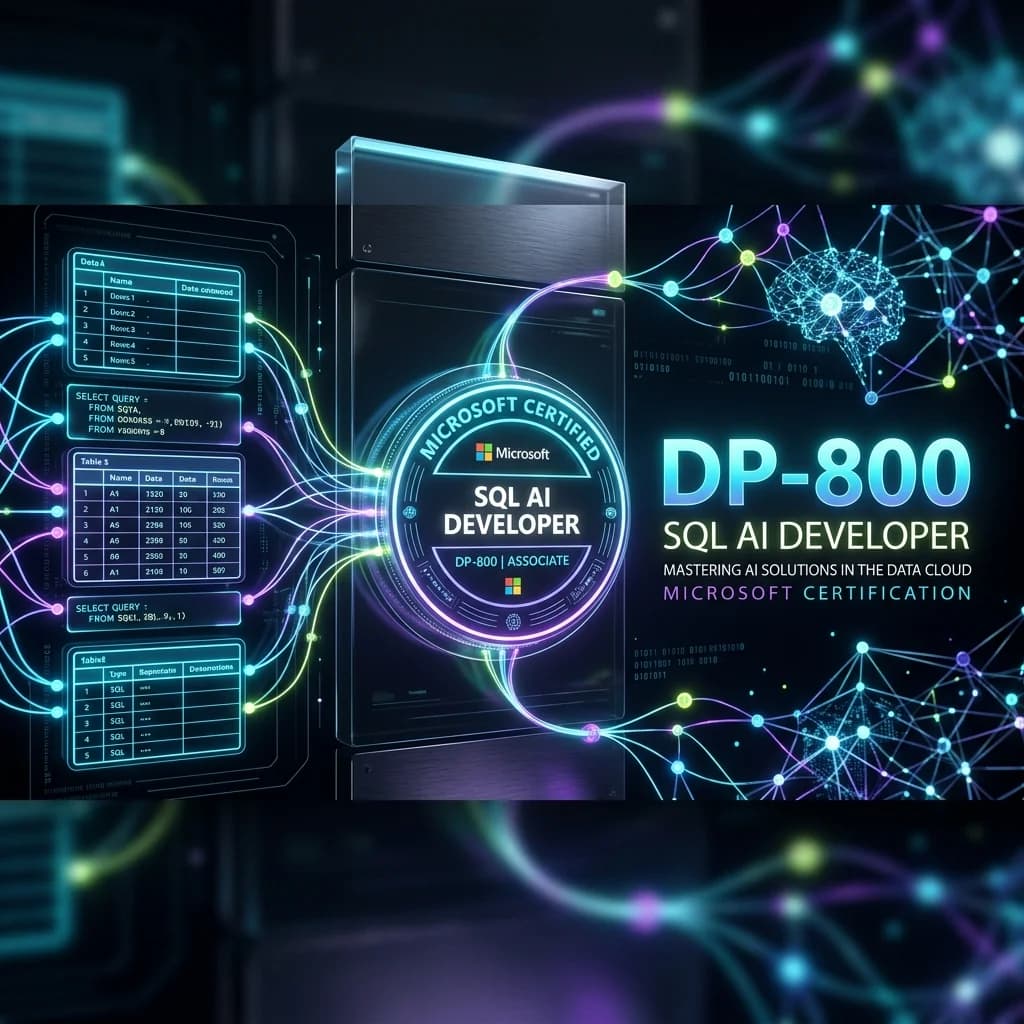

Microsoft's brand-new DP-800 exam (SQL AI Developer Associate) is the first certification that brings AI workloads directly to the database engine. If you are a database developer or administrator looking to expand into Generative AI and vector search, this study guide is your ultimate blueprint. We cover the entire curriculum, including native vector types, inline embeddings generation using AI_GENERATE_EMBEDDINGS, outbound REST calls, and automated database deployments. Read on to master these concepts and pass the exam on your first attempt.
The DP-800 Study Guide 2026 represents a major career opportunity for database professionals. Traditionally, database administrators configured indexes while AI engineers wrote Python scripts. With DP-800, database engines natively run vector search and execute RAG (Retrieval-Augmented Generation) patterns via T-SQL.
Quick Answer: What is the DP-800 Exam?
- Credential Name: Microsoft Certified: SQL AI Developer Associate
- Exam Duration: 120 minutes
- Number of Questions: 40-48 questions
- Passing Score: 700 / 1000
- Cost: $165 USD
- Study Time: 4-6 weeks (6-10 hours/week)
Why This Certification Matters in 2026
Enterprise applications require low-latency access to vectorized data. By integrating AI functions natively within Azure SQL and SQL Server databases, businesses can build smart agents without the complex pipeline costs of copying data to standalone vector stores. Building AI applications directly on the relational database eliminates the need for expensive ETL synchronization, reduces cloud data transport fees, and preserves existing database compliance models (such as Row-Level Security, backups, and audit logs).
As organizations move away from simple chat systems and toward autonomous, database-connected AI agents, the demand for developers who can bridge the gap between structured SQL tables and unstructured LLM contexts is soaring. The DP-800 credential validates this exact specialized skillset.
Skills Measured & Exam Weight
| Exam Domain | Weight | Key Sub-topics |
|---|---|---|
| Design and Develop Database Solutions | 35-40% | Relational database schemas, vector types, index optimization, stored procedures. |
| Secure, Optimize, and Deploy Database Solutions | 35-40% | Database security, CI/CD with dacpac, monitoring execution times, auditing. |
| Implement AI Capabilities in Database Solutions | 25-30% | AI_GENERATE_EMBEDDINGS, vector distance functions, REST procedure integrations, Azure OpenAI. |
Deep Dive: Vector Storage and Native Distance Functions
Azure SQL Database and SQL Server 2026 introduce native support for the VECTOR data type. Vectors are represented as arrays of floating-point numbers. When designing schemas, you must define the vector dimension count based on your embedding model. For example, OpenAI's text-embedding-3-small outputs 1,536 dimensions, whereas Cohere's embed-english-v3.0 outputs 1,024 dimensions.
To compare vector similarities, Microsoft provides the VECTOR_DISTANCE system function. The DP-800 curriculum expects you to know when to use the three supported distance metrics:
- Cosine Distance (
cosine): Measures the angle between two vectors, ignoring magnitude. Best for natural language queries and semantic document search. - Euclidean Distance (
euclidean/ L2): Measures the straight-line distance between two points in a multi-dimensional space. Typically used when vector magnitudes are normalized. - Dot Product (
dot): Multiplies corresponding coordinates. Extremely fast to calculate, but only recommended when vectors are normalized (magnitude equals 1).
Real-World Scenario: Enterprise RAG Setup on Azure SQL Database
An insurance provider wants to query customer policy files using natural language. Historically, their application retrieved the entire PDF, chunked it, converted chunks to vectors using a Python API, and queried a standalone vector store. You are tasked with migrating this complex, multi-hop pipeline to a native Azure SQL AI database.
Step-by-Step T-SQL Implementation Blueprint:
First, create the table structure. We use the native VECTOR(1536) data type to match our OpenAI model:
-- Create table with vector column for text chunks
CREATE TABLE PolicyChunks (
    ChunkId INT IDENTITY(1,1) PRIMARY KEY,
    PolicyNumber VARCHAR(50) NOT NULL,
    ChunkText NVARCHAR(MAX) NOT NULL,
    ChunkVector VECTOR(1536) NOT NULL -- 1536 dimensions for text-embedding-3-small
);

-- Index the vector column for performance optimization under load
CREATE SPATIAL INDEX ix_policy_chunks_vector ON PolicyChunks(ChunkVector);
Next, we write a stored procedure that handles the outbound REST call to Azure OpenAI to retrieve embeddings for a user's natural language query, and queries the database using Cosine Similarity:
CREATE PROCEDURE SearchPolicyChunks
    @SearchQuery NVARCHAR(MAX),
    @PolicyFilter VARCHAR(50)
AS
BEGIN
    SET NOCOUNT ON;

    -- Define parameters for outbound API request
    DECLARE @responseJSON NVARCHAR(MAX);
    DECLARE @payload NVARCHAR(MAX);
    DECLARE @targetUri NVARCHAR(2000) = 'https://your-openai-service.openai.azure.com/openai/deployments/text-embedding-3-small/embeddings?api-version=2023-05-15';

    SET @payload = JSON_OBJECT('input': @SearchQuery);

    -- Execute outbound HTTP POST request directly from the database engine
    EXEC sp_invoke_external_rest_endpoint
        @url = @targetUri,
        @method = 'POST',
        @headers = '{"api-key":"YOUR_AZURE_OPENAI_KEY","Content-Type":"application/json"}',
        @payload = @payload,
        @response = @responseJSON OUTPUT;

    -- Extract vector array from API response JSON using OPENJSON
    DECLARE @queryVector VECTOR(1536);

    SELECT @queryVector = CAST(value AS VECTOR(1536))
    FROM OPENJSON(@responseJSON, '$.data[0].embedding');

    -- Retrieve top matches using Cosine Distance
    SELECT TOP 3
        ChunkId,
        ChunkText,
        VECTOR_DISTANCE('cosine', ChunkVector, @queryVector) AS SimilarityDistance
    FROM PolicyChunks
    WHERE PolicyNumber = @PolicyFilter
    ORDER BY SimilarityDistance ASC;
END;
Security and Governance for SQL AI Implementations
Allowing database engines to perform outbound REST calls (sp_invoke_external_rest_endpoint) requires strict security controls. Under the DP-800 curriculum, you must configure **outbound firewall rules** and credentials securely. The database engine should authenticate against Azure OpenAI using a **Managed Identity** rather than exposing raw API keys in stored procedure strings.
To implement secure access:
- Create a database-scoped credential referencing your Azure Key Vault secret wrapper.
- Restrict the database's external networking endpoint configurations so that it can only connect to pre-authorized API URLs.
- Grant database permissions (
EXECUTE) on the REST endpoint procedure exclusively to database roles that require it, enforcing Least Privilege.
Step-by-Step 6-Week Study Roadmap
Week 1: Vector Basics & Azure SQL Architecture
Objectives: Understand native vector column storage, data types, and differences between Azure SQL Database, Managed Instances, and SQL Server 2026. Practice creating tables with dimensions.
Week 2: Embeddings Generation & Azure OpenAI Integrations
Objectives: Connect databases to Azure OpenAI endpoints. Master AI_GENERATE_EMBEDDINGS, configure network authorization filters, and manage Key Vault database secrets.
Week 3: Indexing and Search Optimization
Objectives: Learn how to optimize query execution times. Study spatial and IVFFlat indexing styles, balance recall rates vs. index construction overhead, and profile execution plans.
Week 4: Advanced REST Handlers & Data Pipelines
Objectives: Master outbound HTTPS orchestration. Map sp_invoke_external_rest_endpoint to external cognitive REST APIs. Parse results with OPENJSON. Read our DP-800 Career Paths guide.
Week 5: CI/CD Databases & dacpac Automations
Objectives: Deploy AI database changes using Git. Wrap vector schemas into Data-Tier Application Packages (dacpac) and configure automated release pipelines in GitHub Actions.
Week 6: Case Studies Review & Mock Exams
Objectives: Practice scenario questions. Solve exam cases regarding security, role boundaries, and vector performance optimization under strict concurrent loads.
Sample Exam Questions & Scenarios
Scenario: You are building an analytics query that retrieves customer support tickets similar to a newly entered ticket. The query must match the ticket's semantic meaning, regardless of exact keyword matches. The system must support sub-second execution speeds under a high concurrency of 200 requests per minute.
Question 1: Which vector distance algorithm should you configure inside your VECTOR_DISTANCE call to evaluate semantic textual similarity? Why?
Answer: **Cosine Distance (cosine)**. Cosine distance measures the angle difference between vectors rather than Euclidean magnitude, making it the industry standard for mapping textual relationships and semantic similarity.
Question 2: To ensure the query completes under the sub-second threshold, what optimization should you apply to the vector database column?
Answer: You must build an optimized database index (such as a spatial index or specialized vector index) on the vector column. In addition, you must recycle connection threads using a shared connection pool to avoid the expensive connection-establishment overhead of TLS handshakes.
Careers & Salaries
| Role | USA Salary | India Salary | Europe Salary |
|---|---|---|---|
| SQL AI Developer | $125,000 - $165,000 | ₹18L - ₹35L | €85,000 - €115,000 |
| Database Agent Engineer | $145,000 - $190,000 | ₹24L - ₹48L | €95,000 - €135,000 |
Frequently Asked Questions (FAQ)
- What is the DP-800 exam? The DP-800 exam is Microsoft's certification for the SQL AI Developer Associate, validating skills in SQL vector search, Azure OpenAI database integrations, and intelligent agent designs.
- Does DP-800 focus on Python or SQL? Unlike standard AI credentials, the DP-800 focuses heavily on database engine architectures, writing T-SQL, vector queries, database security, and dacpac schema deployments.
- What is VECTOR_DISTANCE in SQL? It is a system function that measures the distance between two vectors using algorithms like cosine similarity, dot product, or Euclidean distance.
- How many vector dimensions are supported in Azure SQL? Azure SQL supports up to 2000 dimensions for vector columns, matching models like Ada-002 and text-embedding-3-small/large.
- What is RAG? Retrieval-Augmented Generation is a pattern that retrieves context from a database using vector search and injects it into an LLM prompt to generate an accurate response.
- Can I run vector search on SQL Server on-premises? Yes, starting with SQL Server 2026+, Microsoft supports native vector types and vector distance operators on-premises.
- What is sp_invoke_external_rest_endpoint? It is a system stored procedure that makes outbound HTTP REST requests directly from database engines, commonly used to query cognitive APIs.
- What is a dacpac file? A dacpac is a compiled database schema deployment file used in CI/CD pipelines to apply schema updates safely.
- Is the exam open-book? Yes. Microsoft allows access to Microsoft Learn documentation during associate-level certification exams.
- What is the passing score? The passing score is a scaled score of 700 out of 1000.
- Are there case studies on the DP-800 exam? Yes. Most SQL certification exams feature case study scenarios outlining business objectives and security guidelines.
- How much does the DP-800 cost? The cost is $165 USD, with localized currency pricing depending on the country where the exam is scheduled.
- What is the difference between semantic search and vector search? Vector search compares vector representations of text. Semantic search uses metadata, synonyms, and natural language models to match queries.
- Is DP-800 a database administrator certification? No. It is specialized for database developers who integrate AI, although DBAs looking to expand their skills will benefit.
- Is DP-800 worth it in 2026? Yes. Relational databases remain the source of truth for business data, and SQL AI developers are in high demand to build AI agents on top of them.
Conclusion
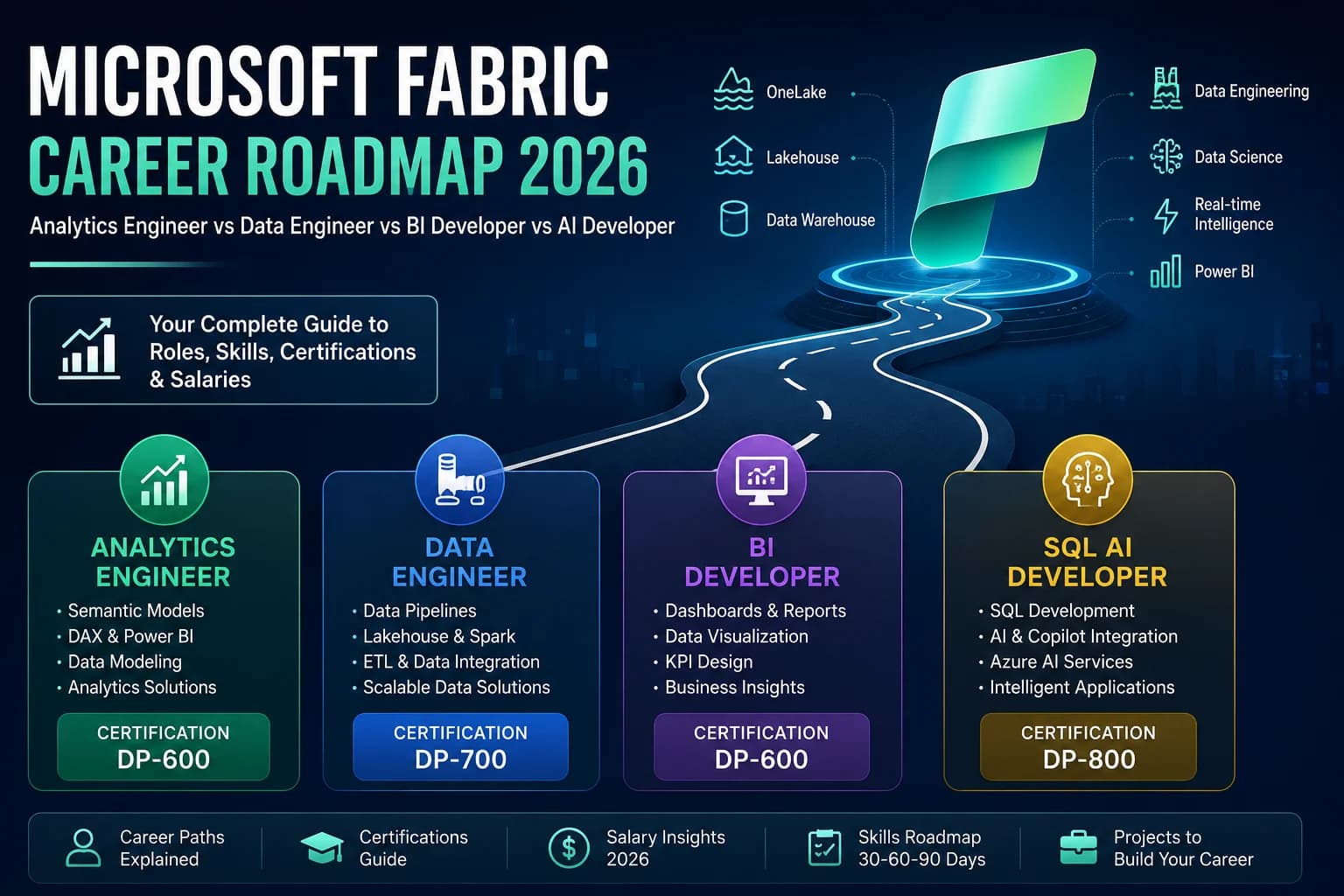
Passing the DP-800 exam confirms your capability to build modern, AI-integrated database applications. By studying native vector capabilities, referring to our Microsoft Fabric Certification Comparison, and practicing T-SQL AI queries, you will pass on your first attempt.
Related Reading:
- Learn how to secure your SQL AI implementations in our comprehensive guide on Hardening the Data Vault: Security Protocols for Enterprise BI Infrastructure.
- Explore prompt engineering methodologies for database applications in Precision Prompt Architecture™: The Blueprint for Precision AI Outputs.