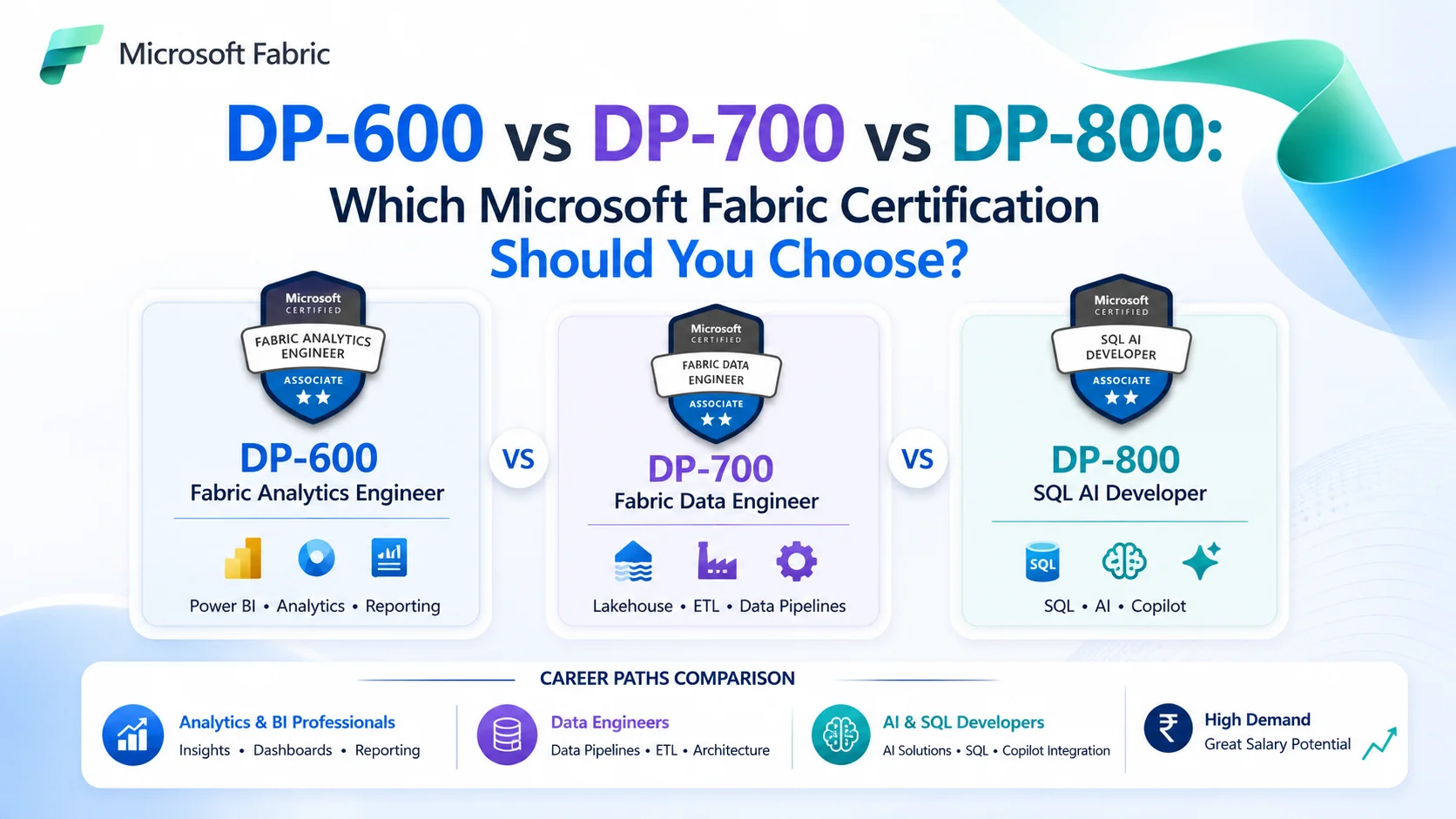

The Microsoft Fabric certification landscape has changed significantly, with DP-600, DP-700, and DP-800 representing three distinct career paths in analytics engineering, data engineering, and AI-driven SQL development. These three associate-level credentials sit at the heart of Microsoft's unified SaaS analytics platform, Microsoft Fabric.
If you are trying to decide which Microsoft Fabric certification to choose in 2026, this guide provides a clear side-by-side comparison of skills, job roles, difficulty level, and salary expectations — helping you make the right decision, whether you are claiming a free voucher from the Fabric Data Days 2026 campaign or planning your next career move.
The Core Breakdown: Understanding the Three Paths
Each certification focuses on a distinct persona within the modern data stack. While they all leverage the Microsoft Fabric ecosystem, they target different engineering disciplines, development tools, and database functionalities.
1. DP-600: Fabric Analytics Engineer Associate
The DP-600 certification is designed for professionals who bridge the gap between raw data engineering and business decision-making. If your work revolves around semantic modeling, data transformation, and reporting optimization, this is your path.
- Target Audience: Data Analysts, Power BI Developers, Analytics Engineers, and Business Intelligence Developers.
- Core Technologies: Power BI (Direct Lake mode), Dataflows Gen2, Data Warehouses, DAX, and SQL.
- Key Focus Areas: Building star schemas, configuring Direct Lake semantic models, optimizing report performance, and orchestrating downstream data transformation pipelines.
2. DP-700: Fabric Data Engineer Associate
The DP-700 certification targets the professionals responsible for building the scalable foundations of the data platform. If you write Spark notebooks, design ETL/ELT pipelines, and manage enterprise data governance, this is your focus.
- Target Audience: Data Engineers, Cloud Architects, and ETL Developers.
- Core Technologies: Apache Spark (PySpark/Scala), Lakehouses, Delta Lake tables, Fabric Pipelines, and Fabric Notebooks.
- Key Focus Areas: Designing medallion architectures (Bronze-Silver-Gold), configuring security policies, scheduling complex pipelines, writing high-performance Spark code, and managing compute capacities.
3. DP-800: SQL AI Developer Associate
The newly introduced DP-800 certification focuses on the convergence of databases and generative AI. It is designed for database administrators and software developers who want to integrate AI capabilities directly inside SQL databases and build intelligent database agents.
- Target Audience: SQL Developers, AI Engineers, and Database Administrators (DBAs).
- Core Technologies: Azure SQL Database, Microsoft Fabric Real-Time Intelligence, SQL Server, Vector Databases, Semantic Search Indexes, and Azure OpenAI Service.
- Key Focus Areas: Writing SQL queries containing native AI functions, configuring vector search and semantic search indexes, building intelligent database agents, and orchestrating RAG (Retrieval-Augmented Generation) patterns within database layers.
DP-600 vs DP-700 vs DP-800 Comparison (Skills, Roles, Salary)
Here is a side-by-side comparison of the core characteristics of the DP-600, DP-700, and DP-800 certifications:
| Feature | DP-600 (Analytics Engineer) | DP-700 (Data Engineer) | DP-800 (SQL AI Developer) |
|---|---|---|---|
| Primary Role | Analytics & BI Specialist | ETL & Infrastructure Engineer | SQL & AI Integration Engineer |
| Data Storage | Data Warehouse & Semantic Models | Lakehouse, OneLake, Delta Tables | Azure SQL DB, Vector Databases |
| Primary Language | SQL, DAX | PySpark (Python), SQL, Scala | SQL (Vector Queries), Python |
| Key Focus | Data transformation, semantic modeling, Direct Lake reporting | Data ingestion pipelines, Lakehouse management, Spark notebooks | Native DB AI functions, vector search indexing, intelligent agents |
| Difficulty Level | Intermediate (Requires DAX/SQL mastery) | Intermediate-Advanced (Requires Spark/Python) | Intermediate-Advanced (Requires SQL/LLM integration knowledge) |
Fabric Analytics Engineer Associate
- Role: Analytics & BI Specialist
- Data Storage: Data Warehouse & Semantic Models
- Languages: SQL, DAX
- Primary Focus: Data transformation, semantic modeling, Direct Lake reporting
- Difficulty: Intermediate
Fabric Data Engineer Associate
- Role: ETL & Infrastructure Engineer
- Data Storage: Lakehouse, OneLake, Delta Tables
- Languages: PySpark (Python), SQL, Scala
- Primary Focus: Data ingestion pipelines, Lakehouse management, Spark notebooks
- Difficulty: Intermediate-Advanced
SQL AI Developer Associate
- Role: SQL & AI Integration Engineer
- Data Storage: Azure SQL DB, Vector Databases
- Languages: SQL (Vector Queries), Python
- Primary Focus: Native DB AI functions, vector search indexing, intelligent agents
- Difficulty: Intermediate-Advanced
🧠 Final Recommendation — Quick Decision Guide
- 👉 Choose DP-600 if you work in Power BI, reporting, or analytics engineering
- 👉 Choose DP-700 if you build data pipelines, Spark systems, or manage lakehouses
- 👉 Choose DP-800 if you work with SQL, AI integration, or vector search systems
💡 Not sure yet? Start with DP-600 — it has the broadest applicability and the fastest time-to-value for most data professionals.
Salary Potential & Market Demand in 2026
As enterprise adoption of Microsoft Fabric and database-integrated AI matures, salaries for certified data professionals continue to rise. Let’s look at the average compensation trends for these certified roles:
- Fabric Analytics Engineer (DP-600): Average base salary ranges from $105,000 to $135,000 annually. Companies migrating legacy Power BI workspaces to Microsoft Fabric capacities actively hunt for professionals who understand how to configure Direct Lake to avoid expensive fallback compute costs.
- Fabric Data Engineer (DP-700): Average base salary ranges from $125,000 to $160,000. Because data engineers construct the pipeline foundations, ingestion scripts, and security controls, their expertise remains one of the highest-paying domains in the cloud space.
- SQL AI Developer (DP-800): Average base salary ranges from $130,000 to $165,000. This represents a highly specialized, fast-growing intersection. With enterprises eager to build RAG systems using their existing SQL database layers rather than spinning up entirely new vector infrastructure, DP-800 holders command premium contract rates.
Career Paths: How These Roles Collaborate
In a mature data department, these three roles work in tandem to deliver clean data and AI applications:
- The Data Engineer (DP-700) configures Microsoft Fabric capacity, orchestrates pipelines to ingest raw data into the Bronze lakehouse, and runs Spark jobs to clean and structure it into the Gold Delta tables.
- The Analytics Engineer (DP-600) takes the Gold Delta tables, creates optimized semantic star schemas, designs relationships, writes complex DAX measures, and develops Direct Lake reports in Power BI.
- The SQL AI Developer (DP-800) integrates natural language search capabilities using vector embeddings in Azure SQL DB, builds intelligent database agents to alert engineers of supply chain anomalies, and exposes database models to corporate AI applications.
Microsoft Fabric is rapidly becoming the unified analytics platform for enterprise data engineering, combining data engineering, analytics, and AI capabilities into a single SaaS ecosystem. Whether you pursue the DP-600 analytics path, the DP-700 data engineering path, or the DP-800 SQL AI developer path, you are positioning yourself at the centre of enterprise data transformation in 2026 and beyond.
Which Certification Should You Choose First?
If you are deciding which certification path to embark on, use this step-by-step decision framework to maximize your return on investment:
Scenario A: You are already a Power BI Developer or Data Analyst
Recommendation: Start with DP-600. The transition from legacy Power BI Desktop to Fabric Analytics Engineering is direct. You will leverage your existing DAX and reporting skills while learning lakehouse storage and warehouse structures. This path provides the fastest time-to-value.
Scenario B: You have a Software Engineering or Python/Spark background
Recommendation: Start with DP-700. Your familiarity with coding, notebooks, and database orchestration makes the DP-700 highly intuitive. You will skip the complexities of visual BI modeling and focus on writing robust PySpark code, scheduling ETL workloads, and configuring Lakehouses.
Scenario C: You are a DBA, SQL Developer, or aspiring AI Integration Specialist
Recommendation: Start with DP-800. If you love writing complex SQL queries, stored procedures, and trigger architectures, the DP-800 will teach you how to embed vector query syntax, configure semantic indexes, and deploy intelligent agents directly within the database engine.
Microsoft Fabric Certification Topic Silo
To help you prepare, check out our comprehensive guides and resources in this topic cluster:
- Read the Complete DP-600 Study Guide for step-by-step Analytics Engineer prep.
- Review our DP-600 Exam Questions & Scenarios to practice real exam cases.
- Read the Complete DP-700 Study Guide for Fabric Data Engineer prep.
- Check out the DP-700 vs DP-203 Comparison to see which engineering track is right for you.
- Read the Complete DP-800 Study Guide for SQL AI Developer prep.
- Explore DP-800 Career Opportunities for salaries and job roles.
- Explore the Microsoft Fabric Certification Roadmap to plan your entire learning journey.
Frequently Asked Questions: DP-600 vs DP-700 vs DP-800
Which is easier: DP-600 or DP-700?
DP-600 is generally considered easier because it focuses on Power BI, DAX, and semantic modeling rather than the low-level Spark programming and distributed systems knowledge required for DP-700. For professionals with an analytics or reporting background, DP-600 provides the most direct learning path.
Can I skip DP-600 and go directly to DP-700?
Yes. DP-600 and DP-700 are independent certifications with no formal prerequisites. If you already have strong Python, PySpark, or data engineering experience, you can go directly to DP-700 without completing DP-600 first. Review the DP-700 Study Guide to assess your readiness.
Is DP-800 good for beginners?
No, DP-800 is not recommended for beginners. It is designed for experienced SQL developers, database administrators, or AI engineers who already understand T-SQL, relational database concepts, and want to extend those skills into AI-driven systems. Beginners are better served starting with DP-600.
Which Microsoft Fabric certification has the highest salary?
DP-800 currently commands the highest salary potential, with average base salaries ranging from $130,000 to $165,000 annually. This reflects the premium enterprises place on SQL AI Developer expertise for building RAG pipelines, vector search systems, and intelligent database agents. DP-700 holders follow closely, given the critical nature of data pipeline infrastructure.
Conclusion: Get Certified for Free
Regardless of the path you choose, validating your expertise with a Microsoft Associate certification is a proven career accelerator. With the ongoing Fabric Data Days 2026 campaign, there has never been a better time to upskill — follow the milestones, complete the required learn modules, and claim your 100% discount code before August 2026.