
To get the most out of this certification breakdown, review our core Microsoft Fabric architectural blueprints:
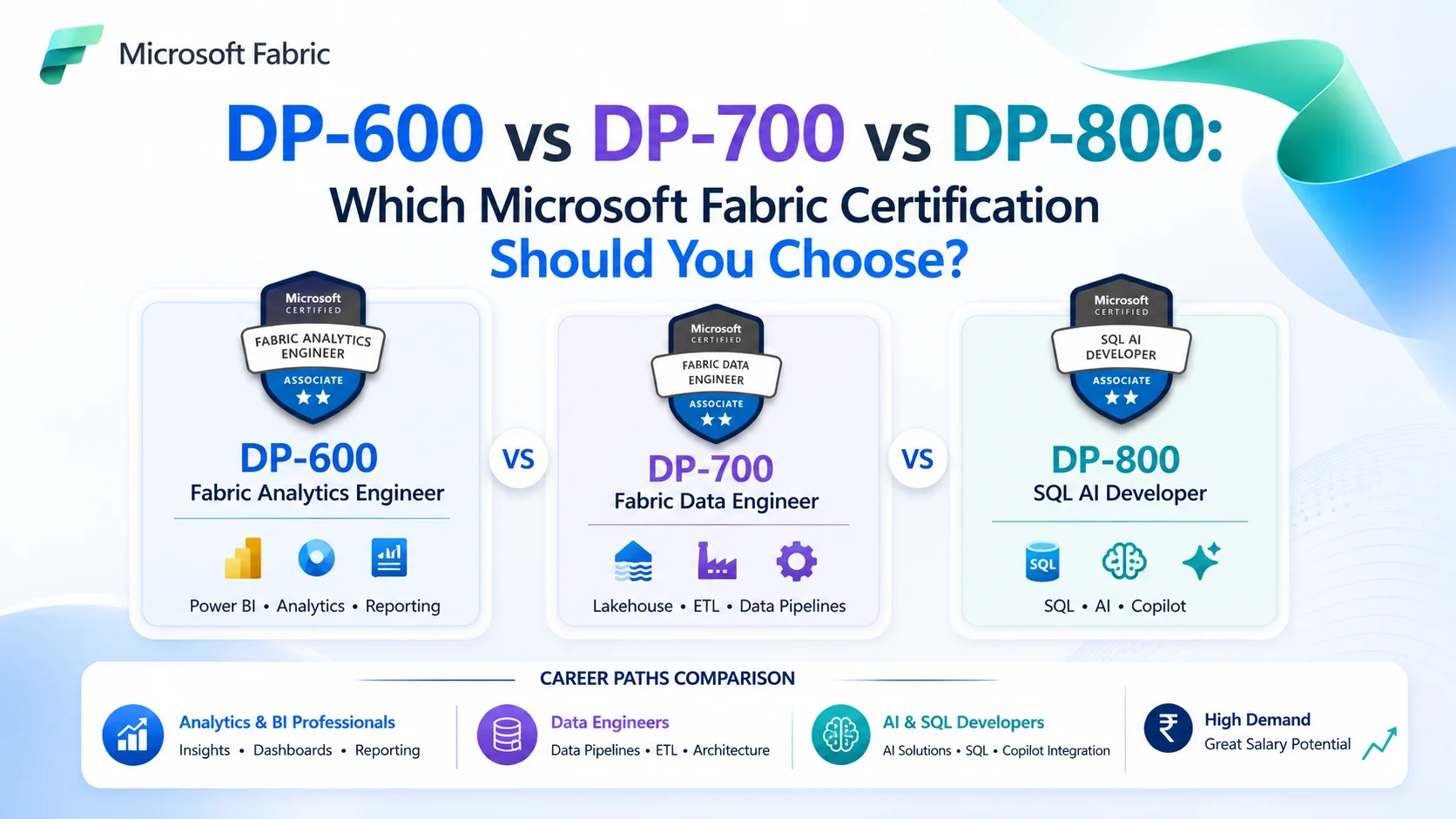
→ DP-600 vs DP-700 vs DP-800: The Three-Way Fabric Matrix → Microsoft Fabric Architecture Explained (2026 Deep Dive) → Power BI Direct Lake Performance Tuning Guide → View Datta Sable Verified Microsoft & Google CredentialsWhat is the difference between PL-300, DP-600, and DP-700? In 2026, Microsoft data credentials represent three distinct tiers of the data ecosystem. PL-300 (Power BI Data Analyst) evaluates visualization, report design, Power Query data transformation, and fundamental DAX calculations. DP-600 (Fabric Analytics Engineer) elevates you into the semantic modeling and lakehouse architecture layer, requiring mastery of Direct Lake mode, OneLake storage, Fabric Warehouses, and Tabular Model Definition Language (TMDL). DP-700 (Fabric Data Engineer) tests the foundational data pipeline and storage backbone, focusing heavily on Apache Spark, PySpark transformations, OneLake shortcuts, database mirroring, and enterprise Purview governance.
Master Table of Contents
- 1. The 2026 Enterprise Context: The Fabric Convergence & The Death of Siloed BI
- 2. Executive 30-Second Comparison Matrix
- 3. Deep Dive: Exam PL-300 (Microsoft Certified: Power BI Data Analyst Associate)
- 4. Deep Dive: Exam DP-600 (Microsoft Certified: Fabric Analytics Engineer Associate)
- 5. Deep Dive: Exam DP-700 (Microsoft Certified: Fabric Data Engineer Associate)
- 6. Head-to-Head Showdowns: Direct Exam Comparisons
- 7. Comprehensive 25-Point Technical Skills Breakdown
- 8. Direct Lake Internals, Memory Paging & Fallback Architecture
- 9. Apache Spark, Delta Lake & V-Order Optimization Mechanics
- 10. Real-World Exam Case Studies: 3 Architectural Scenarios
- 11. 2026 Global Compensation & Market Demand Benchmarks
- 12. Architectural Decision Tree: Which Certification Should You Target?
- 13. The 60-Day First-Attempt Pass Blueprint
- 14. Frequently Asked Questions (FAQ)
1. The 2026 Enterprise Context: The Fabric Convergence & The Death of Siloed BI
For nearly a decade, the business intelligence landscape operated on clean, isolated fault lines. On one side stood the BI Developer, armed with Power BI Desktop, DAX Studio, and Power Query M. Their responsibility ended at the boundary of imported tabular models and scheduled refreshes. On the opposite side stood the Data Engineer, residing in Azure Data Factory, Databricks, and Synapse Analytics, orchestrating complex SQL and Spark pipelines to dump data into cloud storage.
In 2026, that boundary has dissolved entirely. The launch and enterprise adoption of Microsoft Fabric has unified storage into a single open format: OneLake with Delta Parquet tables. With this unified architecture, reporting layers no longer import data into proprietary VertiPaq files. Instead, semantic models query lakehouses directly at memory-speed through Direct Lake mode.
This technical revolution triggered immense confusion across the hiring market and among data practitioners. The most common questions asked by engineers, hiring managers, and enterprise directors are:
- "Is PL-300 dead? Has Microsoft Fabric made the Power BI Data Analyst Associate obsolete?"
- "Should I skip PL-300 entirely and go straight for DP-600?"
- "Where does DP-700 fit, and how does it compare to the retired DP-203 Azure Data Engineer exam?"
- "What is the actual compensation premium of becoming a certified Fabric Analytics Engineer vs a traditional Power BI developer?"
This definitive masterclass answers every single one of those questions with architectural precision, hands-on syllabus analysis, and enterprise hiring realities.
2. Executive 30-Second Comparison Matrix
If you need an immediate reference point before diving into our deep technical breakdowns, review this foundational comparison matrix:
| Evaluation Dimension | PL-300 (Power BI Analyst) | DP-600 (Fabric Analytics Engineer) | DP-700 (Fabric Data Engineer) |
|---|---|---|---|
| Primary Role Focus | Report authoring, dashboard UX, business metrics, basic DAX. | Enterprise semantic models, Direct Lake, Fabric Warehouses, TMDL. | Data ingestion, Spark processing, OneLake shortcuts, Medallion pipelines. |
| Core Technologies | Power BI Desktop, Power Query, Service Workspaces. | OneLake, Fabric Lakehouse/Warehouse, DAX Studio, Git CI/CD. | Apache Spark, PySpark, Data Factory Pipelines, KQL, Purview. |
| Primary Languages | DAX, Power Query M. | Advanced DAX, T-SQL, M, basic PySpark. | PySpark / Python, SQL, KQL (Kusto Query Language). |
| Exam Technical Depth | Moderate (Business logic & visual storytelling focus). | Advanced (Data modeling, performance optimization, Lakehouse internals). | Very Advanced (Code-heavy pipelines, distributed computing, governance). |
| Average Global Salary (US) | $85,000 – $115,000 | $130,000 – $165,000 | $140,000 – $180,000 |
| Pre-Requisite Recommendation | None (Great entry point for data careers). | PL-300 or 18+ months hands-on Power BI experience. | Solid SQL, Python/Spark fundamentals, and cloud storage basics. |
3. Deep Dive: Exam PL-300 (Microsoft Certified: Power BI Data Analyst Associate)
Target Persona & Philosophy
The PL-300 exam validates your ability to deliver actionable business value through data storytelling. The persona targeted is the traditional Business Intelligence Analyst, Reporting Specialist, or Departmental Data Specialist. Your focus is user-centric: taking raw tables from diverse sources, cleaning them via Power Query, shaping them into a clean star schema, and building visually compelling dashboards that business leaders can navigate seamlessly.
Official Exam Domains & Weightage
- Prepare the Data (25–30%): Ingesting data from Excel, SQL databases, SharePoint, and Web endpoints; profiling columns; writing custom M code; pivoting, unpivoting, merging, and appending queries.
- Model the Data (25–30%): Designing dimensional star schemas; configuring relationships (1:many, many:many, active vs inactive); implementing Row-Level Security (RLS); writing foundational DAX measures (
CALCULATE,FILTER, time intelligence likeTOTALYTD,SAMEPERIODLASTYEAR). - Visualize and Analyze the Data (25–30%): Selecting the appropriate chart types; conditional formatting; bookmarks and selection panes; drill-through and tooltips; AI visuals (Key Influencers, Decomposition Tree); Q&A configurations.
- Deploy and Maintain Assets (15–20%): Managing workspace permissions; publishing apps; configuring scheduled gateway refreshes; managing semantic model endorsements (Promoted vs Certified).
The Limitations of PL-300 in 2026
While PL-300 remains the most popular data credential in Microsoft history, it has clear architectural limits. PL-300 completely ignores:
- OneLake & Delta Parquet Architecture: PL-300 assumes data lives in isolated imported
.pbixmodels or traditional DirectQuery relational databases. - Direct Lake Mode: You will not be tested on memory-mapping Delta tables from Fabric Lakehouses without data movement.
- Enterprise DevOps & Git Integration: PL-300 does not test PBIP files, source control, Azure DevOps deployment pipelines, or Fabric workspace Git binding.
- Fabric Capacity Planning: No questions on Capacity Units (CU), F-SKU sizing, bursting, or smoothing.
4. Deep Dive: Exam DP-600 (Microsoft Certified: Fabric Analytics Engineer Associate)
Target Persona & Philosophy
The DP-600 exam tests the modern Analytics Engineer. In the modern data stack, the Analytics Engineer acts as the vital bridge between data infrastructure and consumption. You are not building colorful visuals for quarterly meetings; you are architecting the single source of truth for the entire enterprise. Your job is to transform raw Delta tables into governed, high-performance semantic models that hundreds of analysts can self-serve from simultaneously without crashing server capacities.
Official Exam Domains & Weightage
- Plan, Implement, and Manage a Solution for Data Analytics (10–15%): Workspace architecture, Fabric capacity management (smoothing, throttling, pausing), Git integration, deployment pipelines, semantic model lineage, and monitoring via the Microsoft Fabric Capacity Metrics app.
- Prepare and Serve Data (40–45%): Loading data into Fabric Lakehouses and Warehouses; using Dataflows Gen2; querying Delta tables using T-SQL and Spark; selecting between Lakehouse and Warehouse architectures; optimizing Delta Parquet files (V-Order, compaction).
- Implement and Manage Semantic Models (20–25%): Creating scalable Direct Lake semantic models; designing Star Schemas over Lakehouse Delta tables; managing calculation groups; configuring dynamic Row-Level Security (RLS) and Object-Level Security (OLS); deploying models using Tabular Model Definition Language (TMDL).
- Explore and Analyze Data (20–25%): Writing complex T-SQL queries with Window functions (
LEAD,LAG,DENSE_RANK); analyzing query execution plans; writing advanced DAX to avoid performance bottlenecks; evaluating VertiPaq vs Direct Lake memory footprints using DAX Studio.
Why DP-600 Has a 50%+ Failure Rate for Pure Power BI Developers
Engineers coming from a traditional PL-300 background frequently fail DP-600 because they underestimate the backend data engineering depth. DP-600 tests scenarios such as:
- The Direct Lake Fallback Trap: Knowing the exact triggers that cause Direct Lake mode to drop back into slow DirectQuery mode (e.g., unsupported DAX functions, views over tables, row-level security applied directly on Lakehouse SQL endpoints instead of the semantic model).
- T-SQL Warehousing Quirks: Fabric Warehouse is not traditional SQL Server; it is a distributed engine that does not support identity columns, primary key enforcement, or clustered rowstore indexes. You must understand distribution statistics, cross-database querying, and table partitioning.
- TMDL and External Tooling: Editing semantic models through Tabular Editor 3, scripting deployments via XMLA endpoints, and managing code branches in Git.
5. Deep Dive: Exam DP-700 (Microsoft Certified: Fabric Data Engineer Associate)
Target Persona & Philosophy
The DP-700 exam is the premier credential for the Fabric Data Engineer. While DP-600 centers on data consumption and semantic layers, DP-700 centers on data ingestion, heavy distributed computing, and enterprise data lifecycle orchestration. You are the builder of the pipeline highways. You ingest millions of records per minute from external clouds, on-premises systems, and operational databases, clean them using Apache Spark, and organize them into an immutable Medallion Architecture.
Official Exam Domains & Weightage
- Ingest and Transform Data (35–40%): Building Data Factory pipelines; orchestrating Copy activities, Web hooks, and ForEach loops; developing PySpark notebooks; tuning Spark session pools and executor cores; applying Delta Lake transformations (
MERGE INTO, SCD Type 1 and Type 2 updates). - Design and Implement Data Storage (25–30%): Structuring OneLake storage; configuring OneLake Shortcuts to Amazon S3, Google Cloud Storage, and Azure Data Lake Storage Gen2; setting up Fabric Database Mirroring for Azure SQL, Cosmos DB, and Snowflake; optimizing Delta logs, V-Order, and compaction.
- Secure and Govern Data (15–20%): Implementing OneLake security roles; integrating Microsoft Purview for sensitivity labeling and data loss prevention; configuring managed private endpoints and customer-managed keys (CMK); masking sensitive PII data.
- Monitor and Optimize the Solution (15–20%): Troubleshooting pipeline failures; profiling Spark execution DAGs and skew; analyzing Capacity Unit consumption via Fabric Metrics; managing workspace disaster recovery and tenant governance settings.
DP-700 vs The Old DP-203 Exam
For years, DP-203 (Data Engineering on Microsoft Azure) was the industry benchmark. However, DP-203 required mastering disconnected Azure resources: creating an Azure Synapse workspace, standing up a dedicated Azure Data Factory instance, configuring separate Azure Databricks clusters, and managing Azure Data Lake storage accounts manually.
DP-700 modernizes this entirely into Microsoft Fabric. Instead of provisioning and maintaining 5 separate Azure resources with separate billing models, DP-700 tests your ability to achieve the same data engineering workflows inside a single SaaS workspace powered by OneLake and serverless Spark compute pools.
6. Head-to-Head Showdowns: Direct Exam Comparisons
Showdown 1: PL-300 vs DP-600 (The Power BI Upgrade Dilemma)
The Core Question: "I have 2 years of Power BI experience. Can I skip PL-300 and go directly to DP-600?"
The Architectural Verdict: You can skip PL-300 only if you have strong foundational experience in dimensional modeling and basic SQL. If all your Power BI models are built by importing a single flat Excel sheet and clicking buttons in the UI, jumping into DP-600 will be overwhelming.
| Technical Area | PL-300 Requirement | DP-600 Requirement |
|---|---|---|
| DAX Complexity | Basic to Intermediate (CALCULATE, RELATED, DATEADD) | Advanced (Calculation Groups, Window DAX, Performance Tuning) |
| Data Storage | VertiPaq In-Memory (Power BI Desktop cache) | OneLake Delta Parquet + Direct Lake memory paging |
| Source Control | Manual .PBIX file saves / SharePoint versions | Git Integration, PBIP format, Azure DevOps pipelines |
| SQL Requirement | Optional / Basic SELECT queries | Mandatory advanced T-SQL over distributed tables |
Showdown 2: DP-600 vs DP-700 (Analytics Engineer vs Data Engineer)
The Core Question: "Both are Microsoft Fabric exams. How do I decide between Analytics Engineer and Data Engineer?"
The Architectural Verdict: Look at your day-to-day code. If your preferred languages are DAX, T-SQL, and semantic modeling, take DP-600. If your preferred languages are PySpark, Python, and data pipeline orchestration, take DP-700.
| Architectural Layer | DP-600 (Analytics Engineer) | DP-700 (Data Engineer) |
|---|---|---|
| Medallion Stage | Gold Layer (Business logic, star schema, aggregated views) | Bronze & Silver Layers (Raw ingestion, cleansing, deduplication) |
| Compute Engine | Fabric SQL Engine (T-SQL) & Analysis Services VertiPaq | Apache Spark Engine (PySpark, Scala) & Data Factory |
| Integration Mode | Direct Lake Semantic Models over Gold Tables | OneLake Shortcuts, Real-Time Streams, Database Mirroring |
| Primary Stakeholder | Business Analysts, C-Suite, BI consumers | Analytics Engineers, Data Scientists, Security Architects |
7. Comprehensive 25-Point Technical Skills Breakdown
To help you audit your technical readiness, review this detailed 25-point skills matrix across all three exams:
| Technical Skill / Capability | PL-300 | DP-600 | DP-700 |
|---|---|---|---|
| Power BI Visual Design & Navigation | ★★★ Expert | ★ Basic | - None |
| Power Query M Transformations | ★★★ Expert | ★★ Intermediate | ★ Basic |
| DAX Measures & Context Transition | ★★ Intermediate | ★★★ Expert | - None |
| DAX Calculation Groups & TMDL | - None | ★★★ Expert | - None |
| Direct Lake Model Architecture | - None | ★★★ Expert | ★★ Intermediate |
| OneLake Architecture & Delta Tables | - None | ★★★ Expert | ★★★ Expert |
| Fabric T-SQL Data Warehouse | - None | ★★★ Expert | ★★ Intermediate |
| Apache Spark & PySpark Notebooks | - None | ★ Basic (EDA) | ★★★ Expert |
| Data Factory Ingestion Pipelines | - None | ★ Basic | ★★★ Expert |
| OneLake Shortcuts (S3 / ADLS / Dataverse) | - None | ★★ Intermediate | ★★★ Expert |
| Database Mirroring (Cosmos DB, Snowflake) | - None | ★ Basic | ★★★ Expert |
| Delta Log V-Order & Compaction | - None | ★★★ Expert | ★★★ Expert |
| Fabric Git Integration & CI/CD | - None | ★★★ Expert | ★★★ Expert |
| Fabric Capacity Metrics & Throttling | - None | ★★★ Expert | ★★★ Expert |
| Microsoft Purview Governance & Lineage | - None | ★★ Intermediate | ★★★ Expert |
| Real-Time Intelligence (KQL / Eventhouse) | - None | ★ Basic | ★★★ Expert |
8. Direct Lake Internals, Memory Paging & Fallback Architecture
Understanding Direct Lake mode is the single most tested architectural topic on DP-600 and DP-700. In legacy Power BI architectures, you had two distinct choices: Import mode (lightning-fast VertiPaq columnar memory, but constrained by file sizes and multi-hour scheduled refreshes) or DirectQuery mode (real-time data from SQL, but agonizingly slow rendering with high relational database load).
Direct Lake eliminates this trade-off. Instead of copying and compressing data into proprietary .abf files, the Analysis Services engine reads natively formatted Delta Parquet files directly from OneLake storage. When a DAX query executes, the engine memory-maps the required parquet columns straight into server RAM. There is zero data duplication, zero scheduled model refresh latency, and pure in-memory VertiPaq query speeds.
The 6 Fatal Triggers That Cause Direct Lake Fallback
In both real-world enterprise deployments and Microsoft certification exams, the greatest hazard is unintended fallback to DirectQuery. When fallback occurs, reports that loaded in 400 milliseconds suddenly degrade to 25 seconds. Microsoft exams test whether you can identify and prevent these 6 exact triggers:
- 1. Memory Budget Exceeded (SKU Paging Limits): Every Fabric capacity SKU has a strict Direct Lake memory ceiling. For example, an F64 capacity allows up to 25 GB of memory per semantic model. If user queries require paging columns that exceed this limit, Analysis Services falls back to DirectQuery over the Lakehouse SQL Analytics Endpoint.
- 2. Calculated Columns Defined in the Model: Direct Lake models do not allow DAX calculated columns. Because the VertiPaq engine reads immutable Parquet columns from storage, it cannot write back new calculated row vectors on the fly. If you create a calculated column in the semantic model, the table immediately drops to DirectQuery. Exam Solution: Pre-calculate columns upstream in Delta tables using Spark or T-SQL views.
- 3. Row-Level Security (RLS) Applied at the SQL Endpoint: If you configure security roles on the Lakehouse SQL Analytics Endpoint, Direct Lake cannot bypass the relational security boundary. It must fall back to DirectQuery to enforce SQL permissions. Exam Solution: Define RLS directly inside the Power BI semantic model using DAX expressions.
- 4. Pointing to SQL Views Instead of Native Delta Tables: Direct Lake requires native Delta Parquet files with transaction log checkpoints (
_delta_log). If you point a semantic model partition to a T-SQL view created in the SQL endpoint, it will execute exclusively in DirectQuery mode. - 5. Delta Transaction Log Framing Desynchronization: When a Spark notebook or Data Factory pipeline updates a Lakehouse table, the Delta log advances to a new version. If the semantic model has not refreshed its metadata framing (automatic or via XMLA), queries encountering schema mutations drop back to DirectQuery until framing syncs.
- 6. Unsupported Data Types: Tables containing unsupported types such as binary data, timestamps with non-UTC time zones, or precision scale exceeding 38 digits will refuse to load into Direct Lake memory.
Verifying Direct Lake Execution in DAX Studio
To verify whether your queries run in pure Direct Lake or have suffered silent fallback, you must monitor Server Timings in DAX Studio:
[Pure Direct Lake Execution]
• Storage Engine (SE) Events: Shows VertiPaq SE queries reading memory-mapped Parquet.
• DirectQuery Events: 0 ms (No DirectQueryBegin or DirectQueryEnd events).
• Total SE Duration: < 50 ms.
[Direct Lake Fallback Detected]
• Storage Engine (SE) Events: DirectQueryBegin and DirectQueryEnd triggered.
• Query Text: Shows generated SQL query sent to Lakehouse SQL endpoint.
• Root Cause: Verify memory limits, calculated columns, or Lakehouse SQL views.
Tabular Model Definition Language (TMDL) Direct Lake Partition
On DP-600, you are expected to understand how modern semantic models are declared in code. Here is how a Direct Lake partition is defined in TMDL:
lineageTag: 4a5e3f12-78d1-4e2a-a92c-9bf8d312e091
partition FactInternetSales-DirectLake = entity
mode: directLake
source
entityName: factinternetsales
schemaName: dbo
expressionSource: 'DatabaseQuery'
9. Apache Spark, Delta Lake & V-Order Optimization Mechanics
For candidates taking DP-700 (and advanced sections of DP-600), the underlying storage format is everything. Microsoft Fabric builds upon open-source Delta Lake, but layers on enterprise proprietary optimizations designed specifically for high-concurrency analytical reads.
Understanding Microsoft V-Order Write Optimization
V-Order is a write-time optimization algorithm engineered into Fabric Spark and Fabric Data Warehouses. Standard Parquet files organize data into row groups and columns, but their internal dictionary encoding is optimized for general disk reads, not in-memory columnar engines.
When V-Order is enabled, the writer applies specialized row sorting, dictionary compression, and bit-packing within each Parquet row group. The resulting Parquet file remains 100% compliant with the open Parquet specification, but when loaded into Power BI VertiPaq memory or Fabric SQL engines, it delivers:
- Up to 10x faster DAX query execution in Direct Lake mode because the memory structures mirror VertiPaq internal memory formats.
- 15% to 25% lower physical storage footprint in OneLake compared to standard Spark Parquet writes.
- Automatic enablement: Fabric Spark notebooks and Dataflows Gen2 have V-Order enabled by default (
spark.sql.parquet.vorder.enabled = true).
Delta Liquid Clustering vs Traditional Hive Partitioning
A classic exam question on DP-700 tests your knowledge of table partitioning strategy. Historically, data engineers partitioned tables by folder hierarchies (e.g., /Year=2026/Month=10/Day=20/). In modern Fabric lakehouses, this approach causes severe performance bottlenecks known as the Small File Problem.
Instead, DP-700 champions Delta Lake Liquid Clustering (CLUSTER BY). Liquid Clustering replaces rigid folder directories with dynamic file layout clustering that can adapt as query patterns evolve over time.
| Feature Dimension | Classic Hive Partitioning | Delta Liquid Clustering (Fabric Best Practice) |
|---|---|---|
| Directory Structure | Rigid physical folder trees per partition key | Flat directory structure; metadata tracks clustering bounds |
| High Cardinality Columns | Disastrous (Generates millions of tiny, inefficient files) | Fully supported (Customer ID, Device ID, GUIDs) |
| Key Evolution | Requires complete table rewrite and data migration | Seamlessly altered via ALTER TABLE CLUSTER BY command |
| Write Amplification | High when writing out-of-order data | Low; incremental clustering during scheduled OPTIMIZE runs |
Production Delta Maintenance Scripts (PySpark & SQL)
To pass DP-700, you must know how to prevent Delta log bloat and table degradation. Commit these two maintenance commands to memory:
OPTIMIZE lakehouse_db.gold_sales
ZORDER BY (StoreKey, OrderDate);
-- 2. Garbage Collection of Historical Delta Commits
-- Retains 7 days of historical time travel snapshots, purges orphaned files
VACUUM lakehouse_db.gold_sales RETAIN 168 HOURS;
10. Real-World Exam Case Studies: 3 Architectural Scenarios
Both DP-600 and DP-700 conclude with extensive, multi-requirement Case Study Questions. Review these three real-world blueprints to understand how architectural trade-offs are evaluated:
Case Study 1 (DP-600 Focus): Enterprise Retail Migration
Business Context: A retail conglomerate has 1,200 stores. Their existing on-premises SQL Data Warehouse refreshes nightly, taking 4.5 hours to finish. Business analysts complain that morning Power BI dashboards load slowly and frequently timeout during executive reviews.
Requirements:
- Eliminate the 4.5-hour scheduled refresh window.
- Provide sub-second dashboard filtering across 250 million transaction rows.
- Support dynamic currency conversion between USD, EUR, and GBP without duplicating data.
- Enable strict team collaboration using Git source control.
The Architect's Approved Solution:
Provision a Fabric F64 capacity. Land raw POS transactions into a Lakehouse Gold Delta table using incremental Data Factory copy pipelines with V-Order enabled. Create a Direct Lake semantic model referencing the Gold Delta table. Implement Calculation Groups in Tabular Editor 3 to handle currency conversion dynamically at query runtime. Convert the Power BI project into PBIP format and synchronize the Fabric workspace with an Azure DevOps Git repository, deploying changes through Fabric Deployment Pipelines (Dev → Test → Prod).
Case Study 2 (DP-700 Focus): High-Frequency IoT Fleet Telemetry
Business Context: A logistics enterprise operates 45,000 smart delivery vehicles. Every vehicle transmits GPS coordinates, engine temperature, and fuel levels every 5 seconds (generating over 60 million records per day).
Requirements:
- Ingest streaming telemetry with sub-minute latency for dispatch operations.
- Store historical telemetry immutably for 5-year auditing compliance.
- Prevent the "small file problem" caused by continuous streaming writes.
- Track automated data lineage and sensitivity labels using Microsoft Purview.
The Architect's Approved Solution:
Route incoming vehicle streams into Fabric Real-Time Intelligence Eventstreams. Land real-time telemetry simultaneously into a KQL Eventhouse (for sub-second live dispatch queries) and a Lakehouse Bronze Delta table (for historical archival). Execute a scheduled Fabric Spark notebook using Structured Streaming with Liquid Clustering (CLUSTER BY VehicleId, Timestamp) to write cleansed records into the Silver layer. Schedule daily OPTIMIZE and weekly VACUUM jobs. Bind the workspace to Microsoft Purview to automatically inherit tenant-level data governance and lineage tracking.
Case Study 3 (Multi-Cloud Architecture): The Zero-Copy Data Mesh
Business Context: A multinational financial institution runs customer analytics on AWS (using Amazon S3 data lakes) and marketing automation on Google Cloud Platform (Google Cloud Storage), while their central core banking application resides in an on-premises Azure SQL database.
Requirements:
- Deliver a unified executive analytics layer combining AWS, GCP, and Azure data.
- Strict zero-ETL mandate: Do not duplicate or move raw petabytes across clouds to avoid massive egress fees.
- Near real-time sync with the core banking transactional database.
The Architect's Approved Solution:
Create a centralized Microsoft Fabric Lakehouse. Configure OneLake Shortcuts directly targeting the Amazon S3 buckets and Google Cloud Storage buckets using workload identity authentication. For the transactional banking database, configure Fabric Database Mirroring for Azure SQL to continuously stream change data capture (CDC) logs into OneLake Delta tables with zero pipeline coding. Create a Fabric Warehouse that queries across shortcuts and mirrored tables using standard cross-database T-SQL without paying egress costs or duplicating raw data.
11. 2026 Global Compensation & Market Demand Benchmarks
Holding a certification badge is not just about passing an exam; it is about measurable career progression and salary leverage. Here is our 2026 global compensation analysis compiled from verified technical hiring data:
| Role / Credential | United States | United Kingdom | European Union | India (INR) |
|---|---|---|---|---|
| Power BI Data Analyst (PL-300) | $85,000 – $115,000 | £45,000 – £65,000 | €50,000 – €75,000 | ₹8 – ₹16 LPA |
| Fabric Analytics Engineer (DP-600) | $130,000 – $165,000 | £75,000 – £95,000 | €80,000 – €110,000 | ₹22 – ₹38 LPA |
| Fabric Data Engineer (DP-700) | $140,000 – $180,000 | £80,000 – £105,000 | €85,000 – €120,000 | ₹25 – ₹45 LPA |
12. Architectural Decision Tree: Which Certification Should You Target?
Follow this exact technical logic flow to select your next certification goal:
Case 1: You are a Junior / Mid Data Analyst using Excel and basic Power BI
→ Target: PL-300. Master data storytelling, report distribution, and DAX fundamentals. Earning PL-300 will give you immediate credibility and prepare your dimensional modeling instincts.
Case 2: You are a Senior Power BI Developer / BI Consultant
→ Target: DP-600 Immediately. Do not waste time on PL-300. Enterprise organizations are aggressively moving to Direct Lake mode. DP-600 establishes you as a modern Fabric Analytics Engineer capable of managing Lakehouses, Warehouses, and large-scale semantic models.
Case 3: You have an Azure Data Engineer background (DP-203 holder) or write Python/Spark
→ Target: DP-700. You already understand distributed computing and ETL pipelines. DP-700 validates how to leverage Spark, OneLake Shortcuts, and database mirroring inside Fabric without the overhead of standalone Azure services.
Case 4: You are an Enterprise Architect or Lead BI Architect
→ The Power Duo: DP-600 + DP-700. Having both certifications proves total end-to-end command: from raw Lakehouse ingestion with Spark (DP-700) to the final Direct Lake semantic models and executive reporting layer (DP-600).
13. The 60-Day First-Attempt Pass Blueprint
To pass on your first attempt without burning exam voucher fees, follow this proven 4-stage preparation roadmap:
Microsoft Learn Core Tracks
Complete the official Microsoft Learn modules. Do not skip the hands-on lab exercises. Build a free 60-day Microsoft Fabric trial workspace.
Hands-on Laboratory Builds
Ingest 10M rows into a Lakehouse. Build a Direct Lake semantic model. Use DAX Studio to check SE/FE queries and confirm Direct Lake is not falling back to DirectQuery.
Case Studies & T-SQL/PySpark Depth
For DP-600: Practice Calculation Groups and Window functions in T-SQL. For DP-700: Write Delta MERGE statements and configure OneLake shortcuts to S3.
Practice Assessments & Timing
Take the official Microsoft Practice Assessment until you consistently score 85%+. Review Microsoft exam case studies where multi-requirement trade-offs are tested.
14. Frequently Asked Questions (FAQ)
1. Is PL-300 being retired by Microsoft in 2026?
No. Microsoft has confirmed that PL-300 remains the cornerstone credential for pure report creators and business data analysts. Not every company has migrated to Microsoft Fabric; hundreds of thousands of organizations still operate on standalone Power BI Pro licenses. PL-300 continues to receive active syllabus updates.
2. Does DP-600 expire, and how do I maintain it?
Like all Microsoft role-based associate credentials, DP-600 is valid for one year from the pass date. You can renew it completely free of charge by taking an unproctored online renewal assessment on Microsoft Learn starting 6 months before expiration.
3. Do I need to write Python to pass DP-600?
Only basic exploratory data analysis (EDA). You should know how to read a PySpark DataFrame, load a Delta table into a notebook, and convert data types. However, DP-600 does not test deep Spark optimization or PySpark pipeline writing; that is reserved for DP-700.
4. Is DP-700 harder than the old DP-203 exam?
DP-700 is technically more streamlined because it eliminates the architectural friction of managing separate Azure Synapse, Data Factory, and Databricks networking layers. However, DP-700 tests deeper OneLake concepts, database mirroring, shortcuts, and Purview governance that were not part of DP-203.
5. Can I get a free exam voucher for DP-600 or DP-700?
Yes. Microsoft frequently runs campaigns like the Microsoft Cloud Skills Challenge and Fabric Community Days where completing specified Learn collections awards a 50% to 100% discount exam voucher. Keep an eye on our Free Microsoft Certifications Guide for updated voucher schedules.
6. Which exam is best for transitioning from SQL Server DBA to Cloud Analytics?
DP-600 is the ideal bridge for SQL DBAs. It leverages your deep understanding of relational star schemas, stored procedures, and T-SQL querying, while introducing you to Fabric Warehouses, Delta Parquet storage, and modern semantic layer modeling.
7. How long should I study for DP-600 if I already have PL-300?
If you already hold PL-300 and have hands-on Power BI experience, plan for 4 to 6 weeks of dedicated study (approx. 10–12 hours per week). Focus almost exclusively on OneLake Lakehouses, T-SQL Warehouses, Direct Lake boundaries, and Git integration.
8. What score do I need to pass PL-300, DP-600, or DP-700?
All Microsoft technical exams use a scaled score where 700 out of 1000 is the passing mark. There is no penalty for guessing; unanswered questions count as incorrect.
9. Can I access Microsoft Learn documentation during the live exam?
Yes! All Microsoft role-based associate and expert certification exams (including PL-300, DP-600, and DP-700) now feature the built-in Microsoft Learn Open-Book interface. During the exam, a split-screen browser allows you to search learn.microsoft.com. However, time management is critical: you only have roughly 100–120 minutes for 45–55 questions. You cannot look up every question and finish in time; use Learn strictly for syntax verification and parameter lookups.
10. How does Fabric Capacity Sizing (F32 vs F64) affect Direct Lake mode?
Direct Lake limits are directly pegged to your workspace capacity SKU. An F64 capacity (equivalent to Power BI Premium P1) provides 25 GB of RAM per semantic model before paging occurs, whereas an F32 capacity provides only 12.5 GB. If you exceed this memory budget, Analysis Services will automatically fall back to DirectQuery mode. Furthermore, F64 is the minimum SKU required to enable free Power BI Pro report viewing for non-licensed consumers.
11. What is the fundamental architectural difference between Dataflows Gen2 and Data Factory Pipelines?
Dataflows Gen2 use the Power Query M engine and are designed for low-code data transformation, small-to-medium datasets, and business self-service ETL that outputs directly to OneLake Delta tables. Data Factory Pipelines are distributed orchestrators designed for high-scale control flow, executing Spark notebooks, triggering stored procedures, running REST API loops, and copying petabyte-scale data without row-by-row transformation overhead.
12. Is Python or Scala mandatory for passing DP-700?
PySpark (Python) is mandatory; Scala is optional. DP-700 tests your ability to read and complete PySpark snippets for DataFrame transformations, reading and writing Delta tables with specific merge options, configuring Spark session pools, and handling JSON parsing from semi-structured columns. You do not need to build complex machine learning models, but you must know the core pyspark.sql API.
13. Does PL-300 satisfy requirements for Microsoft Solutions Partner Designations?
PL-300 still qualifies for the Solutions Partner for Data & AI (Azure) designation under the intermediate certification tier. However, Microsoft now places higher partner credential weighting on DP-600 and DP-700, which qualify organizations for advanced Fabric specialization badges and prioritized co-sell benefits.
14. What external tools should I master for DP-600?
For DP-600, you must be comfortable with DAX Studio (for analyzing SE/FE query timings and verifying Direct Lake mode), Tabular Editor 2 or 3 (for authoring Calculation Groups, Object-Level Security, and managing TMDL scripts), and Visual Studio Code with Git (for managing PBIP files and deployment branches).
15. Can I complete hands-on preparation for DP-600 and DP-700 without an enterprise subscription?
Yes. Microsoft offers a free 60-day Microsoft Fabric trial that provides an F64 capacity equivalent with 64 Capacity Units. You can create Lakehouses, Warehouses, execute Spark notebooks, and build Direct Lake semantic models completely free of charge using a work or school organizational email address.
16. If I want to become an Enterprise Data Architect, which sequence is recommended?
The industry-standard progression for enterprise architects in 2026 is: PL-300 (Foundational BI & Modeling) → DP-600 (Fabric Analytics Engineering & Direct Lake) → DP-700 (Distributed Spark & Data Pipelines). Completing this sequence provides end-to-end mastery from raw cloud ingestion to C-suite executive dashboards.