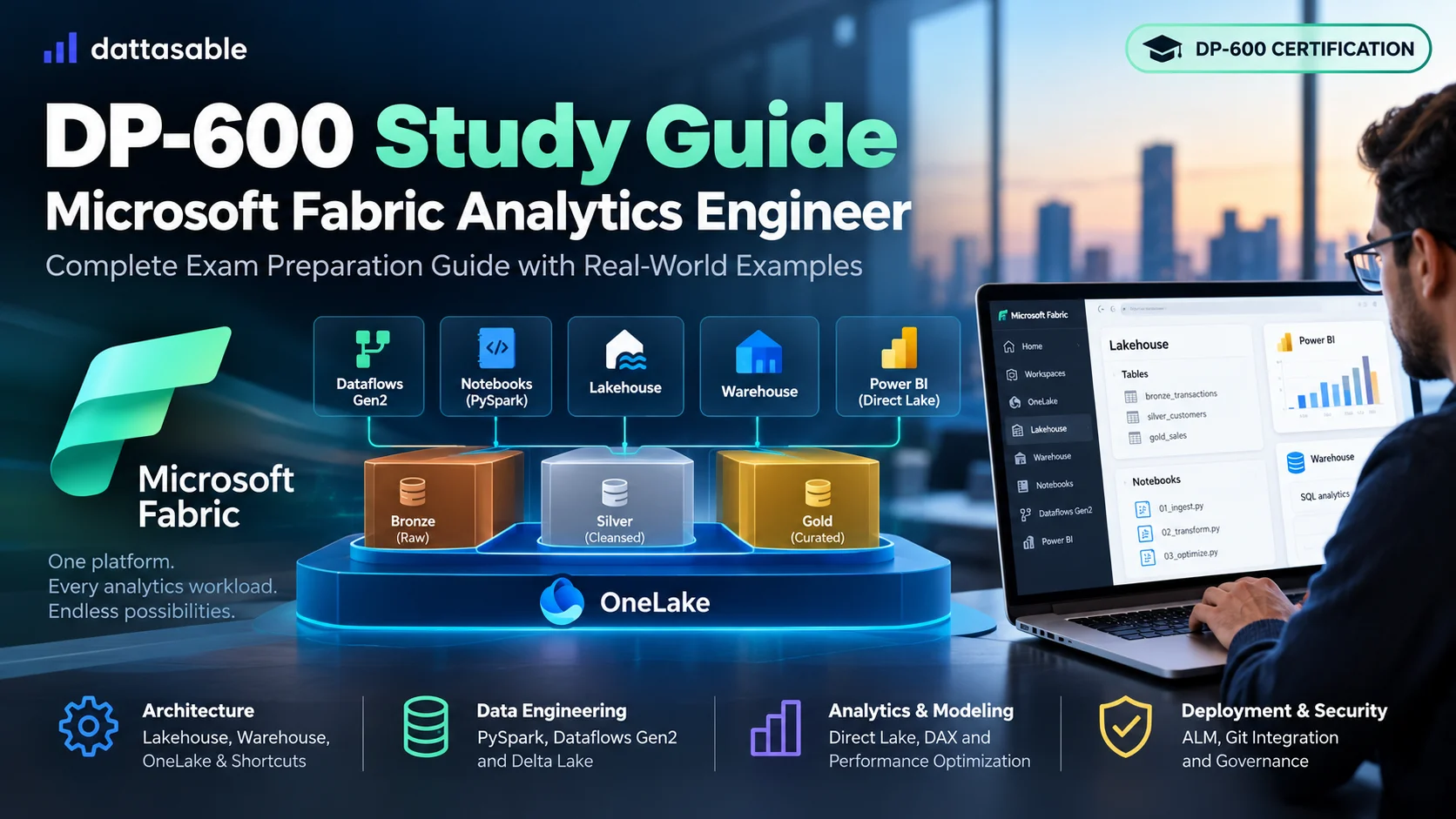

Microsoft Fabric has transformed enterprise analytics by combining data engineering, data warehousing, real-time intelligence, data integration, and Power BI into a unified SaaS platform. For professionals working with Power BI, SQL, enterprise reporting, and business intelligence, the Microsoft DP-600 exam — Implementing Analytics Solutions Using Microsoft Fabric validates the ability to design, implement, secure, optimize, and maintain analytical solutions.
However, passing DP-600 requires more than memorizing Microsoft Fabric features. You must understand how to select appropriate storage architectures, prepare analytical data, implement dimensional models, write efficient DAX, troubleshoot Direct Lake, enforce security, and manage enterprise analytics deployments. This guide combines the official October 2026 exam objectives with practical examples, architecture decisions, troubleshooting exercises, and a structured preparation roadmap.
1. Understanding the DP-600 Certification
The DP-600 exam is designed for analytics engineers responsible for creating and maintaining enterprise analytical solutions.
Typical responsibilities include:
- Designing analytical data architectures using Fabric Lakehouses and Warehouses.
- Preparing and transforming data for reporting.
- Creating dimensional models and enterprise semantic models.
- Implementing advanced DAX calculations.
- Configuring Direct Lake, Import, and DirectQuery storage modes.
- Managing security and governance across workspaces and items.
- Optimizing analytical queries and semantic model performance.
- Implementing version control and deployment processes.
Who should take DP-600?
DP-600 is particularly relevant to:
- Power BI Developers seeking enterprise analytics engineering accreditation
- Business Intelligence Analysts
- Analytics Engineers
- SQL Developers transitioning into Microsoft Fabric
- Data Warehouse Developers
- Enterprise Reporting Specialists
- Data Professionals managing analytical semantic models
Candidates should already understand relational databases, SQL, analytical data modeling, and Power BI fundamentals.
DP-600 versus PL-300 versus DP-700
Understanding the boundary between Microsoft Fabric certifications helps clarify study expectations:
| Certification | Primary Focus | Target Audience |
|---|---|---|
| PL-300 | Power BI data analysis, modeling, visualization, and report distribution | Power BI Analysts & BI Developers |
| DP-600 | Enterprise analytical solutions, lakehouses, warehouses, and semantic models | Fabric Analytics Engineers |
| DP-700 | Data engineering, distributed Spark processing, and lakehouse pipelines | Fabric Data Engineers |
These certifications overlap, but they validate different professional responsibilities. For example, a Power BI analyst might use PL-300 skills to create reports, DP-600 skills to design a governed enterprise semantic model, and DP-700 skills to implement upstream data engineering pipelines.
2. Official DP-600 Exam Domains — October 2026
Microsoft updated the DP-600 skills measured effective October 19, 2026. The current blueprint organizes skills into three core domains:
| Exam Domain | Weight |
|---|---|
| Maintain a data analytics solution | 25–30% |
| Prepare data | 45–50% |
| Implement and manage semantic models | 25–30% |
Important: These percentages represent Microsoft's published weighting ranges. The actual distribution of questions on exam day can vary.
Data preparation represents the largest portion, but semantic modeling, security, and lifecycle management remain essential for passing. Microsoft also expects hands-on proficiency across three primary query languages:
- SQL — querying and transforming relational data in Fabric Warehouses and SQL analytics endpoints.
- KQL — analyzing event, telemetry, and real-time streaming data in Eventhouses.
- DAX — creating analytical calculations and measures in enterprise semantic models.
Part I — Maintain a Data Analytics Solution
3. Microsoft Fabric Architecture Fundamentals
Microsoft Fabric provides a unified environment for storing, processing, analyzing, and visualizing enterprise data. Its major architectural components include:
- OneLake: The unified logical SaaS storage foundation built on open Delta-Parquet format.
- Lakehouse: Delta-based analytical storage supporting both Spark and SQL engine access.
- Warehouse: A relational analytical engine supporting standard multi-table T-SQL transactions.
- Data Factory: Data ingestion pipelines and visual Dataflows Gen2 transformation orchestration.
- Real-Time Intelligence: Eventstreams and Eventhouse KQL databases for streaming telemetry.
- Power BI: Enterprise semantic modeling, calculations, reporting, and interactive visualizations.
- Fabric Workspaces: Collaboration boundaries, role-based access control, and Git lifecycle management.
A typical enterprise analytics architecture follows this flow:
Enterprise Data Sources
        │
        ▼
Data Factory / Pipelines / Shortcuts / Mirroring
        │
        ▼
OneLake (Delta Lake Storage)
   ├── Bronze: Raw Ingestion (Append-Only)
   ├── Silver: Validated, Cleansed & Enriched
   └── Gold: Star Schema Analytical Tables
        │
        ▼
Star Schema / Direct Lake Semantic Model
        │
        ▼
Power BI Reports & Executive Dashboards
        │
        ▼
Informed Business Decisions
The bronze, silver, and gold layers represent a common architectural pattern (medallion architecture), not a mandatory Fabric configuration.
Why OneLake Matters
OneLake provides a single storage foundation that allows multiple Fabric workloads to operate on compatible Delta tables without requiring every analytical engine to maintain an independent copy. OneLake shortcuts can reference data stored in supported external locations (ADLS Gen2, AWS S3, Google Cloud Storage) or internal workspaces.
However, shortcuts should not be interpreted as guaranteeing zero network charges, universal compatibility, or automatic security equivalence across every source. Authentication, source permissions, shortcut capabilities, and cross-region network egress costs must be evaluated for the specific architecture.
4. Fabric Lakehouse vs Warehouse: Choosing the Right Architecture
One of the most heavily tested DP-600 skills is selecting the appropriate data store based on team skills, workload requirements, and data structure.
Lakehouse
A Fabric Lakehouse combines Delta Lake storage with analytical processing capabilities. It is the optimal choice when:
- Data arrives in multiple formats (structured, semi-structured JSON, unstructured).
- Engineers require Spark-based programmatic transformations (PySpark, Spark SQL, Scala).
- Data engineering and analytical workloads share Delta tables.
- Teams implement standard medallion architectures.
- Python notebooks are central to the processing workflow.
Warehouse
A Fabric Warehouse is optimized for relational analytical workloads. It is the optimal choice when:
- Teams rely heavily on standard T-SQL (DDL, DML, stored procedures, multi-table transactions).
- Analytical data follows structured relational schemas.
- SQL-based transformations (CTAS, INSERT-SELECT) are preferred over Spark.
- Fact and dimension tables are managed through relational operations and primary/foreign key constraints (enforced at model level).
- Enterprise reporting requires familiar relational data warehouse development workflows.
Architecture Decision Matrix
| Requirement | Lakehouse | Warehouse |
|---|---|---|
| Spark Transformations | Strong fit (native Spark notebooks) | Use Lakehouse for Spark processing |
| Relational T-SQL Development | Read-only via SQL endpoint | Strong fit (full DDL/DML support) |
| Semi-Structured Ingestion (JSON) | Strong fit | Transform before relational loading |
| Dimensional Reporting | Supported | Strong fit |
| Delta Table Storage | Yes (native Delta Parquet) | Yes (Delta Parquet under the hood) |
| Direct Lake Semantic Modeling | Supported (Direct Lake on OneLake) | Supported (Direct Lake on SQL endpoint) |
| Python Notebook Workflows | Strong fit | Use separate Spark workloads |
Exam Scenario: A financial organization receives transactional CSV files, JSON application logs, and structured customer records. Engineers need Spark transformations before publishing curated analytical tables.
Recommendation: A Lakehouse is the right candidate for ingestion and transformation, while a Warehouse may be appropriate for serving a curated relational reporting layer. The correct choice depends on the processing requirements, not simply dataset volume.
5. Security and Governance in Fabric
Enterprise analytics security involves several distinct layers that candidates must master.
Workspace Access
Fabric workspace roles include:
- Admin: Full control, user permissions, delete workspace, assign capacity.
- Member: Add members/contributors, create and edit items, share items.
- Contributor: Create and edit items, cannot modify workspace membership.
- Viewer: Read-only access to items, execute reports, read underlying data if permitted.
Always apply the principle of least-privilege access.
Item-Level Access
Users may receive permissions on individual Fabric items (e.g., Read on a Semantic Model or View on a Report) without receiving broad access to every item in a workspace. This distinction is critical when sharing reports with business stakeholders.
Row-Level Security (RLS)
Row-Level Security restricts the rows visible to a user based on their identity or role.
Example Scenario: A sales organization has three regional managers. Each manager should see only transactions associated with their assigned region. A static DAX role filter is:
'DimRegion'[Region] = "West"
For scalable enterprise deployments, implement a dynamic security table mapping user email addresses (USERPRINCIPALNAME()) to regions rather than maintaining separate static roles.
Object-Level Security (OLS)
Object-Level Security restricts access to sensitive tables or specific columns (e.g., salary, margins) so that unauthorized users cannot even discover the existence of those columns in the semantic model.
Governance & Access Controls
DP-600 candidates should also understand:
- Sensitivity Labels: Microsoft Purview Information Protection labels applied to Fabric items.
- Endorsement: Promoting items (visible to all) vs. Certifying items (requires tenant admin authorization).
- OneLake Data-Access Controls: Enforcing file and folder permissions directly in storage.
- Lineage & Impact Analysis: Visualizing upstream dependencies and downstream report impacts.
Critical Distinction: Semantic model security, SQL endpoint security, and OneLake security are not interchangeable. The security mechanism must match the specific access path used by the analytical solution.
6. Version Control and Analytics Lifecycle Management
Enterprise analytics solutions require repeatable, automated deployment processes.
Developer Workspace
        │
        ▼
Git Branch / Pull Request (GitHub or Azure DevOps)
        │
        ▼
Code Review & Automated Validation
        │
        ▼
Development Workspace ──► Test Workspace ──► Production Workspace
                          (Deployment Pipelines)
PBIP and TMDL
- Power BI Project (.pbip): Saves report and semantic model definitions as human-readable folder structures rather than binary .pbix blobs.
- Tabular Model Definition Language (TMDL): Text-based syntax for tabular model metadata. TMDL allows developers to review DAX measure changes, table additions, and relationship edits line by line in Git pull requests.
Deployment Pipelines
Deployment pipelines automate promotion across Development, Test, and Production stages. Deployment rules allow connection strings and parameter values to switch automatically between environments. Note that capacity assignment and workspace governance should be managed explicitly.
XMLA Endpoint
The XMLA endpoint allows external tools (Tabular Editor 3, DAX Studio, ALM Toolkit) and CI/CD pipelines to manage semantic models, execute partition processing, and automate schema updates.
Part II — Prepare Data for Analytics
7. Data Discovery and Connection Management
The October 2026 blueprint explicitly highlights data discovery. Candidates should be proficient in:
- Creating and managing cloud and on-premises data connections.
- Discovering organizational data assets through the OneLake catalog.
- Discovering live streams and telemetry through the Real-Time hub.
- Selecting appropriate analytical stores without unnecessary data duplication.
Scenario: An organization has historical sales in SQL Server, customer master data in Azure SQL, event telemetry from web apps, and Parquet files in S3. Rather than running blind copy pipelines for everything, an architect combines shortcuts for S3 Parquet, mirroring for Azure SQL, eventstreams for web telemetry, and scheduled pipelines for legacy SQL Server.
8. Preparing Data with SQL
SQL remains a central skill for DP-600. Candidates must write and optimize analytical queries in Fabric Warehouses and SQL analytics endpoints.
Example: Monthly Sales and Margin Summary Query
SELECT
    YEAR(OrderDate) AS SalesYear,
    MONTH(OrderDate) AS SalesMonth,
    COUNT(DISTINCT OrderID) AS TotalOrders,
    SUM(SalesAmount) AS TotalRevenue,
    SUM(CostAmount) AS TotalCost,
    SUM(SalesAmount - CostAmount) AS GrossProfit
FROM dbo.FactSales
WHERE OrderDate IS NOT NULL
GROUP BY YEAR(OrderDate), MONTH(OrderDate)
ORDER BY SalesYear, SalesMonth;
Business Interpretation: If total revenue increases month-over-month while gross profit declines, analytics engineers should investigate cost increases, supplier price drift, or margin-diluting discount campaigns.
9. Data Quality: Nulls, Duplicates, and Type Conversion
Analytical models require clean, validated source tables. A diagnostic query identifies duplicate transaction business keys:
SELECT
    TransactionID,
    COUNT(*) AS DuplicateCount
FROM dbo.Transactions
GROUP BY TransactionID
HAVING COUNT(*) > 1;
Data Quality Validation Framework
| Validation Dimension | Engineering Purpose |
|---|---|
| Uniqueness | Detect duplicate primary business keys in fact and dimension tables |
| Completeness | Identify missing required values and foreign key nulls |
| Validity | Check value ranges (e.g., negative prices, invalid postal codes) |
| Referential Integrity | Confirm that all fact foreign keys exist in dimension tables |
| Reconciliation | Compare upstream transactional totals with analytical reporting sums |
| Freshness | Verify data arrival timestamps and SLA compliance |
10. Implementing a Star Schema
A star schema organizes analytical data into central numeric fact tables and surrounding descriptive dimension tables:
            ┌─────────────┐
            │   DimDate   │
            └──────┬──────┘
                   │
┌─────────────┐    │    ┌──────────────┐
│ DimCustomer ├────┼────┤  DimProduct  │
└─────────────┘    │    └──────────────┘
                   │
            ┌──────┴──────┐
            │  FactSales  │
            └──────┬──────┘
                   │
            ┌──────┴──────┐
            │  DimRegion  │
└─────────────┘- Fact Table (
FactSales): Contains granular transactional metrics (Quantity,Revenue,Cost) and foreign keys (DateKey,CustomerKey,ProductKey,RegionKey). - Dimension Tables (
DimDate,DimProduct, etc.): Contain context attributes used to filter, slice, and group metrics.
Common Modeling Mistake: Flattening everything into a single wide table. While wide tables work for simple reporting, they duplicate repetitive text, inflate memory usage, and complicate DAX time intelligence.
11. Querying Data with KQL
Kusto Query Language (KQL) is used in Fabric Real-Time Intelligence workloads. The DP-600 blueprint includes querying and analyzing data with KQL in Eventhouses:
WebEvents
| where Timestamp >= ago(24h)
| summarize EventCount = count() by EventType
| order by EventCount desc
SQL vs. KQL: SQL is built for relational sets and transactional operations; KQL is optimized for high-velocity streaming logs, time-series telemetry, and event aggregation.
Part III — Implement and Manage Semantic Models
12. Understanding Power BI Semantic Models
A semantic model standardizes business metrics across an entire organization. It contains tables, relationships, DAX measures, hierarchies, calculation groups, perspective definitions, and security roles. Standardizing measures in the model guarantees that metrics like Gross Margin % report identical values regardless of which user builds the visual.
13. Import vs DirectQuery vs Direct Lake
Selecting the correct storage mode is a core DP-600 competency:
| Feature | Import Mode | DirectQuery Mode | Direct Lake Mode |
|---|---|---|---|
| Data Access | Loaded into compressed VertiPaq memory | Pushes SQL queries to source on demand | Loads Delta Parquet column chunks into memory on demand |
| Data Freshness | Requires scheduled or triggered refresh | Real-time (query latency dependent) | Near real-time (Delta table framing) |
| Performance | Fastest in-memory query response | Slower; depends on source database | Near-Import speed; zero data duplication |
| Dataset Limit | Constrained by model RAM limits | Source capacity bounds | Fabric capacity memory guardrails |
| Modeling Flexibility | Full DAX and calculated table support | Restricted DAX functions | High; best practice avoids calculated columns |
14. Direct Lake on OneLake vs Direct Lake on SQL Analytics Endpoints
CRITICAL OCTOBER 2026 BLUEPRINT DISTINCTION: Microsoft differentiates between the two Direct Lake implementation patterns:
| Capability | Direct Lake on OneLake | Direct Lake on SQL Analytics Endpoint |
|---|---|---|
| DirectQuery Fallback | NO (Queries fail if unsupported) | YES (Falls back to DirectQuery via SQL) |
| SQL Endpoint Dependency | None (bypasses SQL engine entirely) | Requires healthy SQL analytics endpoint |
| SQL Views as Tables | Not supported (Delta tables only) | Views trigger DirectQuery fallback |
| Composite Modeling | Supported with documented constraints | More restricted |
| Security Integration | OneLake & semantic model security | SQL endpoint & semantic model security |
Microsoft recommends Direct Lake on OneLake for new semantic models where its capabilities fit the requirements.
When using Direct Lake on SQL endpoints, the DirectLakeBehavior property governs fallback:
Automatic: Silently falls back to DirectQuery when Direct Lake guardrails or features are exceeded.DirectLakeOnly: Prevents fallback; errors out immediately so developers can diagnose the issue.DirectQueryOnly: Forces DirectQuery execution (useful for benchmark comparisons).
15. Diagnosing Direct Lake Fallback
Common triggers that cause Direct Lake on SQL to fall back to DirectQuery include:
- Row-Level Security (RLS) configured on the SQL endpoint.
- SQL Dynamic Data Masking rules.
- Unmaterialized SQL views included in the model.
- Exceeding capacity memory thresholds (paging limits).
- Tables not framed to the latest Delta snapshot.
Diagnostic DAX
To inspect fallback reasons across tables in a model, execute:
EVALUATE TABLETRAITS()
Troubleshooting Procedure: Identify the table in TABLETRAITS() $ o$ check whether it is a view $ o$ inspect SQL security definitions $ o$ check memory guardrails $ o$ frame the model $ o$ re-run diagnostics.
16. DAX Measures: From Fundamentals to Advanced Analytics
DAX constitutes 25–30% of DP-600. Here are essential production measures:
Core Financial Measures
// Basic Aggregations
Total Revenue = SUM('FactSales'[Revenue])
Total Cost = SUM('FactSales'[Cost])
Gross Profit = [Total Revenue] - [Total Cost]

// Safe Division
Gross Margin % = DIVIDE([Gross Profit], [Total Revenue], 0)

// Average Order Value
Average Order Value = DIVIDE([Total Revenue], DISTINCTCOUNT('FactSales'[OrderID]), 0)
Filter Context Modification (CALCULATE & KEEPFILTERS)
Electronics Revenue =
CALCULATE(
    [Total Revenue],
    KEEPFILTERS('DimProduct'[Category] = "Electronics")
)
Time Intelligence with Safe Handling
Revenue Previous Year =
CALCULATE(
    [Total Revenue],
    SAMEPERIODLASTYEAR('DimDate'[Date])
)

Revenue YoY % =
VAR CurrentRev = [Total Revenue]
VAR PrevRev = [Revenue Previous Year]
RETURN
DIVIDE(CurrentRev - PrevRev, PrevRev)
Iterators (SUMX)
Revenue from Line Items =
SUMX(
    'FactSales',
    'FactSales'[Quantity] * 'FactSales'[UnitPrice]
)
17. Relationships, Bridge Tables and Many-to-Many Modeling
When modeling a many-to-many relationship (e.g., customers belonging to multiple dynamic segments), use a bridge table:
┌─────────────┐        ┌───────────────────────┐        ┌────────────┐
│ DimCustomer │ 1 ──*  │ CustomerSegmentBridge │  *── 1 │ DimSegment │
└─────────────┘        └───────────────────────┘        └────────────┘
Exam Trap: Avoid blindly setting relationships to bidirectional filtering. Bidirectional relationships can introduce ambiguous filter paths and cause metric duplication across related fact tables.
18. Optimizing Semantic Model Performance
- Model Level: Remove unused columns, replace high-cardinality GUIDs, disable auto date/time, prefer integer surrogate keys.
- DAX Level: Cache repeated sub-expressions in
VARvariables, avoidFILTER(ALL(Table))when filtering single columns, useDIVIDE()instead of/. - Report Level: Limit visuals per page, review visual query timings in Performance Analyzer, avoid high-cardinality slicers.
Part IV — Hands-On DP-600 Practice Lab
19. End-to-End Enterprise Sales Analytics Project
To solidify your skills before exam day, build an end-to-end sales analytics project:
- Lab 1: Prepare Analytical Tables: In a Fabric Lakehouse, create
FactSales,DimDate,DimCustomer,DimProduct, andDimRegionDelta tables. - Lab 2: Implement Business Calculations: Build measures for Total Revenue, Gross Margin %, Average Order Value, and YoY Growth. Reconcile results with SQL queries.
- Lab 3: Configure Security: Implement dynamic RLS using
USERPRINCIPALNAME(). Validate user role behavior. - Lab 4: Evaluate Direct Lake: Connect Power BI to the Gold Lakehouse via Direct Lake mode. Execute
TABLETRAITS()to verify zero fallback. - Lab 5: Lifecycle & Git: Save the model in PBIP format, commit to a Git branch, and promote through a deployment pipeline.
Part V — DP-600 Practice Questions
Question 1: Architecture Selection
Scenario: An organization requires Spark transformations over semi-structured JSON files and wants to expose curated Delta tables for reporting. Which Fabric storage architecture is most appropriate?
Options: A) Import-only semantic model | B) Lakehouse | C) Power BI report | D) Deployment pipeline
Answer: B — Lakehouse. A Fabric Lakehouse natively supports Spark compute, semi-structured ingestion, and Delta table storage.
Question 2: Direct Lake Fallback
Scenario: A semantic model uses Direct Lake on OneLake. An operation encounters a condition that prevents Direct Lake execution. What happens?
Options: A) It switches to Import | B) It automatically switches to DirectQuery | C) It returns an error because DirectQuery fallback is unavailable | D) It creates a SQL view
Answer: C. Direct Lake on OneLake does not support DirectQuery fallback; queries fail if requirements are not met.
Question 3: DAX Filter Context
Scenario: You need a measure that calculates revenue only for the Electronics category while respecting existing report slicers. Which function is central to modifying filter context?
Options: A) SUMMARIZECOLUMNS | B) CALCULATE | C) RELATEDTABLE | D) FORMAT
Answer: B — CALCULATE. CALCULATE evaluates an expression within a modified filter context.
Question 4: Security
Scenario: A company needs regional sales managers to see only transactions for their assigned regions. Which feature is most directly applicable?
Options: A) Dynamic format strings | B) Row-Level Security | C) Calculation groups | D) Incremental refresh
Answer: B — Row-Level Security (RLS). RLS restricts row visibility based on user roles and identity.
Question 5: Dimensional Modeling
Scenario: A fact table contains millions of rows with repetitive product brand and category text. Which design improves model efficiency?
Options: A) Duplicate all columns | B) Remove relationships | C) Implement a star schema with a product dimension | D) Convert all numbers to text
Answer: C. A star schema normalizes descriptive attributes into dimension tables, reducing fact table width and memory footprint.
Question 6: Lifecycle Management
Scenario: A development team wants to review semantic model metadata changes line by line in Git pull requests. Which format is particularly relevant?
Options: A) JPEG | B) TMDL | C) CSV only | D) PDF
Answer: B — TMDL. Tabular Model Definition Language represents model metadata as structured, human-readable text.
Question 7: KQL Querying
Scenario: Which operator performs grouped aggregation in KQL?
Options: A) summarize | B) calculate | C) pivotchart | D) relate
Answer: A — summarize. The summarize operator calculates grouped aggregations like count(), sum(), or avg().
Question 8: Troubleshooting
Scenario: A Direct Lake on SQL semantic model unexpectedly begins issuing DirectQuery operations. What should the engineer investigate first?
Options: A) Report background color | B) Fallback diagnostics (e.g., TABLETRAITS()) and underlying table conditions | C) Title length | D) Workspace description
Answer: B. Executing EVALUATE TABLETRAITS() identifies whether views, RLS, or capacity memory limits triggered the fallback.
Part VI — Four-Week DP-600 Study Plan
| Week | Focus Areas | Practical Milestone |
|---|---|---|
| Week 1 | Fabric Architecture, OneLake, Lakehouse vs Warehouse, Security (RLS/OLS), PBIP, TMDL, Git | Configure a Fabric workspace with least-privilege security and Git synchronization. |
| Week 2 | Data Discovery, OneLake Catalog, Real-Time Hub, SQL Transformation, KQL, Star Schema | Build a curated Gold Lakehouse and validate data quality with SQL. |
| Week 3 | Direct Lake vs Import, Direct Lake on OneLake vs SQL, DAX Measures, Bridge Tables | Create an enterprise semantic model with validated business KPIs. |
| Week 4 | Direct Lake Diagnostics, Performance Analyzer, Lifecycle Pipelines, Practice Questions | Execute TABLETRAITS() diagnostics, optimize slow visuals, take official practice exam. |
Part VII — Common DP-600 Mistakes to Avoid
- Mistake 1: Treating DP-600 as a Power BI visual exam. DP-600 focuses on data architecture, Lakehouse engineering, and enterprise semantic modeling, not report cosmetic formatting.
- Mistake 2: Assuming Direct Lake always falls back to DirectQuery. Direct Lake on OneLake does NOT support fallback; operations fail if conditions are not satisfied.
- Mistake 3: Ignoring KQL. Real-Time Intelligence and KQL queries are explicitly measured in the October 2026 blueprint.
- Mistake 4: Memorizing DAX syntax without understanding filter context. Exam questions test how measures behave when filtered by relationships and slicers.
- Mistake 5: Neglecting Fabric governance. Sensitivity labels, endorsement, workspace roles, and deployment pipelines make up a full 25–30% of the exam.
- Mistake 6: Confusing Import refresh with Direct Lake framing. Direct Lake references existing Delta Parquet files in OneLake without importing data into memory.
- Mistake 7: Skipping practical validation. Always reconcile analytical measure outputs with SQL source aggregations.
Part VIII — Frequently Asked Questions
Is DP-600 difficult?
DP-600 is an associate-level exam, but it is technically rigorous because it spans data engineering, SQL, Lakehouses, Warehouses, DAX, and security. Candidates with strong Power BI and SQL experience have a solid foundation.
Is PL-300 required before DP-600?
No. PL-300 is not a prerequisite. However, the data modeling and DAX skills tested in PL-300 provide valuable preparation.
Does DP-600 require Python?
Basic familiarity with PySpark notebooks is helpful, but the exam emphasizes SQL, KQL, and DAX for data transformation and analysis.
What is the passing score for DP-600?
Microsoft requires a scaled passing score of 700 out of 1000.
How long is the certification valid?
The Microsoft Certified: Fabric Analytics Engineer Associate certification is valid for one year and can be renewed annually for free via Microsoft Learn.
Final DP-600 Preparation Checklist
- [x] Explain the purpose and trade-offs of OneLake, Lakehouses, and Warehouses.
- [x] Select appropriate storage and ingestion paths (Pipelines, Shortcuts, Mirroring).
- [x] Implement data quality checks and deduplication in SQL.
- [x] Write analytical KQL queries with
whereandsummarize. - [x] Design and implement an optimized star schema.
- [x] Create robust DAX measures using
CALCULATE,DIVIDE, and time intelligence. - [x] Differentiate between Direct Lake on OneLake and Direct Lake on SQL.
- [x] Diagnose Direct Lake fallback triggers using
EVALUATE TABLETRAITS(). - [x] Implement Row-Level Security (RLS) and Object-Level Security (OLS).
- [x] Configure Git integration, PBIP, TMDL, and deployment pipelines.
Primary references
- Official Microsoft DP-600 Exam Study Guide
- Microsoft Fabric Documentation Overview
- Microsoft Fabric Direct Lake Overview
- Microsoft Fabric OneLake Architecture Guide
- Microsoft Fabric Direct Lake Performance & Fallback Elimination
- Microsoft Fabric Architecture Explained
- Datta Sable Analytics Portfolio
- Open MIS Executive Analytics Simulator
Author: Datta Sable — Senior Business Intelligence & Analytics Engineer
Editorial Note: This is an independent educational study guide and is not affiliated with or endorsed by Microsoft Corporation. Product features and certification blueprints are subject to change.