
Microsoft Fabric is creating entirely new career opportunities, but most professionals are still unsure which path to follow. In 2026, the consolidation of enterprise data operations into unified Software-as-a-Service (SaaS) platforms has accelerated. For Power BI professionals, SQL developers, data analysts, and cloud engineers, this paradigm shift means that traditional roles are morphing. Deciding on a career path and its corresponding learning roadmap—whether targeting the DP-600, DP-700, or the new DP-800 certification—can either propel your career forward or result in months of wasted effort. This ultimate guide maps out the 2026 Microsoft Fabric landscape to help you choose the right path for your technical background, salary goals, and interest areas.
The enterprise data landscape is moving faster than ever. Historically, a data team was a collection of fragmented roles using disjointed tools. Data engineers wrote custom Python and Scala scripts in Apache Spark to move raw files. Database administrators configured indexes on relational data warehouses. BI developers built complex calculations in proprietary desktop applications. And AI specialists spent days trying to connect local machine learning models to enterprise databases.
This fragmentation created what is known as the "data copy tax"—an architectural burden where the same data is copied, transformed, and stored multiple times to serve different user needs. Microsoft Fabric was designed to eliminate this tax by introducing a single, unified, SaaS-based data lake known as OneLake. By storing all enterprise data in open-source Delta Parquet format, Fabric allows multiple specialized compute engines to query the same data concurrently without creating copies.
Because the technical barriers of connecting these tools have been abstracting away, the boundaries between roles have blurred. In this new era, success is not determined by how many tools you can connect, but by how well you can optimize value within a unified data fabric. If you're a data professional or an aspiring career switcher, understanding this roadmap is crucial to identifying your high-value specialization in the 2026 job market.
Table of Contents
- What is Microsoft Fabric?
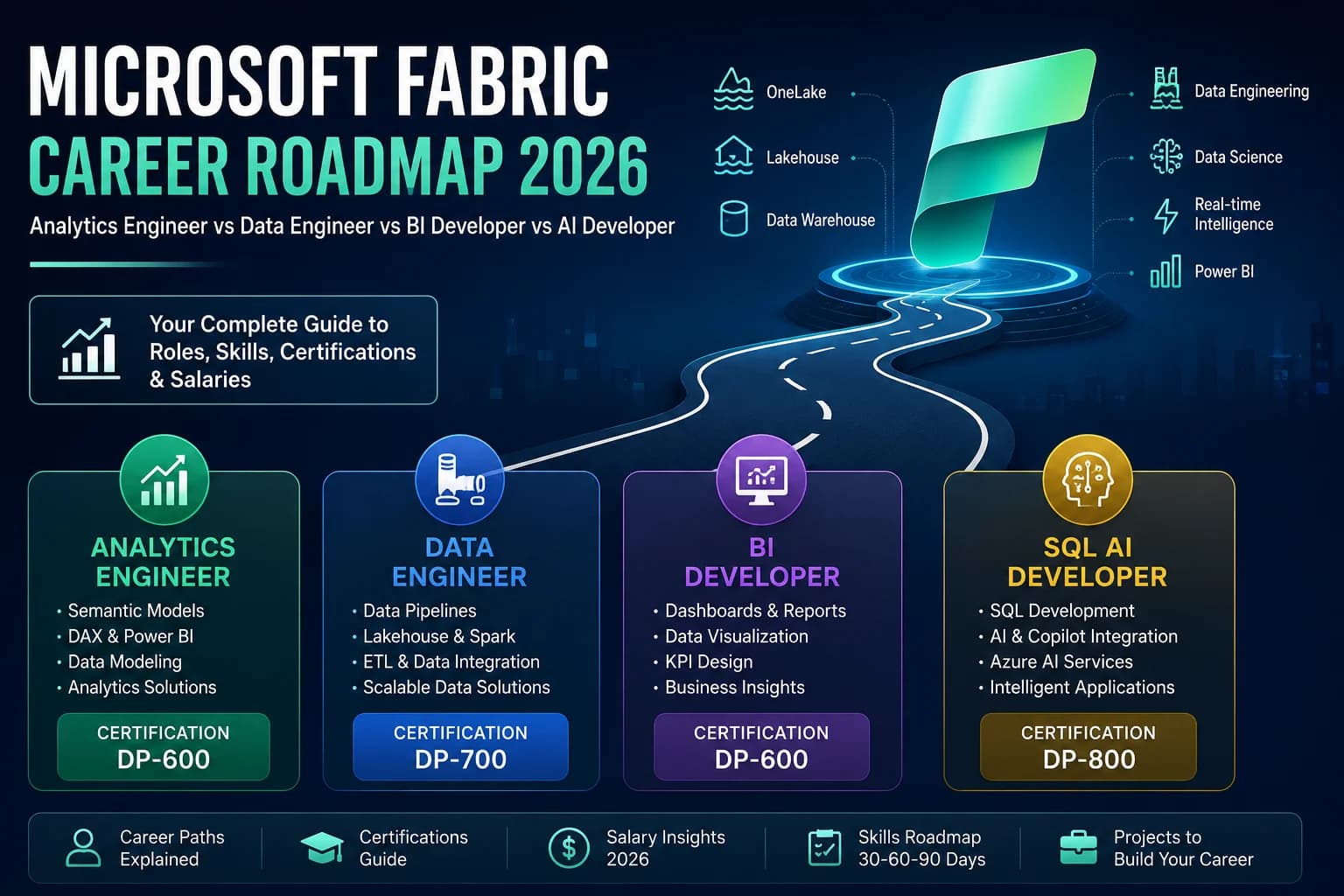
- The Four Major Microsoft Fabric Career Paths
- Career Path 1: Analytics Engineer
- Career Path 2: Data Engineer
- Career Path 3: BI Developer
- Career Path 4: SQL AI Developer
- Certification Decision Matrix
- Salary Guide 2026
- Skills Roadmap
- Common Mistakes to Avoid
- Frequently Asked Questions
Why Trust This Guide?
I have spent 10+ years working across MIS, BI, SQL, Power BI, reporting automation, and enterprise analytics solutions. This roadmap combines official Microsoft documentation, active industry hiring trends, certification paths, and practical, hands-on experience designing and migrating data platforms.
What is Microsoft Fabric? A Unified SaaS Architecture
To understand where you fit in the roadmap, you must understand the underlying structure of Microsoft Fabric. Fabric is not just a bundle of old Azure services rebranded under a new UI. It is an entirely redesigned SaaS platform centered around a single unified data virtualizer: OneLake.
OneLake acts as the "OneDrive for Data." It provides a single storage repository where all files, tables, and unstructured data are stored. Beneath the surface, OneLake stores all structured data in Delta Parquet format. Delta Parquet is an open-source, column-oriented storage format that supports ACID transactions, history versioning, and high-performance querying.
On top of OneLake, Microsoft Fabric deploys specialized compute engines. The primary engines include:
- Lakehouse: A data store that combines the rich metadata and schema enforcement of a relational warehouse with the cheap, file-based storage of a data lake. It is optimized for Spark engines.
- Data Warehouse: A fully transactional SQL warehouse that uses traditional T-SQL syntax and supports full DDL/DML capabilities, optimized for relational database professionals.
- Data Engineering: The compute engine designed for running scalable Spark notebooks (PySpark, Spark SQL, Scala, and Java) to process big data workloads.
- Data Science: Built-in machine learning workspaces that integrate with Azure ML, allowing data scientists to build, train, and track experiments using MLflow.
- Real-Time Intelligence: An engine designed to ingest and query high-velocity streaming data from IoT devices, user clicks, and system logs in real-time, leveraging Kusto Query Language (KQL).
- Power BI: The visualization engine that leverages the unique Direct Lake mode, querying the Delta Parquet files in OneLake directly without importing data or converting it to DirectQuery.
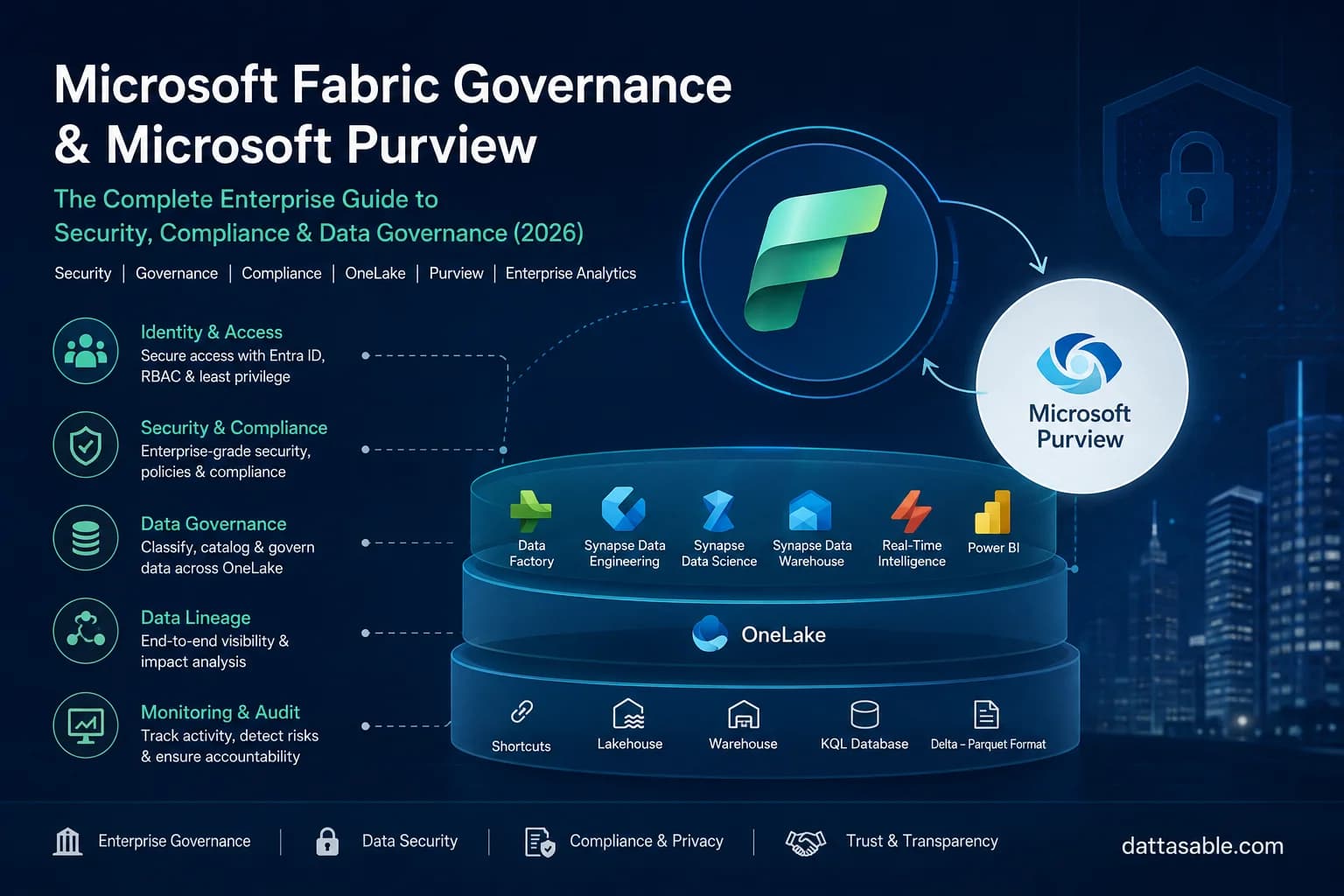
This architecture is visualized in the diagram below:
graph TD
A[OneLake - Delta Parquet Storage]
A --> B[Data Engineering - Synapse Spark]
A --> C[Data Warehouse - Synapse SQL]
A --> D[Data Science - Machine Learning]
A --> E[Real-Time Intelligence - KQL]
A --> F[Power BI - Direct Lake]
For data teams, this architecture means that the Data Engineer can write Spark code to load data into a Lakehouse, the SQL Developer can run T-SQL queries against the SQL Endpoint of that same Lakehouse, the Analytics Engineer can define semantic models on top of those tables, and the BI Developer can render dashboards—all querying the exact same physical Delta Parquet file in OneLake. This eliminates the latency, cost, and synchronization issues associated with copying data across environments.
The Four Major Microsoft Fabric Career Paths
In 2026, the Microsoft Fabric ecosystem has stabilized around four major career personas. While there is overlap, each path requires different technical depths and delivers different business outcomes.
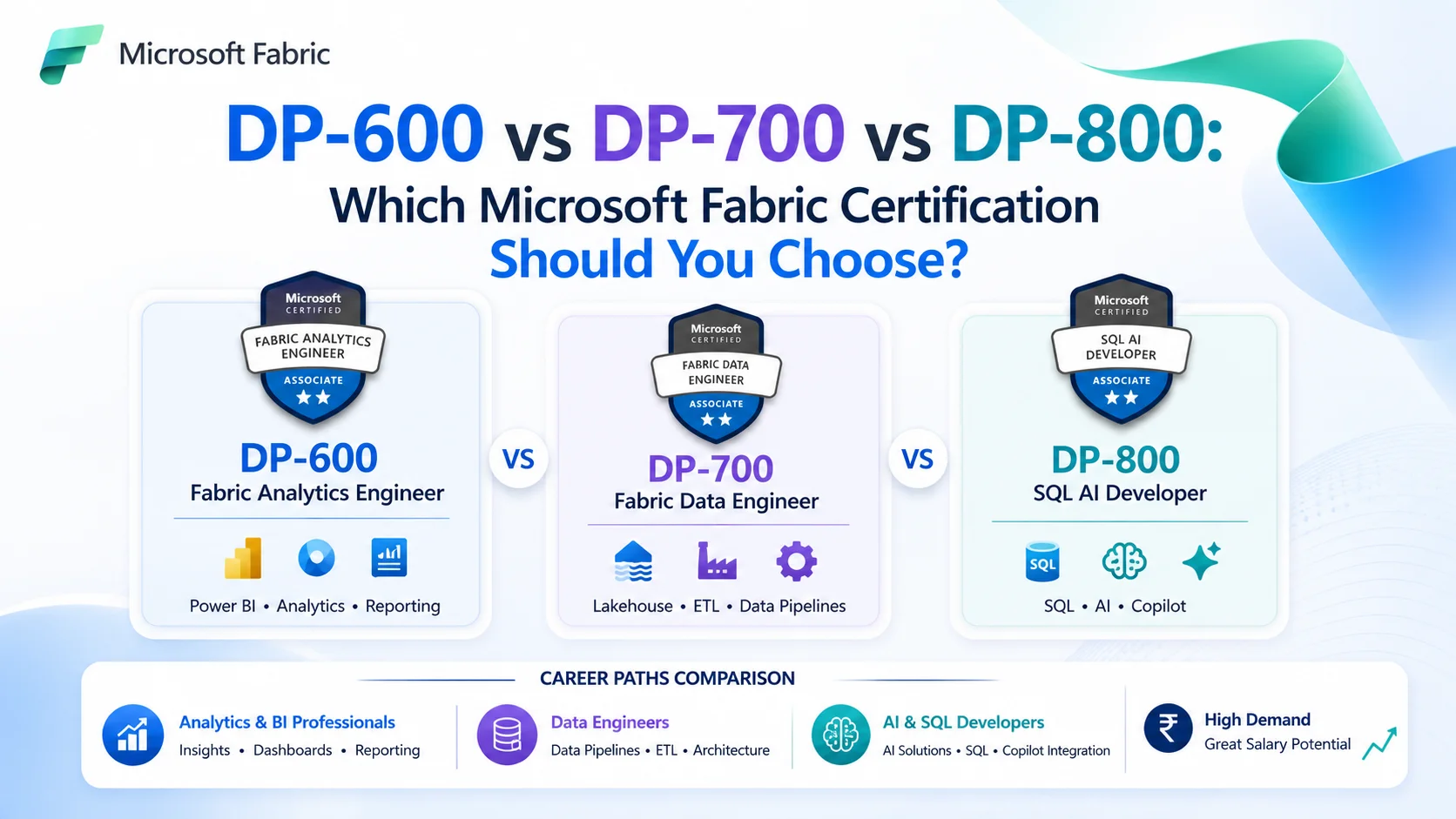
Visual Comparison Grid: DP-600 vs DP-700 vs DP-800 Paths
| Role | Primary Technical Focus | Typical Coding Proficiency | Averaged Global Demand | Recommended Certification |
|---|---|---|---|---|
| Analytics Engineer | Direct Lake semantic models, star schema design, complex DAX, SQL views, and Git integration. | Intermediate (SQL & DAX) | Very High (rapidly expanding) | DP-600 |
| Data Engineer | PySpark notebooks, Medallion layer transformations, Delta Lake performance tuning, and Data Factory pipeline orchestration. | High (Python, SQL & Spark) | Critical (foundational) | DP-700 |
| BI Developer | UX/UI design, interactive reporting, stakeholder requirements gathering, and mobile-friendly dashboards. | Low-Intermediate (DAX & SQL) | High (business-facing) | PL-300 or DP-600 |
| SQL AI Developer | Vector database configurations, Azure OpenAI integration, semantic indexing, real-time alerting, and RAG architectures. | High (SQL, Python & API integration) | Exponential (emerging trend) | DP-800 |
Career Path 1: Analytics Engineer (The Bridge)
The Analytics Engineer is the most rapidly growing role in the modern data stack. Positioned squarely between the infrastructure-heavy Data Engineer and the business-facing BI Developer, the Analytics Engineer is responsible for taking clean datasets from the data lake and transforming them into optimized, high-fidelity semantic models that business users can consume safely.
Daily Responsibilities and Typical Projects
If you choose this path, your daily workflow will involve designing, building, and maintaining the enterprise semantic layer. Instead of just building reports, your project is the "data model itself." Typical projects include:
- Designing optimal star schemas (fact and dimension tables) within Fabric Lakehouses or Data Warehouses to replace legacy, unmanageable "flat" tables.
- Writing complex, performant DAX measures for financial modeling, cohort analysis, or time-intelligence operations.
- Configuring Direct Lake semantic models, ensuring that Power BI reports query the files directly in OneLake to avoid slow DirectQuery fallback or high import refresh overhead.
- Setting up Row-Level Security (RLS) and Object-Level Security (OLS) to ensure that sensitive data (such as HR salaries or region-locked sales) is masked before reaching dashboards.
- Managing version control for BI models, using Git integration in Microsoft Fabric to push changes from local developer workspaces to testing and production environments.
Core Technical Skills
To succeed as an Analytics Engineer, you must master three primary components:
- Advanced SQL: You must know how to write window functions, CTEs (Common Table Expressions), and complex joins to clean and pre-aggregate data before loading it into your semantic model.
- DAX (Data Analysis Expressions): Understanding evaluation contexts (Filter Context vs. Row Context), context transition, and performance tuning DAX calculations is a non-negotiable requirement.
- Data Modeling Concepts: You must master Star Schema modeling, dimensional modeling, slowly changing dimensions (SCD Type 1 and Type 2), and optimization of relationships (active vs. inactive, single vs. bi-directional filtering).
Certification & Salary Expectations
The primary validation for this path is the DP-600 (Fabric Analytics Engineer Associate) exam. The exam tests your ability to plan, implement, and manage data analytics solutions using Microsoft Fabric.
- India: ₹8,00,000 - ₹18,00,000 per annum (increases significantly with Direct Lake optimization experience)
- United States: $95,000 - $145,000 / year
- Europe (UK & Germany): £55,000 - £90,000 / year
Pros & Cons
Pros: Excellent bridge role for Power BI developers who want to move into coding; highly valued because they directly impact report load speed and usability; highly cross-functional.
Cons: Can catch blame from both sides (engineers complaining about bad queries, business users complaining about slow dashboards); requires deep logical thinking to solve context-transition bugs in DAX.
---Career Path 2: Data Engineer (The Builder)
The Data Engineer builds the scalable infrastructure that makes analytics possible. They are responsible for data collection, ingestion, storage architecture, performance tuning, and enterprise data governance. Without a skilled Data Engineer, the data lake quickly devolves into an unmanaged "data swamp."
Daily Responsibilities and Typical Projects
As a Data Engineer, you will spend your day designing pipelines and writing code to orchestrate, transform, and manage big data. Typical projects include:
- Building ingestion pipelines in Data Factory using Copy activities, Web hooks, and Dataflows Gen2 to pull data from legacy on-premises databases, SaaS platforms, and external APIs.
- Writing scalable Apache Spark notebooks (using PySpark or Spark SQL) to clean, de-duplicate, and structure raw Bronze files into Silver tables and Gold Delta tables.
- Implementing the Medallion Architecture within a Fabric Lakehouse to ensure strict data validation and structure separation.
- Configuring compute capacities, defining autoscaling rules, managing Spark pool allocations, and optimizing tenant costs to keep cloud bills manageable.
- Designing enterprise-wide data governance, managing workspace access permissions, configuring managed private endpoints, and auditing pipeline logs.
A typical data engineering pipeline workflow is visualized in the diagram below:
flowchart LR
A[Source Systems - APIs, DBs] -->|Data Factory Pipeline| B[Bronze Lakehouse - Raw Files]
B -->|Spark Notebook - Clean & Validate| C[Silver Lakehouse - Structured Delta]
C -->|Spark Notebook - Aggregations| D[Gold Lakehouse - Reporting Tables]
D -->|Direct Lake Connection| E[Power BI Reporting Layer]
Core Technical Skills
To excel as a Fabric Data Engineer, you need a strong programming background:
- Python/PySpark: Python is the lingua franca of data engineering. You must understand how to leverage Spark DataFrames to read, transform, and write data at scale.
- Data Orchestration: You must know how to design parent-child pipeline workflows, configure loops (For Each), handle errors gracefully, and schedule pipelines based on time or event triggers.
- Delta Lake Mechanics: You need to understand transaction logs, table optimization (using commands like OPTIMIZE and VACUUM), partitioning strategies, and Microsoft's proprietary V-Order sorting to accelerate downstream read performance.
Certification & Salary Expectations
The target credential for this path is the DP-700 (Fabric Data Engineer Associate) exam. This exam validates your competence in building and managing secure, scalable data engineering solutions in Microsoft Fabric.
- India: ₹10,00,000 - ₹24,00,000 per annum
- United States: $115,000 - $175,000 / year
- Europe (UK & Germany): £65,000 - £110,000 / year
Pros & Cons
Pros: High starting salaries and consistent market demand; works closer to software engineering practices; skills are highly transferable to other platforms (Databricks, Snowflake).
Cons: High technical entry bar; requires being "on-call" for critical pipeline failures; less visible to the business stakeholders since most work happens behind the scenes.
Career Path 3: BI Developer (The Storyteller)
The BI Developer translates complex data models into visual, interactive stories. They work directly with business stakeholders, product managers, and executives to align technical data with strategic business goals. A BI Developer’s product is the "user interface" of the data department.
Daily Responsibilities and Typical Projects
In 2026, BI Developers are focusing less on writing backend transformation pipelines (which have shifted to Analytics Engineers) and more on user experience, storytelling, and dashboard optimization. Typical projects include:
- Developing interactive Power BI reports utilizing advanced features like field parameters, bookmarks, and dynamic styling to create app-like navigation.
- Conducting stakeholder discovery sessions to translate vague business requests into clean, measurable Key Performance Indicators (KPIs).
- Designing mobile-first layouts to enable executives to monitor business health on their smartphones.
- Managing workspace distribution, configuring Power BI Apps, and organizing user permissions to ensure dashboards reach the right people.
- Training business users on self-service BI capabilities, encouraging data-driven culture across departments.
Core Technical Skills
A BI Developer needs a strong mix of technical proficiency and soft skills:
- Data Visualization Principles: Knowing how to choose the right chart for the right data, managing cognitive load, configuring logical color palettes, and prioritizing user accessibility.
- UI/UX Design: Understanding dashboard layout, page-flow navigation, tooltip design, and interactive filtering mechanisms.
- Business Acumen: The ability to speak the language of business (ROI, CAC, LTV, churn rate) and translate those concepts into quantitative dashboard metrics.
Pros & Cons
Pros: High visibility within the company; direct interface with business leadership; lower entry bar for those transition from non-technical fields.
Cons: Can suffer from "report factory" requests (stakeholders asking for a dashboard for every minor question); salaries can plateaus compared to data engineering roles unless you transition into strategy or management.
- India: ₹5,00,000 - ₹12,00,000 per annum
- United States: $80,000 - $120,000 / year
- Europe (UK & Germany): £45,000 - £75,000 / year
Career Path 4: SQL AI Developer (The Innovator)
The SQL AI Developer is a brand new role introduced in 2026. This path bridges the gap between relational SQL databases and modern generative AI models. Instead of forcing database administrators to learn complex software development frameworks, this role leverages SQL and native database extensions to integrate LLMs, vector search, and automated agents directly within the database layer.
Microsoft officially established this path by launching the DP-800: Developing AI-Enabled Database Solutions exam, leading to the **Microsoft Certified: SQL AI Developer Associate** credential. This certification validates that database developers can deploy vector indexing, generate embeddings, and build RAG (Retrieval-Augmented Generation) patterns directly using SQL.
Daily Responsibilities and Typical Projects
As a SQL AI Developer, you will focus on building intelligent systems that run on top of transactional and analytical databases. Typical projects include:
- Configuring Vector Database structures and Semantic Search indexes inside Azure SQL Database and Fabric Real-Time Intelligence.
- Writing SQL queries containing native AI functions to generate embeddings, translate text, extract entities, or predict values directly inside stored procedures.
- Building and deploying Intelligent Database Agents that monitor transaction streams and perform complex logic using LLMs (e.g., detecting fraud or calling APIs when inventory drops below a threshold).
- Orchestrating Retrieval-Augmented Generation (RAG) systems, ensuring that corporate AI assistants retrieve contextual data from structured SQL schemas accurately and securely.
- Configuring Real-Time Eventhouses to ingest, embed, and analyze high-velocity text streams (such as support chat logs) in real-time.
Core Technical Skills
This role is highly specialized, requiring mastery of databases and basic AI architectures:
- Modern T-SQL & Vector Extensions: You must know how to store vector embeddings, run similarity metrics (Cosine Distance, Euclidean Distance) inside SQL queries, and optimize index performance.
- LLM Mechanics: Understanding tokenization, prompt structures, temperature settings, and how to structure database prompts to avoid hallucinations.
- Real-Time Analytics (KQL): Knowing how to use Kusto Query Language inside Fabric Eventhouses to run high-velocity search and vector operations on live data streams.
Certification & Salary Expectations
The target credential for this role is the DP-800 (SQL AI Developer Associate) exam, testing database-integrated AI, vector search, and real-time streaming analytics.
- India: ₹12,00,000 - ₹28,00,000 per annum (commands a massive premium due to talent scarcity)
- United States: $130,000 - $185,000 / year
- Europe (UK & Germany): £70,000 - £120,000 / year
Pros & Cons
Pros: Extremely high demand; commands premium salaries and consulting rates; works on cutting-edge generative AI integration projects.
Cons: Rapidly changing toolset; requires constant upskilling; tool documentation can be sparse since many database AI extensions are newly released.
Certification Decision Matrix: DP-600 vs DP-700 vs DP-800
With three distinct associate-level certifications available, choosing where to start can be confusing. To make an informed decision, locate your current professional profile and follow the recommended path:
| If your current role is... | And your career goal is... | Your target exam code is... | Why this makes sense: |
|---|---|---|---|
| Power BI Developer / Data Analyst | Analytics Engineer | DP-600 | Leverages your existing Power BI and DAX skills while expanding your capability into OneLake architecture and Delta Parquet modeling. |
| Data Engineer / Python Developer | Fabric Data Engineer | DP-700 | Allows you to skip reporting layouts and focus on PySpark notebook development, Data Factory pipeline design, and Lakehouse architecture. |
| SQL Developer / Database Administrator | SQL AI Integration Engineer | DP-800 | Validates your ability to configure vector search, write LLM-integrated database logic, and orchestrate RAG patterns directly within SQL. |
| Student / Industry Switcher | Analytics Engineer | DP-600 | Offers the lowest technical coding barrier while delivering high job placement rates due to the massive corporate migration to Fabric. |
Salary Guide 2026: Global Comparison
The adoption of Microsoft Fabric varies by region, but because it is a global enterprise product, certified professionals command premium compensation packages across the world. Here is a comparison of average annual salaries across key regions for mid-to-senior level roles:
| Role | India (INR) | United States (USD) | United Kingdom (GBP) | Canada (CAD) | Australia (AUD) |
|---|---|---|---|---|---|
| Analytics Engineer | ₹12,00,000 - ₹22,00,000 | $110,000 - $145,000 | £65,000 - £90,000 | $100,000 - $135,000 | $120,000 - $160,000 |
| Data Engineer | ₹14,00,000 - ₹28,00,000 | $125,000 - $170,000 | £75,000 - £115,000 | $115,000 - $155,000 | $135,000 - $180,000 |
| BI Developer | ₹8,00,000 - ₹15,00,000 | $90,000 - $125,000 | £50,000 - £75,000 | $85,000 - $115,000 | $95,000 - $130,000 |
| SQL AI Developer | ₹16,00,000 - ₹32,00,000 | $135,000 - $185,000 | £80,000 - £125,000 | $120,000 - $170,000 | $140,000 - $195,000 |
Note: The salary ranges above represent average base compensation for professionals with 3-7 years of relevant experience. Compensation can vary based on secondary skills (such as React, Python Scrapers, or specialized cloud certifications) and the size of the hiring organization.
---Skills Roadmap: From Beginner to Fabric Specialist
No matter which career path you select, you must structure your training in a logical progression. Building professional-grade skills requires a balanced learning cycle of concepts, implementation, and portfolio creation.
The 30-Day Foundation (All Roles)
Your first 30 days are dedicated to establishing core data manipulation skills and understanding the baseline Microsoft Fabric workspace.
- Days 1-10: Master Relational SQL. Learn to write efficient SELECT queries, use window functions (ROW_NUMBER, LEAD, LAG), manage subqueries, and understand execution plans. SQL is the foundation of all four career paths.
- Days 11-20: Understand OneLake and Workspace Mechanics. Create a free Microsoft Fabric trial account. Practice creating workspaces, uploading files to a Lakehouse, and querying files using the serverless SQL Endpoint.
- Days 21-30: Power BI Desktop Core. Learn to connect Power BI to databases, write basic DAX measures (CALCULATE, SUMX, DIVIDE), build relationships, and understand star schema modeling principles.
The 90-Day Specialization (Role-Based)
During the next two months, you branch out into your chosen specialization. Focus on building hands-on projects instead of just reading documentation.
For Analytics Engineers (DP-600 Track):
- Master evaluation contexts, context transition, and active/inactive relationships in DAX.
- Learn to configure and optimize Direct Lake semantic models. Practice identifying fallback triggers using DAX Studio and Performance Analyzer.
- Implement Git integration within Fabric, linking workspaces to a GitHub repository and practicing deployment pipeline branching.
For Data Engineers (DP-700 Track):
- Learn Python programming and Spark Dataframe APIs (PySpark).
- Build Medallion architectures inside Lakehouses. Write scripts to transform raw Bronze CSV files into clean Silver Delta tables.
- Orchestrate pipelines in Data Factory, setting up looping constructs, error alerts, and parameterized execution.
For SQL AI Developers (DP-800 Track):
- Learn vector database concepts, distance metrics, and embedding algorithms.
- Deploy Azure SQL Databases and practice configuring native vector search and semantic search indexes.
- Query LLMs directly using SQL native extensions and design basic stored-procedure-based agents.
The 180-Day Portfolio Phase (Going Professional)
The final three months are dedicated to building a production-grade portfolio that validates your skills to potential recruiters.
- Build a Complete End-to-End Project. Do not build generic "cookie-cutter" dashboards. Build an actual system: ingest real-time API data (using Python Scrapers or Azure Functions), load it into a Medallion Lakehouse, orchestrate with Data Factory, build an Analytics semantic model, and expose the metrics through a high-performance Power BI report or an AI-integrated chatbot.
- Deploy to Git. Write a detailed README file explaining your architectural decisions, data modeling layout, DAX optimization strategy, and pipeline orchestration logs.
- Certify. Schedule and pass your target certification (DP-600, DP-700, or DP-800) using the free practice assessments provided by Microsoft.
Common Mistakes to Avoid in Your Fabric Journey
As you begin learning, avoid these common traps that can stall your career progress:
1. Chasing Certifications Without Practical Projects
Passing a multiple-choice exam is not the same as solving a production issue. Recruiters can easily spot "paper-certified" candidates during technical interviews. Always back up your certifications with a GitHub portfolio containing clean, documented code and architectural diagrams.
2. Ignoring Relational SQL
Many beginners rush into advanced Spark and AI before mastering SQL. Almost every compute engine in Microsoft Fabric—from Spark SQL to the SQL Endpoint of the Lakehouse—uses SQL. If you cannot write a clean query to de-duplicate a table, you will struggle to build reliable enterprise pipelines.
3. Ignoring Data Modeling
Creating an interactive dashboard is easy, but if your underlying database structure is a mess of flat files, your dashboards will load slowly once data sizes scale. Invest time in learning Star Schema design, normalization, and dimensional indexing.
4. Learning Tools Instead of Core Concepts
Do not just memorize which buttons to click in Microsoft Fabric. Tools change, but core principles do not. Focus on learning why you choose a Lakehouse over a Data Warehouse, why a Star Schema is preferred for analytics, and how column-oriented storage queries data efficiently.
---Recommended Learning Resources
To support your upskilling journey, utilize these highly-rated resources categorized by difficulty:
Beginner Resources
- Microsoft Learn: Microsoft Fabric Fundamentals. The official, free learning path that covers workspace navigation, lakehouse basics, and simple data transformations.
- SQLZoo / LeetCode (SQL Section). Excellent platforms to practice writing SQL queries and mastering joins, window functions, and aggregations.
- Guy in a Cube (YouTube). The premier community channel for learning Power BI layout, semantic modeling, and Fabric product updates.
Intermediate Resources
- SQLBI (sqlbi.com - Marco Russo & Alberto Ferrari). The absolute gold standard for learning DAX and data modeling. Their articles and courses on context transition and star schemas are essential for Analytics Engineers.
- Microsoft Learn DP-600 and DP-700 Learning Paths. Comprehensive learning paths specifically designed to prepare you for the certification exams.
- dattasable.com (Blog). Read our technical articles, such as Which Microsoft Fabric Certification Should You Choose? and the Fabric Medallion Architecture Guide to bridge the gap between theory and production realities.
Advanced Resources
- Apache Spark Documentation. Essential for Data Engineers looking to master Spark engine tuning, executor allocations, and memory configurations.
- Microsoft Fabric Security Whitepapers. Learn to design secure networks, configure private endpoints, and manage tenant-wide settings for financial or healthcare organizations.
- SQL Server Vector Search and Semantic Kernel Documentation. Critical for SQL AI Developers building database-integrated agents and RAG loops.
Frequently Asked Questions
Q1: Is Microsoft Fabric replacing Power BI?
No. Power BI is a core component of Microsoft Fabric. Power BI remains the visualization and reporting interface, while Fabric provides the backend data warehousing, ingestion, and lakehouse storage infrastructure to support Power BI reports at scale.
Q2: Is the DP-600 certification worth it?
Yes. The DP-600 is currently one of the most sought-after credentials in the Microsoft data ecosystem. It validates your expertise in analytics engineering, a domain that is experiencing rapid hiring growth as organizations migrate to Fabric.
Q3: Is the DP-700 exam difficult?
The DP-700 is an associate-level exam, but it requires a solid understanding of Apache Spark, Python scripting, and data engineering concepts. It is more challenging than traditional analyst exams, but highly achievable with hands-on practice.
Q4: Can a complete beginner learn Microsoft Fabric?
Yes, but you should start with the basics of SQL and relational data concepts first. Learning Fabric without understanding how databases store and query data will make it difficult to grasp advanced lakehouse configurations.
Q5: Which Microsoft Fabric role pays the most?
Currently, SQL AI Developers (DP-800) and Senior Data Engineers (DP-700) command the highest salaries due to the programming expertise required and the scarcity of talent. However, a skilled Analytics Engineer with strong Direct Lake optimization skills can earn comparable rates.
Q6: What is Direct Lake mode, and why does it matter?
Direct Lake is a Power BI storage mode that loads data directly from OneLake Delta Parquet files into memory, skipping the need to import data or run slow DirectQuery SQL queries. It offers import-like performance with real-time data freshness.
Q7: Do I need to learn Scala or Java for Fabric Data Engineering?
No. While Spark supports Scala and Java, PySpark (Python) and SQL are the dominant languages used in Fabric Data Engineering. Mastering Python and SQL is more than sufficient for almost all production scenarios.
Q8: How long does it take to prepare for the DP-600?
If you already have a solid background in Power BI and SQL, you can prepare for the DP-600 in 4 to 6 weeks. If you are starting from scratch, plan for 3 to 4 months of consistent study.
Q9: Can I use Microsoft Fabric on my local computer?
Fabric is a SaaS cloud platform, so you cannot install it locally. However, you can sign up for a free 60-day Fabric trial capacity to build and test projects using a web browser.
Q10: What is the difference between a Lakehouse and a Data Warehouse in Fabric?
A Lakehouse is centered around Apache Spark and Delta Parquet storage, allowing you to use Spark notebooks to write and read data. A Data Warehouse is optimized for traditional T-SQL queries and supports full transactional relational database commands.
Q11: Will AI replace Data Engineers and BI Developers?
AI will automate routine tasks like writing simple SQL queries or building basic charts, but it will not replace the need for human architects. Designing complex enterprise integrations, managing stakeholder requirements, and debugging performance bottlenecks will always require skilled professionals.
Q12: Can I migrate my existing Synapse Spark notebooks to Fabric?
Yes. Fabric Spark is highly compatible with Azure Synapse. You can import your existing notebooks and scripts, though you will want to adjust your data paths to point to OneLake file URIs.
Final Verdict: Selecting Your Best Path
Choosing your path in the Microsoft Fabric ecosystem depends on your primary strengths and interests:
- Choose Analytics Engineering (DP-600) if you love writing DAX, structuring clean semantic models, optimizing reports, and bridging the gap between raw data and business users. This is the optimal path for Power BI specialists.
- Choose Data Engineering (DP-700) if you enjoy writing Python code, orchestrating complex ETL pipelines, working with big data storage formats, and configuring cloud capacities. This is the path for infrastructure builders.
- Choose SQL AI Development (DP-800) if you are a database professional who wants to build generative AI systems, configure semantic indexes, and integrate vector databases inside relational database engines. This is the path for innovators.
- Choose BI Development if your passion lies in storytelling, dashboard UX design, stakeholder requirements alignment, and business KPI strategy.
What role are you targeting in 2026?
Analytics Engineer, Data Engineer, BI Developer, or SQL AI Developer?
Leave a comment below or connect with me on LinkedIn to discuss your Microsoft Fabric career roadmap.