
Rust for Data Engineers in 2026: Why Python Data Tools Are Moving to Rust
💡 TIP
TL;DR
Rust isn't replacing Python in data engineering. Instead, Rust is increasingly powering the performance-critical engines underneath Python APIs. Polars, Apache DataFusion, and other parts of the modern data stack demonstrate this shift. For most data engineers, the practical skill isn't becoming a full-time Rust developer — it's understanding where Python ends and native execution begins.
Introduction: Python isn't going away. The execution layer is changing.
You write Python. You import Polars. You call a DataFrame operation. Your Python code looks simple.
But the expensive computation isn't actually happening in Python. Increasingly, the engine underneath that Python syntax is Rust.
There is a growing narrative that "Python is dying" or that every data engineer needs to learn Rust to stay relevant in 2026. This is a fundamental misunderstanding of the modern data ecosystem. Python isn't being replaced. It's being repositioned.
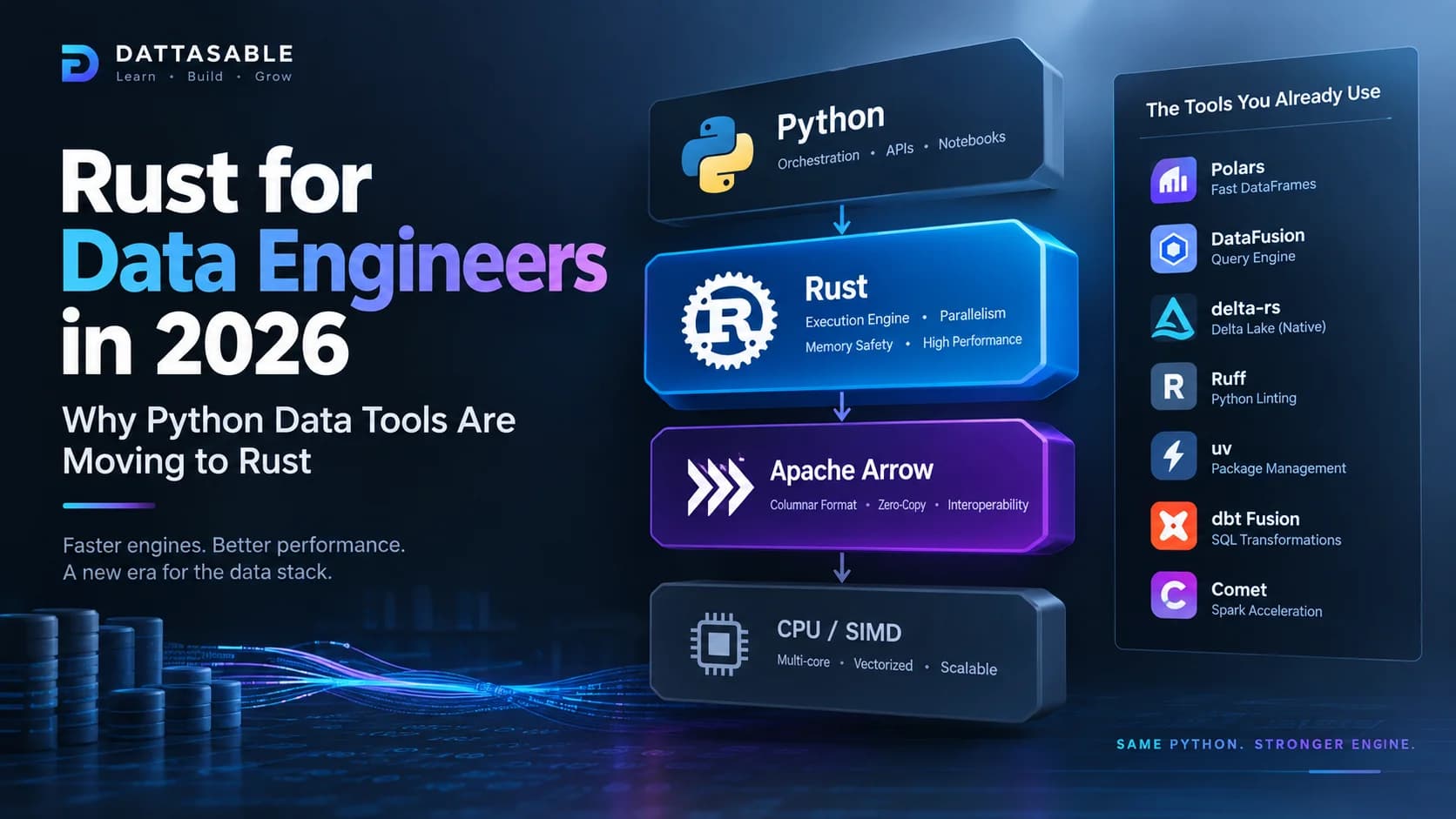
The Python code may be the interface, but the execution engine increasingly isn't Python. As a data engineer in 2026, the future of your stack looks something like this:
- Python: API / Orchestration
- Rust: Execution engine
- Apache Arrow: Memory / Data interchange
In this article, we'll break down exactly why the data engineering stack is changing, the Rust-powered tools you are likely already using, and whether you actually need to learn Rust to survive the next decade of data engineering.
1. The Data Engineering Stack Is Changing
To understand the rise of Rust in data engineering, we have to look at how the execution stack has evolved over the past decade.
In the Traditional Data Stack, the architecture was relatively straightforward:
- Python (The API) ↓
- NumPy / Pandas (The logic) ↓
- C / C++ (The execution) ↓
- CPU
In the Modern Data Stack (2026), the architecture looks fundamentally different:
- Python / SQL (The API) ↓
- Polars / DataFusion / Native Engines (The logic & optimizer) ↓
- Rust (The execution) ↓
- Apache Arrow (The memory format) ↓
- CPU / SIMD / Multi-core
This doesn't mean every modern tool follows this exact architecture, but it illustrates why the language underneath the interface matters. Polars is a perfect example: its core is written in Rust, it explicitly utilizes parallel execution and streaming, but it exposes a beautiful, pythonic API.
The future data engineer will write Python without realizing just how much Rust is executing underneath it.
2. Why Are Data Infrastructure Projects Choosing Rust?
When building databases, query engines, and heavy-duty data infrastructure, why are creators overwhelmingly migrating away from Python (and even C++) toward Rust?
It isn't simply because "Rust is fast." The better question is: How much computation can happen outside the Python interpreter?
1. Memory Safety
Rust provides memory safety without requiring a garbage collector. In data processing, where you are moving gigabytes or terabytes of data through RAM, garbage collection pauses (like those in Java/Scala) introduce unpredictable latency. Rust eliminates this.
2. Multithreaded Execution
Modern analytical workloads are heavily parallel. Rust's strict compiler makes data races nearly impossible, allowing developers to safely write fearless, heavily multithreaded data engines that maximize every core on a modern CPU.
3. Predictable Resource Usage
Important for databases, query engines, and data infrastructure. When you know exactly when memory is allocated and deallocated, you can build streaming execution engines that don't crash with Out of Memory (OOM) errors.
4. Native Performance
By dropping down to a native language, infrastructure developers can take advantage of hardware-level optimizations like SIMD (Single Instruction, Multiple Data) to vectorize query execution.
5. Modern Developer Tooling
Rust provides a modern alternative for systems programming where developers want native performance together with stronger compile-time safety guarantees. Cargo (Rust's package manager) makes dependency management remarkably smooth compared to the historical nightmares of C/C++ builds.
3. The Rust-Powered Data Tools You Should Know
You might not write Rust, but your stack relies on it. Here is the modern Rust-powered data landscape:
| Technology | What it does | Rust's role | Why Data Engineers care |
|---|---|---|---|
| Polars | DataFrame engine | Core engine | Faster local/embedded analytics |
| Apache DataFusion | Query engine | Core implementation | Build analytical systems |
| delta-rs | Delta Lake implementation | Rust | Native Delta access without Spark/JVM |
| Apache Arrow | Columnar memory format | Multi-language ecosystem | Zero-copy Interoperability |
| Ruff | Python lint/format | Rust | Faster developer tooling |
| uv | Python package/project management | Rust | Faster Python workflows |
| dbt Fusion | SQL transformation engine | Rust | Faster SQL development |
| Comet | Spark acceleration | DataFusion/Rust | Native query execution for Spark |
If you are using Microsoft Fabric, OneLake, or pushing data via Python, there is a high likelihood one of these libraries is sitting somewhere in your pipeline. DataFusion's ecosystem, for example, natively integrates with delta-rs, dbt Fusion, and Comet.
4. Polars vs Pandas: What Actually Changes?
This is the most common entry point for data engineers interacting with Rust. But the difference isn't just "Polars is faster, Pandas is slower."
Pandas vs Polars is the difference between direct execution and optimized execution.
Pandas Architecture
Python API ↓ DataFrame operations ↓ NumPy / native components
In Pandas, operations are eagerly evaluated step-by-step. If you filter a dataset and then group it, Pandas loads the data, filters it in memory, creates an intermediate object, and then groups it.
Polars Architecture
Python API ↓ Rust execution engine ↓ Query optimization ↓ Parallel execution
Polars utilizes a lazy API. When you write code in Polars, you are building a logical query plan. Polars' Rust engine optimizes that plan before executing it, pushing down filters, dropping unnecessary columns, and distributing the workload across all CPU cores.
Code Comparison:
# Pandas
import pandas as pd

result = (
    df.groupby("region")["revenue"]
    .sum()
    .sort_values(ascending=False)
)
Versus:
# Polars
import polars as pl

result = (
    df.group_by("region")
    .agg(pl.col("revenue").sum())
    .sort("revenue", descending=True)
)
The syntax is similar, but the mechanics are entirely different. Polars is taking that Python instruction, handing it to a Rust query optimizer, executing it in parallel using Apache Arrow memory formats, and returning the result.
5. Apache DataFusion: The Part Most Data Engineers Haven't Looked At Yet
While Polars gets all the hype for replacing Pandas, Apache DataFusion is arguably the more critical architectural piece of the puzzle.
What happens when you stop thinking of Rust as a DataFrame language and start thinking of it as a query-engine language?
DataFusion is not just a SQL CLI. It is an extensible query planner, optimizer, and columnar/vectorized execution engine.
SQL ↓ Logical Plan ↓ Optimizer ↓ Physical Plan ↓ Parallel Execution ↓ Arrow
DataFusion allows you to build custom databases and analytical systems. It exposes extension points for data sources, functions, optimizer rules, and execution plans. If you are building a custom data platform in 2026, you don't build it from scratch—you build it on top of DataFusion.
6. Apache Arrow: The Hidden Story
Why are all these projects using Rust? The deeper story is actually Apache Arrow.
Rust + Arrow + columnar execution + vectorization + parallelism = The Modern Native Data Stack.
Arrow acts as the universal interoperability layer. Historically, moving data between Python, a database, and a visualization tool required expensive serialization and deserialization (converting data formats back and forth).
Apache Arrow is an in-memory columnar format. If Polars (Rust) and DuckDB (C++) both use Arrow, they can pass gigabytes of data between each other instantly, with zero-copy overhead.
graph TD
    A[Apache Arrow <br> In-Memory Columnar Format] --> B(Polars)
    A --> C(DataFusion)
    A --> D(DuckDB)

    B -.-> |Zero-Copy| C
    C -.-> |Zero-Copy| D
    B -.-> |Zero-Copy| D

    B --> E[Rust]
    C --> F[Rust]
    D --> G[C++]
The future isn't necessarily Rust everywhere. The future is language-independent analytical engines connected through common columnar formats and execution standards.
7. Ruff and uv: Rust Is Also Eating Python Tooling
Rust isn't only appearing in the data-processing layer. It's also appearing in the tooling developers use to build Python applications.
- Ruff: An incredibly fast Python linter and code formatter written in Rust. It replaces Flake8, Isort, Black, and others, running in milliseconds.
- uv: A Python package and project manager backed by Astral. It resolves dependencies and installs packages orders of magnitude faster than
pip.
When even the Python ecosystem's own tooling is being rewritten in Rust for speed, the trend becomes impossible to ignore.
8. Rust Is Not the Only Answer: Enter DuckDB
It is strategically important to note that Rust is not the only language benefiting from this native-execution shift.
DuckDB is one of the most powerful and popular analytical engines in the world right now—and it is written in C++.
The data-engineering trend is broader than Rust. Native analytical execution is becoming increasingly important, but Rust is simply one of the primary languages benefiting from that shift.
- Polars → Rust
- DataFusion → Rust
- DuckDB → C++
- Pandas → Python API + native dependencies
Choosing Rust simply because "it is fast" is not a data engineering architecture. Choosing the right native execution engine for the right workload is.
9. Do Data Engineers Need to Learn Rust?
This is the emotional center of the debate. Do you need to go learn Rust right now?
You probably don't need to write Rust every day. But you should understand:
- why Polars is fast
- what Arrow does
- what DataFusion is
- how native execution differs from Python execution
- when Python becomes the bottleneck
- when Rust is worth introducing
Here is a pragmatic matrix of how much Rust you actually need to know based on your role:
| Your role | Rust depth needed |
|---|---|
| BI / Analytics Engineer | Awareness |
| Python Data Engineer | Basic understanding |
| Data Platform Engineer | Intermediate |
| Data Infrastructure Engineer | Strong |
| Query Engine / Database Developer | Advanced |
| Performance / Systems Engineer | Deep |
10. When Rust Is Worth Learning
Rust is not automatically better. Rust isn't automatically the right choice when:
- your dataset is small
- development speed matters more than execution speed
- the ecosystem/library you need is Python-first
- you're building orchestration (like Airflow or Prefect) rather than infrastructure
- your workload is already handled efficiently by a cloud data warehouse like Microsoft Fabric
- the bottleneck is I/O (network/disk) rather than CPU
If you fall into these categories, stick to Python.
11. When Python Is Still the Better Choice
Python and Rust are increasingly complementary. Python will continue to dominate:
- Orchestration
- Notebooks and exploratory analysis
- Experimentation
- The Machine Learning ecosystem (PyTorch, TensorFlow)
- API development (FastAPI)
- Rapid prototyping
12. The Future: Python + Rust, Not Python vs Rust
The important skill in 2026 isn't necessarily "Become a Rust developer."
The skill is: "Understand where your data workload is actually executing."
The Modern Python + Rust Data Stack
┌───────────────────────────────────────┐
│           Data Engineer               │
│        (Python / SQL / APIs)          │
└───────────────────┬───────────────────┘
                    │
        ┌───────────┴───────────┐
        │     Orchestration     │
        │       Analytics       │
        │                       │
        │   Python      Polars  │
        │          DataFusion   │
        └───────────┬───────────┘
                    │
            Apache Arrow Layer
                    │
               Rust Runtime
                    │
        CPU / SIMD / Parallelism
Python isn't going away. It will remain the lingua franca of data. But the execution engines powering that data are getting faster, safer, and native. Embrace the abstraction, understand the underlying engine, and you will build significantly more robust data systems in 2026.
FAQ
Is Rust useful for data engineers? Yes, but primarily for understanding how modern infrastructure operates, or for those transitioning into Data Platform or Infrastructure Engineering roles. For day-to-day pipeline building, Python remains dominant.
Should I learn Rust after Python? If you want to build high-performance data tooling, query engines, or work on systems-level performance, Rust is the premier second language for a Python data engineer to learn.
Is Polars better than Pandas? For large datasets, yes. Polars leverages lazy execution, query optimization, and multithreading via its Rust core, making it significantly faster and more memory-efficient than Pandas for gigabyte-scale data.
Is Apache DataFusion a database? No, it is an extensible query engine framework. You can use it to build databases, custom analytical tools, or embed SQL execution inside your applications.
Do data engineers need Rust? No, you do not need to write Rust to be a successful data engineer. However, understanding how Rust-based tools like Polars and DataFusion execute your Python commands will make you a far superior architect.