
Table of Contents
- • Table of Contents
- 1. The 30,000-Foot View: Defining the Three AI Pillars
- • Power BI Copilot: The Presentation Layer Assistant
- • Fabric IQ: The Enterprise Brain
- • Microsoft Fabric Data Agents: The Autonomous Executors
- 2. Architectural Comparison: How They Interact
- • The Query Resolution Path
- 3. Power BI Copilot: Deep Dive
- • Core Capabilities
- • Architectural Limitations
- 4. Fabric Data Agents: Deep Dive
- • Core Capabilities
- • The Role of OneLake MCP
- 5. Security & Governance: The Crucial Differences
- 6. Direct Lake Considerations
- 7. When to Use Which: The Architectural Matrix
- Frequently Asked Questions (FAQ)
- Final Takeaway
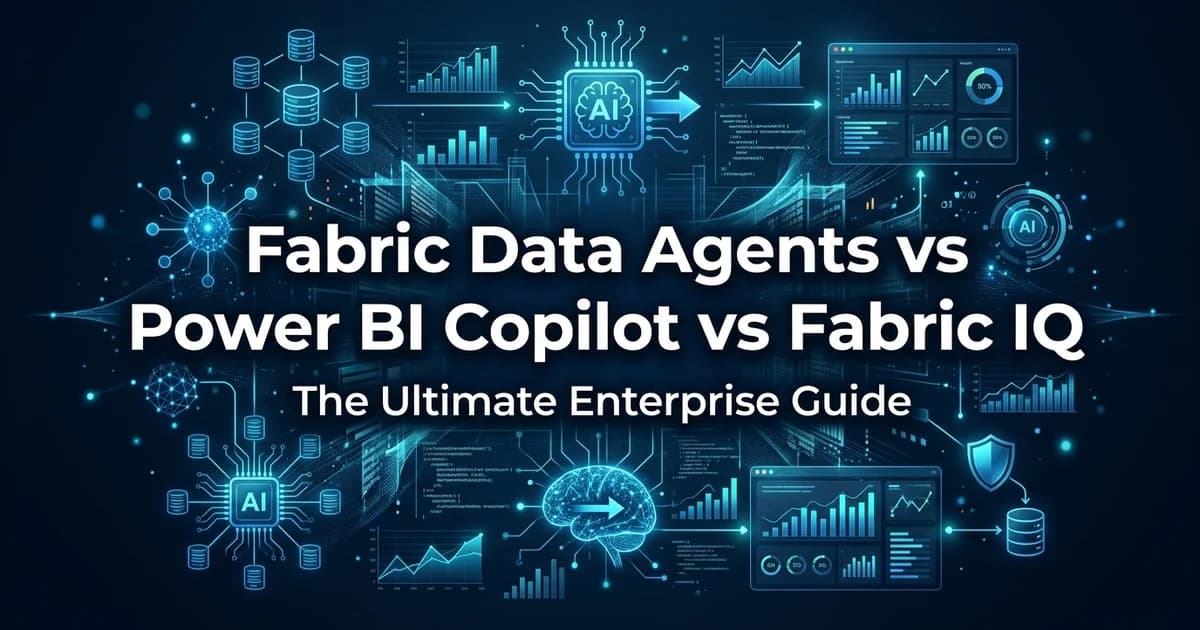
By 2026, Microsoft Fabric has introduced a staggering amount of AI capabilities into the data ecosystem. For a Data Architect, the overlapping terminology can be dizzying. If a business user asks a natural language question about revenue, should that request be handled by Power BI Copilot, orchestrated by Fabric IQ, or delegated to a custom Fabric Data Agent?
The distinction is not just semantic—it represents fundamentally different security models, query engines, and operational paradigms.
In this ultimate architectural guide, we will tear down the exact engineering boundaries between Power BI Copilot, Fabric IQ, and Microsoft Fabric Data Agents. We will explore how they interact with OneLake, respect Fabric Security models, and impact Direct Lake performance.
Table of Contents
1. The 30,000-Foot View: Defining the Three AI Pillars
Before diving into the underlying architecture, we must define what these three components actually are within the Microsoft Fabric Architecture.
Power BI Copilot: The Presentation Layer Assistant
Power BI Copilot is an end-user and developer assistant strictly bound to the visualization and semantic layer. It operates within the context of a specific Power BI report or semantic model. Its primary job is to translate user prompts into DAX queries, generate report pages, and summarize visuals that already exist.
Fabric IQ: The Enterprise Brain
Fabric IQ is the tenant-wide orchestration and semantic routing layer. It is not an agent itself; rather, it is the underlying intelligence that maps raw data to your enterprise ontology. Fabric IQ understands that "churn" in the EU region has a different mathematical definition than "churn" in North America, and it ensures that any AI operating within the tenant adheres to that definition.
Microsoft Fabric Data Agents: The Autonomous Executors
Microsoft Fabric Data Agents are autonomous, task-specific units that execute governed actions directly against your data infrastructure. While Copilot waits for a human prompt, a Data Agent can be triggered programmatically to analyze a Lakehouse delta table, write a KQL query against an Eventhouse, or trigger an external workflow using the Model Context Protocol (MCP).
2. Architectural Comparison: How They Interact
To understand the boundaries, we must look at how a user query flows through the modern Fabric ecosystem.
graph TD
    User([Business User]) -->|Natural Language Query| FIQ{Fabric IQ}

    FIQ -->|Analyzes Ontology| Router[Semantic Router]

    Router -->|Context = Existing Report| PBC[Power BI Copilot]
    Router -->|Context = Deep Data Analysis| FDA[Fabric Data Agents]

    PBC -->|Generates DAX| SM[(Power BI Semantic Model)]
    SM -->|Direct Lake| OL[OneLake]

    FDA -->|Generates SQL/PySpark| LH[(Lakehouse / Warehouse)]
    FDA -->|Generates KQL| EH[(Eventhouse)]
    LH -->|Delta Parquet| OL
    EH -->|Real-Time Data| OL

    subgraph Fabric Governance
        FIQ
        Router
    end

    classDef copilot fill:#0078D4,stroke:#fff,stroke-width:2px,color:#fff;
    classDef agent fill:#107C10,stroke:#fff,stroke-width:2px,color:#fff;
    classDef iq fill:#5C2D91,stroke:#fff,stroke-width:2px,color:#fff;

    class PBC copilot;
    class FDA agent;
    class FIQ iq;
The Query Resolution Path
The Request: A user asks, "Why did supply chain costs spike last week?"
Fabric IQ Evaluation: Fabric IQ intercepts the prompt. It checks the enterprise Purview data catalog and the overarching business ontology. It realizes that "supply chain costs" involves data spanning three different Lakehouses and a real-time KQL stream.
Routing to the Data Agent: Because this query exceeds the scope of a single pre-built Power BI report, Fabric IQ delegates the task to a Supply Chain Data Agent.
Execution: The Data Agent writes the necessary SQL and KQL, queries OneLake directly, aggregates the data, and returns a cohesive natural language answer.
If the user had instead asked, "Summarize this sales page," Fabric IQ would have routed the request directly to Power BI Copilot.
3. Power BI Copilot: Deep Dive
Power BI Copilot is incredibly powerful, but it is fundamentally limited by its bounding box.
Core Capabilities
DAX Generation: Translates English into complex DAX measures.
Report Generation: Automatically builds report pages based on the underlying semantic model.
Narrative Summaries: Generates dynamic text boxes that summarize the current cross-filtered state of a report page.
Architectural Limitations
Model-Bound: Copilot cannot query data that is not explicitly defined in the semantic model. If a column exists in the Lakehouse but wasn't pulled into the model, Copilot is blind to it.
Synchronous & User-Driven: Copilot only acts when a human clicks a button or types a prompt. It cannot run in the background on a schedule.
Engineering Tip: For optimal Power BI Copilot performance, your semantic models must be flawless. Vague column names (Col1_Final_v2) will cause Copilot to hallucinate.
4. Fabric Data Agents: Deep Dive
Where Copilot ends, Fabric Data Agents begin. Data Agents are designed for RAG (Retrieval-Augmented Generation) on structured data.
Core Capabilities
Multi-Dialect Generation: Capable of generating SQL, PySpark, and KQL natively.
Autonomous Execution: Agents can be triggered by external events (e.g., an Azure Function, an ADF pipeline, or an MCP orchestration request).
Cross-Workspace Data Access: Unlike Copilot, which is bound to a single model, a Data Agent can scan metadata across the entire tenant to find the right Lakehouse to answer a prompt.
The Role of OneLake MCP
The true power of Data Agents in 2026 relies on the Model Context Protocol (MCP). This allows external AI systems to securely request data from Fabric. When an external system pings the Fabric Data Agent, the agent securely fetches data from OneLake and returns it, acting as an intelligent, conversational API for your data platform.
5. Security & Governance: The Crucial Differences
When dealing with GenAI, security is the primary concern. Microsoft Fabric handles security differently depending on which layer you are using. Strict adherence to Fabric Governance is mandatory.
Security FeaturePower BI CopilotFabric Data AgentsRow-Level Security (RLS)Applied at the DAX Semantic Model level.Applied at the SQL Endpoint / Lakehouse level.Object-Level Security (OLS)Fully supported (hides tables/columns).Fully supported via SQL DENY permissions.Purview IntegrationAdheres to semantic model sensitivity labels.Reads raw metadata and compliance labels across OneLake.Execution IdentityRuns under the delegated identity of the active user.Can run via delegated user OR as a Service Principal for background tasks.
Fabric IQ acts as the overarching watchtower here, ensuring that regardless of whether a query goes through Copilot or a Data Agent, Purview DLP (Data Loss Prevention) policies are strictly enforced.
6. Direct Lake Considerations
When a Fabric Data Agent generates SQL to query a Lakehouse, it spins up Serverless SQL compute. However, when Power BI Copilot queries a semantic model, it utilizes Direct Lake.
If a Data Agent attempts to query a Lakehouse table that is actively being swapped in a Direct Lake model, it must rely on v-ordering and Delta Parquet optimizations. Architects must ensure that heavy, agentic SQL queries do not contend for the same underlying OneLake IOPS that the Direct Lake models require for sub-second report rendering.
7. When to Use Which: The Architectural Matrix
To simplify the decision matrix for your engineering teams in 2026:
Use Power BI Copilot WHEN:
The user is actively viewing a Power BI report.
The question can be answered entirely by an existing, certified semantic model.
You need dynamic narrative summaries for executives.
Use Fabric Data Agents WHEN:
The question spans multiple un-modeled datasets across the data warehouse and lakehouse.
You need autonomous, scheduled analysis (e.g., "Analyze the telemetry Eventhouse every morning and alert me if anomalies exist").
You are integrating Fabric data with external AI applications via OneLake MCP.
Rely on Fabric IQ ALWAYS:
You do not "build" Fabric IQ; you curate it. By properly defining your enterprise ontology, metadata, and Purview classifications, you feed Fabric IQ the context it needs to route queries perfectly between Copilot and your Agents.
Frequently Asked Questions (FAQ)
What is the main difference between Power BI Copilot and a Fabric Data Agent?
Power BI Copilot is a user-facing assistant that translates natural language into DAX against a specific semantic model. A Fabric Data Agent is an autonomous unit that translates natural language into SQL, PySpark, or KQL to query raw data across Lakehouses and Warehouses.
Does Fabric IQ replace Azure OpenAI?
No. Fabric IQ is the semantic routing layer that utilizes Azure OpenAI under the hood. It provides the enterprise business context (the ontology) to the LLM so that the Azure OpenAI models do not hallucinate your business logic.
Can a Fabric Data Agent build a Power BI report?
No. Fabric Data Agents generate data outputs and analytical answers. If you want to automatically generate a visual Power BI report page, you must use Power BI Copilot.
How does security work when an external system calls a Fabric Data Agent?
Through the OneLake Model Context Protocol (MCP), external systems authenticate using Entra ID. The Fabric Data Agent executes the request using the delegated permissions of the caller, meaning all Row-Level Security (RLS) and Object-Level Security (OLS) are strictly enforced.
Do I need a specific Fabric capacity to use Data Agents and Fabric IQ?
Yes, advanced AI capabilities like Copilot, Fabric IQ routing, and Data Agents require a Fabric F64 capacity or higher in 2026.
Final Takeaway
The era of monolithic AI chatbots is over. In 2026, Microsoft Fabric provides a highly specialized, multi-tiered AI architecture. Power BI Copilot dominates the presentation layer, Microsoft Fabric Data Agents dominate the raw data and external integration layer, and Fabric IQ orchestrates the entire symphony.
By understanding the technical boundaries of each, data architects can design compound AI systems that are highly performant, fundamentally secure, and perfectly aligned with enterprise governance.
\n \n
For more official context on the platform capabilities, review the official Microsoft Fabric documentation.
Fabric Data Agents vs Power BI Copilot vs Fabric IQ. Fabric Data Agents vs Power BI Copilot vs Fabric IQ. Fabric Data Agents vs Power BI Copilot vs Fabric IQ. Fabric Data Agents vs Power BI Copilot vs Fabric IQ. Fabric Data Agents vs Power BI Copilot vs Fabric IQ. Fabric Data Agents vs Power BI Copilot vs Fabric IQ. Fabric Data Agents vs Power BI Copilot vs Fabric IQ. Fabric Data Agents vs Power BI Copilot vs Fabric IQ. Fabric Data Agents vs Power BI Copilot vs Fabric IQ. Fabric Data Agents vs Power BI Copilot vs Fabric IQ. Fabric Data Agents vs Power BI Copilot vs Fabric IQ. Fabric Data Agents vs Power BI Copilot vs Fabric IQ. Fabric Data Agents vs Power BI Copilot vs Fabric IQ. Fabric Data Agents vs Power BI Copilot vs Fabric IQ. Fabric Data Agents vs Power BI Copilot vs Fabric IQ.