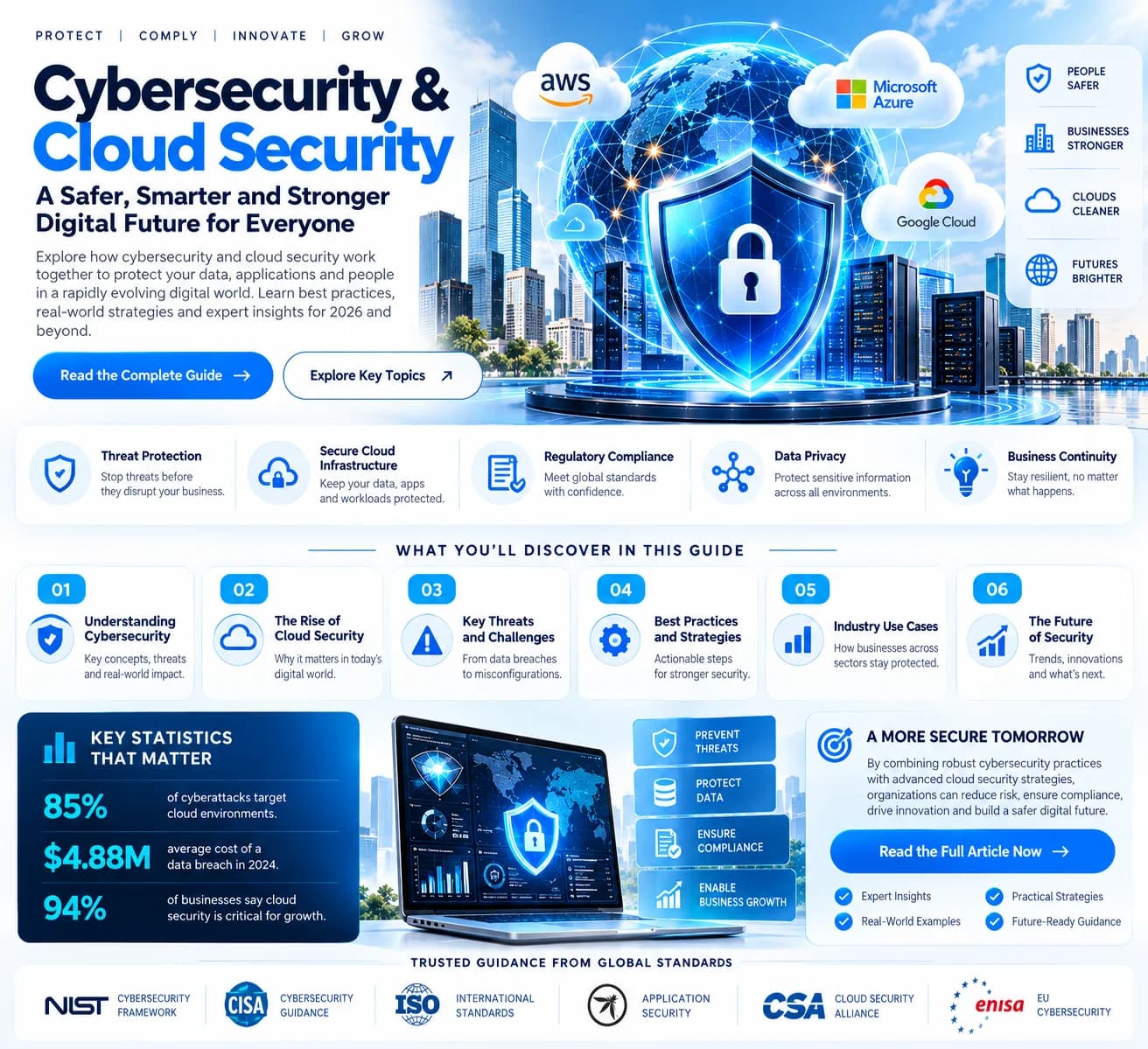

This foundational guide serves as the master pillar for enterprise security and cloud protection. To complement this architecture, explore our specialized data vault and governance deep-dives:
→ Hardening the Data Vault: Security Protocols for Enterprise BI Infrastructure → Microsoft Fabric Security & Governance Architecture Blueprint (2026) → AI Governance & Data Democratization Risk MitigationWhat is the fundamental difference between cybersecurity and cloud security? Cybersecurity is the overarching discipline of safeguarding digital systems, networks, physical devices, operational technology, and data from unauthorized intrusion, disruption, or destruction. Cloud security is a specialized subset of cybersecurity focused specifically on the unique shared-responsibility boundaries, ephemeral infrastructure, software-defined perimeters, API security, and identity-centric controls required to protect workloads hosted on Infrastructure-as-a-Service (IaaS), Platform-as-a-Service (PaaS), and Software-as-a-Service (SaaS) environments. In 2026, enterprise defense requires unifying traditional cybersecurity hygiene with continuous, automated cloud security posture management.
Executive Introduction: The State of Enterprise Protection in 2026
Enterprise technology in 2026 operates in an environment characterized by distributed cloud footprints, widespread AI agent adoption, containerized microservices, and relentless automated adversary campaigns. The traditional network perimeter—once defined by firewalls, on-premises VPN concentrators, and corporate data centers—has dissolved completely. Today, a single Fortune 500 or mid-market enterprise routinely orchestrates thousands of ephemeral cloud workloads across Amazon Web Services (AWS), Microsoft Azure, Google Cloud Platform (GCP), and dozens of critical SaaS platforms.
This fundamental architectural transformation delivers unprecedented operational agility and scalable compute power. However, it simultaneously expands the enterprise threat surface by orders of magnitude. A single misconfigured cloud storage bucket, an overly permissive IAM role assigned to a developer's CI/CD token, or an unmonitored shadow AI integration can expose millions of customer records in minutes. Cloud-native breaches in 2026 rarely stem from adversaries hacking through cryptographic algorithms; they stem from adversaries logging in through stolen session tokens, leveraging privilege escalation in identity fabrics, and exploiting configuration drift across cloud accounts.
📌 Executive Summary & Core Strategic Takeaways
- Identity Is the Only True Perimeter: In multi-cloud topologies, network firewalls are secondary to continuous identity verification, phishing-resistant Multi-Factor Authentication (FIDO2 / Passkeys), and just-in-time (JIT) access.
- The Shared Responsibility Model Is Inflexible: Cloud service providers guarantee the security of the cloud (physical facilities, virtualization host hypervisors, hardware maintenance), but customer organizations remain 100% accountable for the security in the cloud (IAM policies, data classification, encryption keys, application code, and logging configurations).
- Autonomous & AI Threats Require Automated Defense: Adversaries leverage automated vulnerability scanners and LLM-assisted phishing engines. Human SOC analysts cannot manually triage 50,000 daily alerts; organizations must adopt Cloud-Native Application Protection Platforms (CNAPP) and automated Security Orchestration, Automation, and Response (SOAR).
- Shift-Left DevSecOps Is Non-Negotiable: Remediating an insecure Infrastructure-as-Code (IaC) Terraform module or container misconfiguration in production costs up to 30x more than catching it via automated static analysis inside GitHub Actions or GitLab CI.
- Compliance Does Not Equal Security: Achieving SOC 2 Type II or ISO 27001 certification confirms that processes exist at an audit timestamp, but genuine resilience requires continuous posture monitoring against frameworks like NIST CSF 2.0 and the Australian Essential Eight.
Table of Contents — Master Blueprint
- What Is Cybersecurity? Fundamentals, CIA Triad & Governance
- What Is Cloud Security? IaaS, PaaS, SaaS & Shared Responsibility
- Cybersecurity vs. Cloud Security: Comprehensive 12-Point Comparison Matrix
- The Cybersecurity Threat Landscape in 2026 (Ransomware, Identity & Shadow AI)
- Major Cloud Security Risks & Enterprise Impact Matrix
- Understanding Zero Trust Architecture (NIST SP 800-207 Principles)
- Identity & Access Management: Phishing-Resistant MFA, PAM & JIT
- AWS Cloud Security Architecture (Organizations, GuardDuty, KMS & Security Hub)
- Microsoft Azure Cloud Security (Entra ID, Defender for Cloud & Sentinel)
- Google Cloud Security (Security Command Center, Cloud KMS & VPC Service Controls)
- AWS vs. Azure vs. Google Cloud: Security Capability Comparison Matrix
- Enterprise Cloud Security Reference Architecture (Defense in Depth)
- Cloud Security Posture Management: CSPM vs. CNAPP vs. CWPP vs. CIEM
- AI and Machine Learning in Defensive Cybersecurity Operations
- Security for Generative AI and LLM Applications (OWASP GenAI Top 10)
- DevSecOps & Secure Software Supply Chains (SBOM & IaC Scanning)
- Kubernetes and Container Security Hardening Blueprint
- Cloud Data Security: Envelope Encryption, KMS & DLP Governance
- Cybersecurity Compliance & Regulatory Standards (NIST CSF 2.0, ISO 27001, SOC 2, Essential Eight)
- Modern SOC Operations: SIEM vs. SOAR vs. XDR & Executive KPIs
- Incident Response, Containment Protocols & Disaster Recovery (RTO/RPO)
- Cybersecurity Strategy for Small & Medium Businesses (Budget-Conscious Defense)
- Enterprise Cybersecurity Budget Planning & Tool Consolidation
- Vendor-Neutral Buyer's Evaluation Framework for Security Software
- Cybersecurity Maturity Assessment Model (Levels 1 through 5)
- The 30/60/90-Day Cloud Security Execution Roadmap
- Emerging Cybersecurity & Cloud Security Trends for 2027
- Frequently Asked Questions (20 Comprehensive Answers)
- Executive Conclusion & Actionable Security Checklist
1. What Is Cybersecurity? Fundamentals, CIA Triad & Governance
Cybersecurity is the comprehensive discipline of designing, deploying, and maintaining administrative, technical, and physical safeguards to defend computers, servers, mobile devices, electronic systems, networks, data, and operational infrastructure from malicious exploitation, theft, damage, or operational compromise.
To design an enterprise security program, leadership must understand the distinction between three terms frequently used interchangeably:
- Information Security (InfoSec): The broader practice of preserving the confidentiality, integrity, and availability of all organizational information assets, regardless of format (both digital records and physical paper archives).
- Cybersecurity: The subset of InfoSec that focuses specifically on protecting electronic information, digital networks, software systems, and data in transit or at rest across connected digital infrastructure.
- IT Security: The operational implementation of hardware maintenance, operating system patching, endpoint configuration, and network routing designed to keep technical infrastructure functional and protected against routine failures.
The CIA Triad: Core Tenets of Defense
Every security policy, encryption algorithm, and network segmentation boundary exists to uphold one or more pillars of the classical CIA Triad:
1. Confidentiality
Ensuring that sensitive information is accessible solely to authenticated and authorized entities. Enforced via AES-256 encryption at rest, TLS 1.3 in transit, granular attribute-based access control (ABAC), and strict data loss prevention (DLP) rules.
2. Integrity
Guaranteeing that data, source code, and configurations remain mathematically unaltered, complete, and trustworthy. Enforced via SHA-256 cryptographic hashing, digital signatures, immutable audit logs, and database constraint validations.
3. Availability
Ensuring that computational resources, APIs, and data lakes remain accessible to authorized users when required for business operations. Protected via multi-region failover, load balancing, DDoS scrubbing, and immutable air-gapped backups.
2. What Is Cloud Security? IaaS, PaaS, SaaS & Shared Responsibility
Cloud security is the specialized branch of cybersecurity that addresses the technical architecture, operational practices, and compliance controls required to secure cloud computing environments. Unlike traditional on-premises infrastructure—where an enterprise owns and secures the physical data center, server racks, network cabling, hypervisors, and applications—cloud computing splits security obligations between the cloud provider and the tenant.
The Cloud Shared Responsibility Model Explained
The Shared Responsibility Model is the cornerstone contract governing every deployment in AWS, Microsoft Azure, Google Cloud, and SaaS platforms. Failing to understand where the provider's responsibility ends and the tenant's responsibility begins is the root cause of the vast majority of enterprise cloud security incidents.
| Infrastructure Layer | On-Premises | IaaS (e.g. AWS EC2, Azure VM) | PaaS (e.g. AWS RDS, Azure SQL) | SaaS (e.g. Microsoft 365, Salesforce) |
|---|---|---|---|---|
| Data Classification & Accountability | Customer | Customer | Customer | Customer |
| Identity & Access Management (IAM) | Customer | Customer | Customer | Customer |
| Application Code & API Logic | Customer | Customer | Customer | Provider |
| Operating System & Patch Management | Customer | Customer | Provider | Provider |
| Network Routing & Firewalls | Customer | Customer (Security Groups/VPC) | Shared (Rules vs. Subnet) | Provider |
| Hypervisors, Racks & Physical Security | Customer | Provider | Provider | Provider |
Note: Across every service model (IaaS, PaaS, SaaS), the customer retains 100% legal and operational ownership over identity lifecycle governance and data classification. A cloud provider will never configure your IAM privileges or enforce internal data retention mandates.
3. Cybersecurity vs. Cloud Security: 12-Point Comparative Matrix
While cloud security exists under the broad umbrella of cybersecurity, their operational realities, tooling landscapes, and threat vectors differ substantially. Understanding these 12 strategic dimensions ensures IT leaders allocate security capital effectively:
| Evaluation Dimension | Traditional Enterprise Cybersecurity | Modern Cloud Security |
|---|---|---|
| 1. Primary Perimeter | Physical perimeter: corporate firewalls, DMZs, edge routers, and campus VPNs. | Software-defined perimeter: Identity fabrics (Entra ID, Okta, IAM roles) and API gateway endpoints. |
| 2. Infrastructure Lifespan | Static, long-lived hardware: physical bare-metal servers running for 3–5 years. | Dynamic and ephemeral: microservices, Kubernetes pods, and Lambda functions living for minutes or seconds. |
| 3. Asset Discovery | Manual CMDB spreadsheets, IP subnet sweeps, and physical asset tagging. | API-driven real-time graph discovery (CSPM) querying cloud control planes continuously. |
| 4. Security Enforcement Point | Choke points: network intrusion detection appliances and core switches. | Distributed micro-segmentation, sidecar proxies, and IAM evaluation engines at every service boundary. |
| 5. Predominant Threat Vector | Malware execution, macro payloads, network worms, and physical port tampering. | Overly privileged cloud service accounts, stolen session cookies, leaked API secrets, and IaC drift. |
| 6. Patching Cadence | Scheduled monthly patch windows with extensive manual server downtime negotiations. | Immutable infrastructure: rebuilding container base images and re-deploying stateless nodes via CI/CD pipelines. |
| 7. Data Exposure Risk | Physical disk theft, unencrypted laptop loss, internal USB exfiltration. | Publicly readable cloud object storage buckets (S3 / Azure Blob) and unauthenticated REST APIs. |
| 8. Configuration Management | Host-level Group Policy Objects (GPO) and manual admin console clicks. | Infrastructure-as-Code (Terraform, Bicep, Pulumi) enforced via GitOps and pre-commit linting policies. |
| 9. Visibility & Telemetry | Syslog forwarding from physical switches, Windows Event Logs, and server agents. | CloudTrail, VPC Flow Logs, Azure Activity Logs, and Kubernetes audit logs ingested into cloud data lakes. |
| 10. Primary Tooling Stack | Hardware firewalls (Palo Alto, Fortinet), endpoint antivirus, legacy SIEMs. | Cloud-Native Application Protection Platforms (CNAPP), CIEM, CSPM, and SASE/SSE architectures. |
| 11. Regulatory Compliance | Annual point-in-time auditor inspections and binder-based artifact reviews. | Continuous automated evidence collection (e.g. Vanta, Drata) evaluating cloud state in real time. |
| 12. Incident Containment | Physically unplugging network cables and re-imaging local drive images. | Revoking cloud IAM session tokens, modifying security group egress rules via API, and isolating container namespaces. |
4. The Cybersecurity Threat Landscape in 2026
Threat intelligence reports in 2026—including the Verizon Data Breach Investigations Report (DBIR) and CISA alerts—illustrate a decisive shift away from traditional brute-force penetration toward identity abuse and software supply-chain poisoning. Key attack vectors dominating enterprise risk include:
A. Adversary-in-the-Middle (AiTM) Phishing & Session Hijacking
Standard SMS-based or push-notification multi-factor authentication is no longer sufficient. Threat actors utilize automated reverse-proxy frameworks (such as Evilginx variants) that mirror legitimate enterprise login portals. When an employee enters their credentials and approves a push notification, the proxy intercepts the unencrypted HTTP session cookie. The adversary injects this session cookie directly into their browser, completely bypassing MFA requirements without ever needing the user's password again. Defensive Mandate: Organizations must transition to phishing-resistant FIDO2 / WebAuthn hardware passkeys or certificate-based authentication.
B. Software Supply Chain Compromises
Modern cloud applications are constructed from thousands of open-source npm, PyPI, and container dependencies. Attackers frequently execute typosquatting attacks, compromise neglected maintainer accounts, or submit subtle malicious PRs that introduce obfuscated backdoors into widely used utilities. Once integrated into an enterprise build pipeline, malicious packages harvest environment secrets and CI/CD cloud credentials. Defensive Mandate: Enforce signed Software Bills of Materials (SBOMs), pin dependency hashes, and scan all third-party libraries using automated Software Composition Analysis (SCA).
C. Shadow AI & LLM Data Poisoning
The rapid adoption of internal AI chatbots, autonomous agent workflows, and Retrieval-Augmented Generation (RAG) pipelines has created a massive blind spot. Employees paste proprietary financial models, customer PII, and source code into unvetted public generative AI platforms. Simultaneously, RAG systems connected to corporate data repositories often lack granular row-level and object-level permissions, allowing internal users to query sensitive HR or executive compensation records through the AI prompt interface. Defensive Mandate: Deploy Cloud Access Security Brokers (CASB) with AI discovery rules and enforce strict data-sanitization gateways on all model inputs.
5. Major Cloud Security Risks & Enterprise Impact Matrix
According to the Cloud Security Alliance (CSA) Top Threats, over 80% of cloud security failures originate from customer misconfigurations rather than provider vulnerabilities. The table below outlines the five most severe cloud risk scenarios and their preventative controls:
| Risk Scenario | Business Impact | Early Warning Indicators | Primary Preventive Control | Responsible Team |
|---|---|---|---|---|
| Excessive IAM Privileges | Lateral movement, privilege escalation, full tenant takeover. | Service accounts possessing wildcard (*) permissions or unused Admin roles. |
Cloud Infrastructure Entitlement Management (CIEM) with automated least-privilege pruning. | Cloud Architecture & IAM |
| Public Cloud Storage Exposure | Mass regulatory fines (GDPR/HIPAA), brand destruction, lawsuits. | Alerts for s3:GetObject from unauthorized external IPs, CSPM public bucket alerts. |
Organization-level SCPs (AWS Block Public Access, Azure Policy disallowing public blob access). | SecOps & Platform Engineering |
| Unprotected API Endpoints | Automated credential stuffing, data scraping, denial of wallet (compute exhaustion). | Spike in 401/403 HTTP response codes, traffic anomalies from residential proxy networks. | Web Application Firewall (WAF) with rate limiting, bot protection, and OAuth token validation. | Application Security / DevSecOps |
| Hardcoded Secrets in Source Code | Direct credential abuse, database exfiltration, unauthorized crypto mining. | GitHub secret scanning alerts, access tokens used from abnormal geographical coordinates. | Pre-commit hooks (TruffleHog, Gitleaks), centralized secrets management (Vault, AWS Secrets Manager). | DevSecOps Lead |
| Inadequate Immutable Backups | Complete operational paralysis following ransomware encryption. | Backup snapshot deletions occurring without dual-custody authorization. | AWS Backup Vault Lock / Azure Immutable Blob with Write-Once-Read-Many (WORM) policies. | Infrastructure & Business Continuity |
6. Understanding Zero Trust Architecture (NIST SP 800-207)
Zero Trust is not a single software product or appliance; it is an architectural philosophy governed by the fundamental premise: "Never trust, always verify." Formalized by the National Institute of Standards and Technology in NIST Special Publication 800-207, Zero Trust assumes that adversaries are already inside the enterprise network perimeter.
The Three Core Tenets of Zero Trust
- Verify Explicitly: Always authenticate and authorize based on all available data points—including user identity, location, device health posture, service or workload context, data classification, and anomalous behavior telemetry.
- Use Least-Privilege Access: Limit user and machine access with Just-In-Time (JIT) and Just-Enough-Access (JEA), risk-based adaptive policies, and data protection mechanisms.
- Assume Breach: Minimize blast radius by segmenting access by network, user, devices, and application awareness. Encrypt all sessions end-to-end, and leverage automated analytics to inspect traffic and detect threats in real time.
+---------------------------------------------------------------------------------+
|                       POLICY ENGINE & POLICY ADMINISTRATOR                      |
|                      (Identity Provider + Device Telemetry + Threat Intel)       |
+---------------------------------------------------------------------------------+
                                       |
                   Control Plane: Continuous Evaluation
                                       v
[ Subject / Device ] ----> [ Policy Enforcement Point (PEP) ] ----> [ Enterprise Resource ]
 (Untrusted Zone)               (API Gateway / SASE Agent)            (Data / Microservice)
                                       |
                                       +--- Encrypted, Identity-Bound Data Plane
7. Identity & Access Management: Phishing-Resistant MFA, PAM & JIT
Identity and Access Management (IAM) is the foundational security boundary in multi-cloud architecture. In modern environments, identities belong not only to human employees but also to non-human entities: CI/CD runners, Kubernetes pods, serverless functions, and third-party SaaS integrations. In fact, non-human identities outnumber human identities by more than 10 to 1 in typical cloud deployments.
Phishing-Resistant Authentication (FIDO2 / Passkeys)
Legacy MFA methods—including SMS codes, email verification links, and time-based one-time password (TOTP) apps (Google Authenticator)—are susceptible to SIM swapping, prompt fatigue attacks, and reverse-proxy interception. Enterprise organizations must enforce FIDO2 WebAuthn authentication (YubiKeys, Windows Hello, Apple Touch ID). Under FIDO2 standards, credentials are cryptographically bound to the browser's exact URL domain, making it mathematically impossible for an attacker's fake phishing proxy to intercept and reuse the authenticated token.
Privileged Access Management (PAM) and Just-in-Time (JIT)
Standing privileges represent an unacceptable vulnerability. Engineers should never hold perpetual administrative rights over production AWS accounts or Azure subscriptions. Instead, modern cloud IAM utilizes Privileged Access Management with Just-in-Time elevation:
- Zero Standing Access: Engineers hold zero administrative rights during routine operations.
- Time-Bound Elevation: When a production issue occurs, the engineer requests temporary elevation (e.g., via Entra PIM or AWS IAM Identity Center) for a specific task duration (e.g., 2 hours).
- Multi-Person Approval: Elevations require peer review or manager approval, accompanied by an explicit ticketing system reference (e.g., Jira INC-4521).
- Comprehensive Audit Logging: Every action taken during the elevated session is recorded in immutable audit trails. Once the time expires, access is revoked automatically.
8. AWS Cloud Security Architecture Blueprint
Amazon Web Services provides an extensive ecosystem of native security services. A production-grade AWS enterprise landing zone implements defense in depth across the following foundational components:
Account Structure & Governance
AWS Organizations & Control Tower: Multi-account hierarchy segregating Management, Core Security, Shared Services, and individual Production/Dev workloads. Service Control Policies (SCPs) enforce baseline guardrails (e.g., preventing region expansion, blocking public S3 access, and enforcing CloudTrail immutability).
Threat Detection & Visibility
Amazon GuardDuty: Continuous intelligent threat detection analyzing VPC Flow Logs, CloudTrail management/data events, DNS logs, and EKS audit logs using machine learning to identify compromised credentials, port scanning, and unauthorized crypto-mining.
Cryptographic Key Governance
AWS Key Management Service (KMS): FIPS 140-3 validated Customer Managed Keys (CMKs) with automated annual rotation. Separate key policies guarantee that even account administrators cannot decrypt sensitive data stores without explicit cryptor privileges.
Centralized Posture & Compliance
AWS Security Hub: Centralized dashboard aggregating findings across GuardDuty, Macie (sensitive PII discovery), Inspector (vulnerability scanning), and AWS Config. Automatically scores environment state against CIS AWS Foundations Benchmarks.
9. Microsoft Azure Cloud Security Architecture Blueprint
Microsoft Azure's security posture is deeply integrated with its enterprise identity backbone, making it a natural choice for organizations operating hybrid Active Directory and Microsoft 365 environments:
- Microsoft Entra ID (formerly Azure AD): Provides centralized identity federation, Conditional Access policies (evaluating device compliance, user risk, and geographic signals), and Privileged Identity Management (PIM) for JIT role elevation.
- Microsoft Defender for Cloud: A comprehensive CNAPP solution combining Cloud Security Posture Management (CSPM) with Cloud Workload Protection (CWPP). Delivers real-time regulatory compliance mapping against NIST, ISO, and PCI standards.
- Microsoft Sentinel: Cloud-native SIEM and SOAR platform powered by AI. Ingests petabytes of operational telemetry across Azure, AWS, on-premises systems, and Office 365, correlating events to reduce alert fatigue by up to 80%.
- Azure Key Vault & Managed HSM: Dedicated hardware security modules providing secure secrets management, cryptographic key storage, and automated SSL/TLS certificate renewal.
10. Google Cloud Security Architecture Blueprint
Google Cloud Platform leverages decades of internal zero-trust operational experience (pioneered by Google BeyondCorp). Its core security differentiators include:
- VPC Service Controls: Enables architects to configure fine-grained perimeter security around Google-managed data services (BigQuery, Cloud Storage, Vertex AI). Even if credentials are compromised, data cannot be copied outside the defined network boundary, mitigating data exfiltration risks completely.
- Security Command Center (SCC) Premium: GCP's centralized vulnerability and threat detection suite. Automatically identifies container configuration vulnerabilities, detects active crypto-mining attacks, and evaluates CIS benchmarks.
- Cloud KMS & External Key Manager (EKM): Supports customer-supplied encryption keys and integration with third-party hardware modules, ensuring Google has zero technical ability to access decryption keys without tenant authorization.
- Google Cloud Armor: Enterprise-grade DDoS mitigation and Web Application Firewall built on the same global infrastructure defending Google Search and YouTube.
11. AWS vs. Azure vs. Google Cloud: Security Capability Matrix
When architecting multi-cloud workloads, engineering teams must evaluate security capabilities across hyperscalers objectively:
| Security Capability | Amazon Web Services (AWS) | Microsoft Azure | Google Cloud Platform (GCP) |
|---|---|---|---|
| Identity & Access Management | AWS IAM & IAM Identity Center | Microsoft Entra ID (Industry benchmark for enterprise identity) | Google Cloud IAM & Workload Identity |
| Posture Management (CSPM) | AWS Security Hub + AWS Config | Defender for Cloud (Multi-cloud native) | Security Command Center (SCC) |
| Native SIEM / Log Analytics | Amazon OpenSearch / CloudWatch (Frequently paired with 3rd-party SIEM) | Microsoft Sentinel (Market leader cloud SIEM/SOAR) | Google Security Operations (Chronicle) |
| Data Exfiltration Prevention | VPC Endpoints & S3 Bucket Policies | Azure Private Link & Network Security Groups | VPC Service Controls (Superior cryptographic isolation boundary) |
| DDoS & Edge WAF Protection | AWS Shield Advanced & AWS WAF | Azure Front Door & Azure WAF | Cloud Armor (Massive global bandwidth capacity) |
| Workload Protection (CWPP) | Amazon Inspector & GuardDuty Runtime | Defender for Servers / Defender for Containers | SCC Container Threat Detection |
12. Enterprise Cloud Security Reference Architecture (Defense in Depth)
A resilient enterprise cloud architecture never relies on a single protective wall. Instead, it implements concentric, mutually reinforcing layers of defense:
+-----------------------------------------------------------------------------------+
| LAYER 1: IDENTITY & ACCESS FABRIC (Entra ID / Okta / FIDO2 / Conditional Access)   |
+-----------------------------------------------------------------------------------+
                                         |
+-----------------------------------------------------------------------------------+
| LAYER 2: EDGE & PERIMETER (Cloudflare / Cloud Armor / WAF / DDoS Scrubbing)       |
+-----------------------------------------------------------------------------------+
                                         |
+-----------------------------------------------------------------------------------+
| LAYER 3: NETWORK ISOLATION (Private VPCs / Subnets / Private Link / Micro-seg)   |
+-----------------------------------------------------------------------------------+
                                         |
+-----------------------------------------------------------------------------------+
| LAYER 4: WORKLOAD RUNTIME (Container Vulnerability Scanning / AppArmor / Falco)   |
+-----------------------------------------------------------------------------------+
                                         |
+-----------------------------------------------------------------------------------+
| LAYER 5: DATA ENCRYPTION & GOVERNANCE (Envelope KMS / Purview / Immutable WORM)  |
+-----------------------------------------------------------------------------------+
                                         |
+-----------------------------------------------------------------------------------+
| CONTINUOUS VISIBILITY: SIEM / SOAR / XDR Telemetry Pipeline (Sentinel / Splunk)  |
+-----------------------------------------------------------------------------------+
13. Cloud Security Posture Management: CSPM vs. CNAPP vs. CWPP vs. CIEM
The cloud security market has seen an explosion of acronyms. Security leaders must understand what each technology addresses to avoid redundant vendor purchases:
- CSPM (Cloud Security Posture Management): Focuses on the cloud control plane. Analyzes configurations across subscriptions and buckets to detect misconfigurations, compliance drift, and exposure risks (e.g., finding unencrypted EBS volumes or public databases).
- CWPP (Cloud Workload Protection Platform): Focuses on the workload data plane. Deploys lightweight agents or sidecars to monitor running EC2 instances, containers, and serverless functions for active runtime intrusions, memory tampering, and malware execution.
- CIEM (Cloud Infrastructure Entitlement Management): Analyzes the complex web of IAM users, roles, groups, and cross-account policies. Identifies "permission gap"—the delta between privileges granted and privileges actually utilized—to enforce least privilege automatically.
- CNAPP (Cloud-Native Application Protection Platform): The modern converged standard. Consolidates CSPM, CWPP, CIEM, IaC scanning, and API protection into a unified graph database. Instead of generating 1,000 isolated alerts, a CNAPP correlates attack paths (e.g., flagging an open port 22 connected to an overprivileged IAM role containing critical customer PII).
14. AI & Machine Learning in Defensive Cybersecurity Operations
Artificial intelligence has revolutionized defensive Security Operations Center (SOC) efficiency. Where legacy SIEMs relied on static regex correlation rules that produced overwhelming false-positive storms, modern machine learning models analyze behavioral baselines across users and workloads.
Key defensive AI capabilities include automated anomaly detection (e.g., flagging an engineer accessing a database at 3:00 AM from an unfamiliar ASN), automated alert grouping, and synthetic triage summaries that explain complex MITRE ATT&CK kill chains to tier-1 analysts in natural language. However, AI models cannot replace experienced human analysts. Human verification remains mandatory before isolating production clusters or blocking critical executive accounts.
15. Security for Generative AI & LLM Applications (OWASP GenAI Top 10)
As enterprises build RAG pipelines and autonomous agent workflows on top of OpenAI, Anthropic, or open-source Llama models, they expose new attack surfaces mapped by the OWASP Top 10 for Large Language Models:
- Prompt Injection (LLM01): Adversaries craft manipulative user inputs that bypass system guardrails, forcing the LLM to execute unauthorized actions or disclose hidden prompt instructions. Defense: Enforce strict privilege separation between user input channels and backend tool execution APIs.
- Sensitive Information Disclosure (LLM06): Models output confidential training data, API keys, or personal health records. Defense: Deploy automated data-masking gateways (e.g., Presidio) that redact PII prior to model ingestion and prior to returning responses.
- Insecure Plugin & Tool Execution (LLM08): Giving an LLM agent uncontrolled autonomy to execute SQL queries or shell commands without human validation. Defense: Enforce human-in-the-loop approvals for sensitive write/delete operations and run agent tool executions inside isolated, short-lived sandboxes.
16. DevSecOps & Secure Software Supply Chains (SBOM & IaC Scanning)
Security cannot be an afterthought audited right before production release. High-velocity engineering teams embed security automated gates directly into developer workflows (Shift-Left Security):
1. Pre-Commit / IDE
Local linting and secret scanning (TruffleHog, Gitleaks) preventing API tokens and private keys from ever being committed to Git history.
2. CI Pipeline Build
Automated Static Application Security Testing (SAST) and Software Composition Analysis (SCA) checking open-source dependencies against vulnerability CVE databases (e.g., Snyk, Trivy).
3. Infrastructure as Code (IaC)
Scanning Terraform, Bicep, and Helm charts (Checkov, tfsec) to fail pipeline builds whenever a module attempts to create an unencrypted database or open 0.0.0.0/0 ingress rule.
4. Provenance & SBOM
Generating signed CycloneDX or SPDX Software Bills of Materials (SBOM) and cryptographically signing container images with Sigstore / Cosign prior to container registry publishing.
17. Kubernetes & Container Security Hardening Blueprint
Kubernetes is the de facto cloud operating system, but an unhardened cluster provides attackers with numerous privilege escalation paths. Production clusters must enforce these 5 non-negotiable hardening standards:
- Disallow Root Execution: Enforce
runAsNonRoot: true, drop all Linux capabilities (drop: ["ALL"]), and mount container root filesystems as read-only. - Implement Kubernetes Admission Controllers: Deploy Policy-as-Code engines like Open Policy Agent (OPA) Gatekeeper or Kyverno to block any pod deployment that lacks resource limits, uses the
defaultservice account, or pulls from unapproved container registries. - Default-Deny Network Policies: By default, all pods in a Kubernetes cluster can communicate with all other pods. Implement default-deny ingress and egress
NetworkPoliciesusing Calico or Cilium eBPF, explicitly whitelisting only essential service-to-service communication. - Eliminate Long-Lived Static Kubeconfigs: Disallow static admin kubeconfig tokens. Enforce short-lived, identity-federated cluster authentication via AWS IAM Identity Center or Azure Entra RBAC.
- Runtime Anomaly Monitoring: Deploy kernel-level eBPF monitoring tools (e.g. Falco) to detect runtime anomalies, such as unexpected shell launches inside containers or outbound connection attempts to public crypto-mining pools.
18. Cloud Data Security: Envelope Encryption & Key Lifecycle Management
Cloud data protection requires a robust cryptographic foundation. In enterprise architectures, data must be encrypted in three states:
- Data in Transit: Enforce TLS 1.3 across all load balancers, API gateways, and internal microservice service-mesh connections (mTLS). Disable legacy protocols (TLS 1.0, 1.1) and insecure ciphers.
- Data at Rest: Utilize AES-256 GCM envelope encryption. Under envelope encryption, a unique Data Encryption Key (DEK) encrypts the actual file, and the DEK is subsequently encrypted by a Master Key (KEK) managed inside AWS KMS, Azure Key Vault, or GCP Cloud KMS. This ensures the master key never leaves the secure hardware boundary.
- Data in Use (Confidential Computing): Modern cloud platforms support hardware-based Trusted Execution Environments (TEEs) like AMD SEV-SNP and Intel SGX. Memory encryption ensures that even if an attacker gains root hypervisor access on the host node, data in RAM remains fully encrypted.
19. Cybersecurity Compliance & Governance Frameworks
Compliance frameworks provide structured benchmarks for managing risk. However, architects must distinguish between mandatory legal regulations (which carry statutory penalties) and voluntary commercial standards:
| Framework / Regulation | Jurisdiction / Scope | Classification | Core Security Objectives |
|---|---|---|---|
| NIST CSF 2.0 | United States & Global | Voluntary Standard | Six core functions: Govern, Identify, Protect, Detect, Respond, and Recover. Serves as the universal gold-standard benchmark for enterprise security programs. |
| ISO/IEC 27001:2022 | International / Global | Audited Certification | Information Security Management System (ISMS) framework requiring formal risk assessment, executive management reviews, and continuous operational audits. |
| SOC 2 (Type I & II) | North America (AICPA) | Commercial Benchmark | Evaluates service organizations across Trust Services Criteria: Security, Availability, Processing Integrity, Confidentiality, and Privacy over a 6–12 month operational window. |
| GDPR / UK GDPR | European Union & UK | Mandatory Law | Strict data protection law mandating explicit consent, data residency safeguards, 72-hour breach notification, and penalties up to 4% of global annual turnover. |
| Australian Essential Eight | Australia (ACSC) | Mandatory/Recommended | Eight baseline mitigation strategies prioritized across maturity levels: application control, patch applications, configure Microsoft macros, user application hardening, restrict admin privileges, patch OS, multi-factor auth, and regular backups. |
| PCI DSS v4.0 | Global Payment Cards | Contractual Mandate | Requires rigorous encryption of cardholder data, customized security approaches, automated multi-factor authentication, and continuous network vulnerability monitoring. |
Disclaimer: This overview represents educational technical analysis and does not constitute formal legal counsel or compliance certification advice.
20. Modern SOC Operations: SIEM vs. SOAR vs. XDR & Executive KPIs
A modern Security Operations Center (SOC) operates as the analytical nervous system of an enterprise. Coordinating defense requires orchestrating three distinct tooling paradigms:
- SIEM (Security Information & Event Management): The centralized logging aggregator. Ingests petabytes of event streams from firewalls, operating systems, cloud audit logs, and identity providers for forensic indexing and regulatory compliance retention.
- SOAR (Security Orchestration, Automation & Response): The automated workflow engine. Executes pre-programmed playbooks when high-confidence alerts fire (e.g., automatically isolating a malware-infected endpoint, revoking an active session token, or blocking an attacker IP at the edge firewall in seconds).
- XDR (Extended Detection & Response): Telemetry-native correlation. Connects endpoint agents, email gateways, identity providers, and cloud workloads directly into a single coordinated threat-detection engine to reconstruct adversary attack paths.
Executive Security KPIs That Matter in 2026
CISOs and technology executives measure SOC effectiveness using standardized operational metrics:
21. Incident Response, Containment & Disaster Recovery (RTO/RPO)
An incident response plan is worthless if tested for the first time during an active ransomware extortion event. Enterprise response programs follow the 6-phase lifecycle established by NIST SP 800-61 Rev. 2:
- Preparation: Establishing response retainers with external forensic firms, configuring out-of-band communication channels (e.g. Signal groups separate from corporate Slack/Teams), and ensuring immutable offline backups.
- Detection & Analysis: Validating alert indicators of compromise (IOCs), determining the entry vector, and scoping adversary dwell time.
- Containment: Executing immediate isolation maneuvers (disconnecting virtual networks via API, revoking federated OAuth refresh tokens, and resetting service account credentials).
- Eradication: Rebuilding affected container images from clean Git tags, revoking compromised certificates, and eliminating persistent adversary backdoors.
- Recovery: Restoring workloads in a phased manner from verified immutable backups, continuously monitoring network traffic for reinfection indicators.
- Post-Incident Review: Conducting a blameless post-mortem within 14 days to identify control failures, update detection engineering rules, and present findings to executive leadership.
Defining Disaster Recovery Parameters: RTO vs. RPO
Enterprise business continuity hinges on two measurable metrics negotiated between technical architects and business executives:
- Recovery Point Objective (RPO): The maximum acceptable volume of data loss measured in time. An RPO of 1 hour means that database snapshots must occur at least hourly; if a disaster strikes, the business can afford to lose at most 60 minutes of transactional data.
- Recovery Time Objective (RTO): The maximum acceptable duration of operational system downtime. An RTO of 4 hours means that infrastructure automation must fully restore customer-facing APIs and services within 240 minutes of a declared outage.
22. Cybersecurity Strategy for Small & Medium Businesses
Small and mid-market organizations often assume they are too small to be targeted by cyber adversaries. In reality, automated ransomware gangs target SMBs specifically because they lack dedicated 24/7 security personnel. However, effective security does not require millions in tooling capital. An SMB can mitigate over 90% of opportunistic attacks by prioritizing the following 5 controls:
- Enforce Universal MFA: Mandate authenticator apps or hardware keys on all business email accounts (Google Workspace / Microsoft 365) and SaaS applications with zero exceptions.
- Deploy Cloud-Managed EDR: Replace legacy consumer antivirus with cloud-managed Endpoint Detection and Response (e.g. Defender for Business, CrowdStrike Falcon Go) on all company laptops.
- Automate OS & Browser Patching: Enforce automatic silent updates across macOS, Windows, and browsers to neutralize known vulnerability exploits within 7 days.
- Air-Gapped Immutable Backups: Store critical accounting and client records on an independent cloud backup service (e.g. AWS Backup with Vault Lock) utilizing non-root credentials completely isolated from regular corporate accounts.
- Conduct Regular Phishing Simulation & Training: Train employees monthly on recognizing financial fraud, invoice manipulation, and urgent executive impersonation scams.
23. Enterprise Cybersecurity Budget Planning & Tool Consolidation
In 2026, enterprise security budgets have pivoted sharply away from tool sprawl toward platform consolidation. Running 40 disparate point solutions from different vendors creates operational friction, blind spots, and exorbitant integration overhead. A typical high-performing enterprise allocates its annual security investment according to the following framework:
📊 Illustrative Enterprise Security Budget Allocation Model
24. Vendor-Neutral Buyer's Evaluation Framework for Security Software
When evaluating third-party security vendors (e.g. Wiz, Palo Alto Prisma Cloud, CrowdStrike, Datadog Security, SentinelOne), procurement teams should apply a strict 7-point evaluation framework:
- Agentless vs. Agent-Based Architecture: Does the solution utilize API-driven snapshot analysis (deploying in hours with zero compute overhead) or does it require kernel agents on every virtual machine? High-maturity teams combine agentless discovery for posture with lightweight eBPF agents for runtime protection.
- Multi-Cloud Coverage Parity: Does the vendor deliver identical detection fidelity across AWS, Azure, and GCP, or is it heavily optimized for AWS while treating Azure as a secondary thought?
- Alert Context & Graph Correlation: Does the platform dump hundreds of raw notifications, or does it construct risk graphs correlating misconfiguration, public network accessibility, and excessive IAM permissions?
- Infrastructure-as-Code Feedback Loop: Can the tool trace a production vulnerability back to the exact Git commit, pull request, and Terraform line of code that created it?
- Transparent Predictable Licensing: Is pricing based on static cloud accounts, total virtual CPUs, or volatile data volume ingestion that spikes unpredictably during traffic surges?
- Data Residency & Privacy Compliance: Where does the vendor process and store your cloud configuration metadata? Does the vendor satisfy GDPR, HIPAA, and SOC 2 requirements?
- Open API & Webhook Integrations: Can alerts be forwarded seamlessly into Jira, Slack, PagerDuty, and custom SIEM pipelines without vendor lock-in?
25. Cybersecurity Maturity Assessment Model (Levels 1 Through 5)
Organizations can objectively assess their operational defense posture across five progressive maturity levels:
| Maturity Level | Identity & Access | Cloud Infrastructure | Monitoring & SOC | Software Delivery |
|---|---|---|---|---|
| Level 1: Initial / Ad-Hoc | Static passwords, optional SMS MFA, unmanaged standing admin accounts. | Manual console provisioning, unencrypted buckets, zero network segmentation. | No centralized logging. Incidents discovered only after external customer reports. | Developers push code directly to production without automated security scans. |
| Level 2: Developing | Mandatory TOTP authenticator MFA, basic centralized identity directory. | Cloud accounts separated by environment (Dev vs Prod), default encryption enabled. | CloudTrail enabled, basic SIEM log collection with high alert noise. | Manual code reviews prior to release; periodic quarterly vulnerability scans. |
| Level 3: Defined | Conditional access policies, role-based access control (RBAC), annual access reviews. | IaC (Terraform) adoption, native CSPM enabled (Security Hub / Defender for Cloud). | 24/7 Managed Detection & Response (MDR), documented incident playbooks. | Automated SAST and container image scanning integrated into CI pipelines. |
| Level 4: Managed & Measured | Phishing-resistant FIDO2 passkeys, Just-in-Time PAM elevation with zero standing access. | Multi-cloud landing zones with guardrail SCPs, automated drift remediation. | AI-assisted SIEM/XDR correlation, automated SOAR incident isolation playbooks. | IaC policy-as-code gates, signed container provenance and automated SBOM generation. |
| Level 5: Optimized / Zero Trust | Continuous adaptive evaluation (NIST SP 800-207), CIEM automated privilege pruning. | Immutable infrastructure, micro-segmentation, confidential computing in memory. | Autonomous threat hunting, continuous automated red-team simulations (BAS). | Zero-trust pipeline execution with hardware-bound cryptographic commit signatures. |
26. The 30/60/90-Day Cloud Security Execution Roadmap
Transforming an enterprise security posture requires a phased, pragmatic execution methodology:
Phase 1: First 30 Days (Discovery, Hygiene & Critical Containment)
- Asset Inventory: Deploy an agentless CSPM across all AWS, Azure, and GCP accounts to inventory all running resources, databases, and exposed endpoints.
- Lock Down Public Storage: Enforce organization-level block public access policies on all cloud object storage buckets.
- Audit Admin Identities: Review all active administrator credentials; eliminate unused accounts and enforce phishing-resistant MFA for 100% of privileged users.
- Validate Offline Backups: Confirm that critical operational databases possess immutable, write-once-read-many (WORM) snapshots isolated from production.
Phase 2: Days 31–60 (Posture Hardening & Pipeline Integration)
- Deploy Shift-Left Security: Integrate secret scanning (Gitleaks) and IaC vulnerability linting (Checkov) into GitHub Actions / GitLab CI pipelines.
- Implement Just-in-Time Access: Eliminate permanent standing cloud permissions; deploy Privileged Access Management (PIM) with peer-approval workflows.
- Network Micro-Segmentation: Configure Kubernetes NetworkPolicies and cloud security groups to restrict lateral movement between microservice tiers.
- Establish Incident Playbooks: Conduct a tabletop simulation testing response protocols for cloud credential leaks and ransomware containment.
Phase 3: Days 61–90 (Zero Trust Optimization & Continuous Governance)
- Zero Trust Network Access (ZTNA): Deprecate legacy corporate VPNs in favor of identity-aware SASE/SSE proxies with continuous device-health evaluation.
- Automate Drift Remediation: Implement automated SOAR playbooks that instantly revert unauthorized security group modifications or revoked logging configurations.
- Software Supply Chain Signing: Enforce cryptographic container signing (Cosign) and mandate SBOM verification prior to Kubernetes production deployment.
- Executive Board Reporting: Establish automated monthly reporting on core security KPIs (MTTD, MTTR, vulnerability SLA compliance, and cloud posture scores).
27. Emerging Cybersecurity & Cloud Security Trends for 2027
Looking toward 2027, forward-thinking cloud architects must prepare for three transformative developments:
- Post-Quantum Cryptography (PQC) Migration: With NIST releasing finalized post-quantum encryption standards (FIPS 203 ML-KEM, FIPS 204 ML-DSA), adversaries are actively collecting encrypted enterprise traffic today under "Store Now, Decrypt Later" campaigns. Enterprise architects must begin cataloging cryptographic dependencies and adopting quantum-resistant TLS cipher suites.
- Security Governance for Autonomous AI Agents: As enterprises transition from passive LLMs to autonomous multi-agent frameworks capable of executing actions across databases and APIs, security perimeters must shift toward runtime agent authorization boundaries and cryptographically verifiable execution traces.
- Hardware-Enforced Confidential Computing Everywhere: As multi-tenant cloud adoption reaches maturity, memory encryption via Confidential VMs (protecting data while actively processed in CPU cache) will transition from a specialized niche in financial services to the universal baseline standard across all cloud workloads.
28. Frequently Asked Questions (FAQ)
Clear, authoritative answers to the most common enterprise cybersecurity and cloud protection inquiries:
1. Is cloud computing inherently more secure than an on-premises data center?
Cloud infrastructure is physically and architecturally more secure than the vast majority of private corporate data centers because hyperscalers invest billions in hardware isolation, redundancy, and physical guards. However, cloud environments can become far less secure if the customer misconfigures IAM policies, leaves storage buckets public, or fails to patch workloads.
2. What is the difference between CSPM and CWPP?
CSPM (Cloud Security Posture Management) inspects the cloud control plane from the outside (checking bucket permissions, security groups, and encryption settings via APIs). CWPP (Cloud Workload Protection Platform) inspects the inside of the running workload (monitoring processes, memory, and container runtimes for active malware and intrusion attempts).
3. Why is SMS multi-factor authentication no longer recommended?
SMS MFA is vulnerable to SIM-swapping attacks (where an attacker convinces a mobile carrier to reassign a victim's phone number), SS7 cellular protocol interception, and modern reverse-proxy phishing kits. Enterprise standards mandate FIDO2 hardware security keys (e.g., YubiKeys) or passkeys.
4. What is a CNAPP and why are enterprises consolidating onto it?
A Cloud-Native Application Protection Platform (CNAPP) combines CSPM, CWPP, CIEM, container registry scanning, and IaC analysis into a single platform. Organizations consolidate onto CNAPP to eliminate alert fatigue by correlating risks into prioritized attack paths.
5. What are the key principles of Zero Trust Architecture (NIST SP 800-207)?
The three foundational principles are: 1) Verify explicitly (authenticate on all available telemetry every session), 2) Use least-privilege access (grant just-in-time access only when required), and 3) Assume breach (minimize blast radius through micro-segmentation and end-to-end encryption).
6. What is the Shared Responsibility Model?
It is the contractual boundary dividing security obligations between the cloud provider and the tenant. The provider secures the physical infrastructure, hypervisors, and data center facilities ("security OF the cloud"), while the customer secures their data, IAM permissions, network rules, and operating system configs ("security IN the cloud").
7. How does AWS protect cloud workloads natively?
AWS provides native architectural security through AWS Organizations (multi-account governance with Service Control Policies), Amazon GuardDuty (machine learning threat detection), AWS KMS (envelope encryption), AWS WAF, and AWS Security Hub for centralized posture aggregation.
8. What security services does Microsoft Azure offer?
Microsoft Azure provides Microsoft Entra ID (enterprise identity, Conditional Access, and PIM), Microsoft Defender for Cloud (CNAPP solution covering posture and workloads), Microsoft Sentinel (cloud-native SIEM/SOAR), and Azure Key Vault for hardware-backed cryptographic secrets management.
9. How does Google Cloud approach data security differently?
Google Cloud uniquely features VPC Service Controls, which enforce cryptographic perimeter boundaries around managed services (BigQuery, Cloud Storage) to prevent data exfiltration even if IAM credentials are stolen. It also features Cloud Armor for edge DDoS mitigation and Security Command Center.
10. What is the difference between SIEM, SOAR, and XDR?
SIEM aggregates and stores raw logs across all enterprise sources for forensic analysis. SOAR executes automated scripts/playbooks to isolate infected endpoints or revoke tokens. XDR integrates endpoint, identity, and cloud telemetry natively into a single high-fidelity detection engine.
11. What is Shift-Left Security?
Shift-Left Security is the practice of integrating automated security checks (SAST, secret scanning, dependency analysis, and Infrastructure as Code linting) early in the software development lifecycle (IDE and CI/CD), preventing misconfigurations from ever reaching production.
12. What is an SBOM and why is it important in 2026?
A Software Bill of Materials (SBOM) is an inventory of every open-source component, library, and module utilized inside a software application. When a critical zero-day vulnerability (like Log4j) occurs, an SBOM allows security teams to query their entire application catalog within seconds to identify affected workloads.
13. How does prompt injection threaten enterprise AI applications?
Prompt injection occurs when untrusted user input manipulates the LLM's system instructions, causing the AI model to execute unauthorized actions, disclose system prompts, or bypass data access boundaries. It is the #1 vulnerability on the OWASP Top 10 for LLMs.
14. What are the core requirements of NIST CSF 2.0?
Released in 2024, NIST CSF 2.0 expanded the original framework by adding a foundational sixth function: Govern (GV), alongside Identify (ID), Protect (PR), Detect (DE), Respond (RS), and Recover (RC), emphasizing that cybersecurity strategy must integrate directly with executive enterprise risk governance.
15. What are the Australian Essential Eight?
The Essential Eight is a prioritized set of mitigation strategies defined by the Australian Cyber Security Centre (ACSC): application control, patch applications, configure Microsoft macros, user application hardening, restrict administrative privileges, patch operating systems, multi-factor authentication, and regular backups.
16. What is envelope encryption?
Envelope encryption is a cryptographic practice where plain data is encrypted with a unique Data Key (DEK), and the DEK itself is encrypted using a Master Key (KEK) stored inside a secure Hardware Security Module (KMS). This ensures the master key never travels over the network or touches application memory.
17. What is CIEM (Cloud Infrastructure Entitlement Management)?
CIEM is a security technology that maps and manages identities, access rights, and privileges across multi-cloud environments. It continuously analyzes active permissions versus utilized permissions to automatically identify and revoke excessive or dormant access rights.
18. What is the difference between RTO and RPO in disaster recovery?
RTO (Recovery Time Objective) is the maximum acceptable duration of downtime before services must be restored. RPO (Recovery Point Objective) is the maximum acceptable age of data lost due to a disaster (e.g. 1 hour of lost transactions).
19. How should an enterprise evaluate security software vendors?
Evaluation should be vendor-neutral, assessing agentless vs. agent-based architecture, multi-cloud feature parity, alert graph correlation, IaC remediation integration, predictable licensing models, data residency compliance, and open API extensibility.
20. How should an organization begin a cloud security transformation?
Begin with the first 30 days of the execution roadmap: inventory all running cloud assets using an agentless scanner, block public access on all cloud storage buckets, enforce phishing-resistant MFA for all privileged users, and verify air-gapped immutable backup locks.
29. Executive Conclusion & Actionable Security Checklist
Enterprise cybersecurity and cloud security in 2026 are not technical puzzles solved by purchasing another standalone security appliance. They represent continuous operational disciplines grounded in identity governance, software supply-chain hygiene, least-privilege automation, and assumed breach architecture.
As organizations expand into multi-cloud environments and autonomous AI agent workflows, the enterprises that survive and dominate their sectors will be those that dismantle silos between security, platform engineering, and executive leadership. Security must be treated as an essential business enabler—accelerating deployment confidence, protecting enterprise valuation, and establishing unassailable customer trust.
✅ The Enterprise Cloud Security Master Checklist
- [ ] Identity: 100% of human and machine administrators enforce phishing-resistant FIDO2 hardware keys or short-lived workload identity federation.
- [ ] Storage: Account-level block public access enforced across all S3 buckets, Azure Blobs, and Google Cloud Storage buckets.
- [ ] Privilege: Zero standing administrator access; Just-in-Time elevation enforced via PIM/PAM with mandatory multi-person signoff.
- [ ] Pipelines: Secret scanning and Infrastructure-as-Code policy gates (Checkov/Trivy) integrated into all CI/CD deployment pipelines.
- [ ] Containers: Kubernetes admission controllers block containers running as root or pulling from unapproved registries.
- [ ] Telemetry: Centralized audit logs (CloudTrail, VPC Flow, Entra ID) ingested into immutable log archives with automated anomaly alerting.
- [ ] Resilience: Automated database backups protected by immutable WORM locks tested against strict RTO/RPO objectives every quarter.
- [ ] Supply Chain: Signed Software Bills of Materials (SBOMs) generated and verified for all third-party software dependencies.

Datta specializes in architecting scalable data platforms, zero-trust enterprise topologies, and high-throughput analytics pipelines. View verified Microsoft & Google credentials at dattasable.com/certification or connect directly on LinkedIn.